
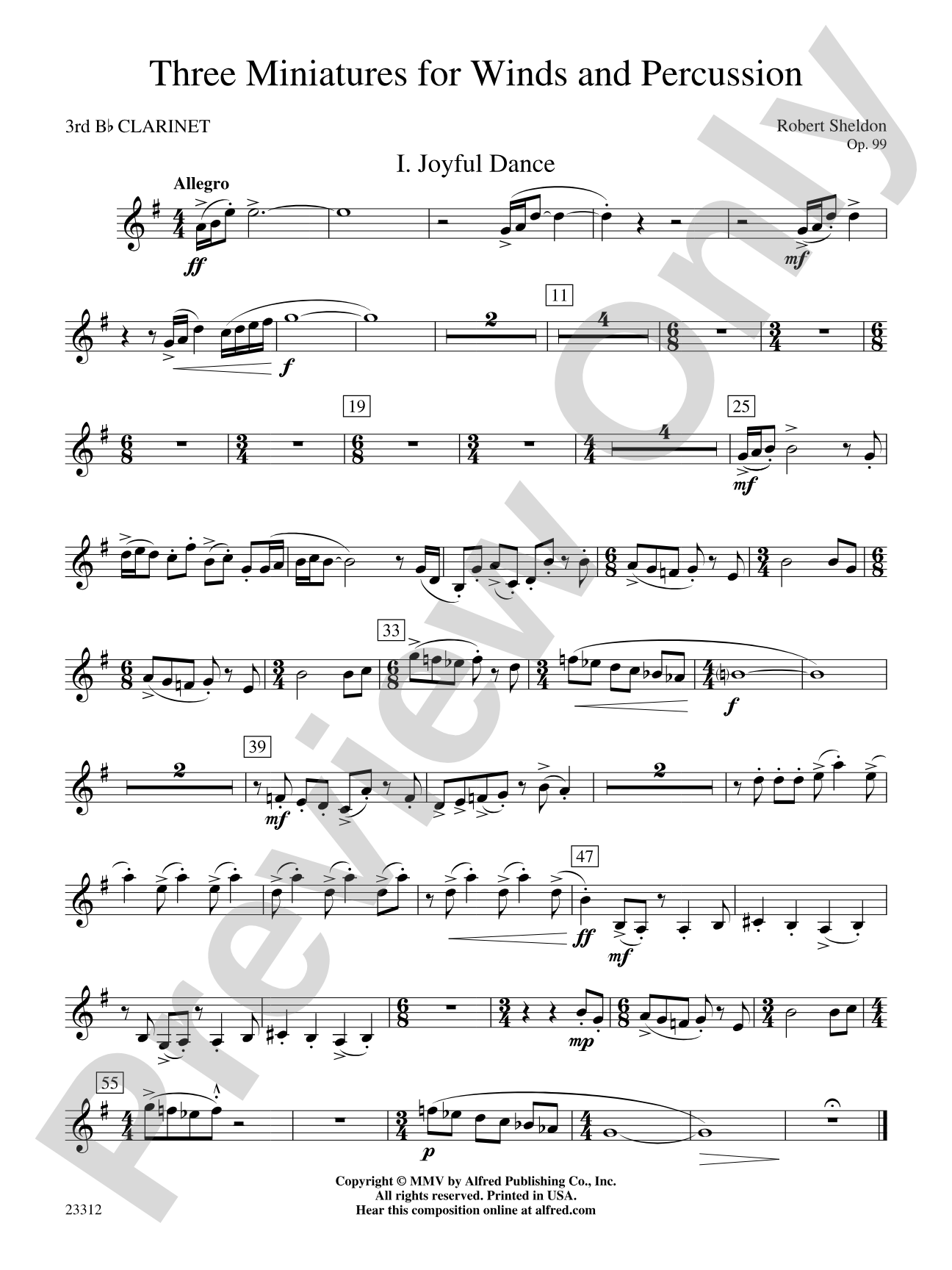

Three Miniatures for Winds and Percussion: 3rd B-flat Clarinet
By Robert Sheldon
Grade: 3 (Medium)
Item: 00-PC-0000662_C3
$3.00
Pickup currently not available
Description
Dance like no one is watching, sing like no one is listening and live each day as if it were your last. This famous poem has many versions and is attributed to several authors, yet its simple, eloquent message speaks volumes to millions of people worldwide. The composition therefore has a first movement entitled "Joyful Dance," the second movement is "Simple Song," and the final movement is a "Celebration." Each movement is quite brief but distinctly different, each expressing the feelings inherent in the poem from which the work was drawn. This title is available in MakeMusic Cloud.


Don't just read it, hear it, play along with it, and watch your students grow with it. In MakeMusic Cloud, Three Miniatures for Winds and Percussion: 3rd B-flat Clarinet comes alive with professional accompaniment, adjustable tempo, and built-in practice tools that turn solo practice into real progress.
Open in the Player
Jump straight in and assign it today.
Start Your Free Trial
Open this title and explore the full library in minutes.
Sample Audio
1
Audio File
--:--
0:00
0:00
Sample Video
Additional Details
Series:
Alfred Concert Band
Publisher:
Alfred Music
Page Count:
292
SKU:
00-PC-0000662_C3
More about this title
About the Composer: Robert Sheldon

Robert Sheldon stands among the most frequently performed composers in the wind band repertoire. His works appear consistently on contest and concert programs across the globe, and he has received major recognition from the American School Band Directors Association, Phi Beta Mu, and the American Society of Composers, Authors and Publishers.
Beyond composition, Sheldon contributes significantly to music education as the lead author of Sound Innovations for Concert Band. He maintains an active schedule as a guest conductor for All-State and Regional Honor Bands, and serves regularly as a clinician at colleges, universities, and state music education conferences. His conducting appearances span the United States, Japan, Canada, Italy, Germany, Australia, and China, and his compositions have been performed at Carnegie Hall, Orchestra Hall in Chicago, Boston Symphony Hall, the Sydney Opera House, and the Kennedy Center for the Performing Arts. In 2020, VanderCook College of Music awarded him an honorary doctorate.
Why we love this
Sheldon takes a poem with universal resonance and translates it into three movements that breathe as a complete arc, moving from kinetic joy through intimate reflection to triumphant closure. The brevity of each movement means you gain fresh musical material and emotional variety without stretching rehearsal time, making this an ideal choice when you need substance that doesn't demand weeks of preparation.
What to expect
The opening movement sparkles with rhythmic vitality and brassy optimism, inviting the band to move with genuine joy. The second movement strips away the activity and settles into a quiet, almost hymn-like tenderness that lets the ensemble breathe and listen to one another. The finale explodes outward with renewed energy and celebration, leaving audiences and players alike energized.
Who it's for
Concert bands at the high school or strong middle school level seeking repertoire that works at festivals and concerts alike. This is a smart choice for groups looking to build expressive range while maintaining technical accessibility, and for directors who value music with a meaningful extramusical foundation.
How to get the most out of it
- Establish clear character distinctions between movements in early rehearsals. Mark tempo, articulation, and dynamic targets for each section so players understand what 'joyful,' 'simple,' and 'celebratory' sound like in your ensemble's voice.
- Balance the second movement's lyrical quality against ensemble balance challenges; wind band scoring in singing passages often requires careful attention to blend and intonation across the lower voices.
- Use the final movement's momentum to propel through any rough ensemble passages. The forward energy of 'Celebration' naturally supports tight execution when the band commits fully to the pulse.
- Record and listen to your rehearsals between movements. The contrasting moods mean small adjustments in pacing or articulation can shift how dramatically the pieces differentiate from one another.
How to use it
This work functions beautifully as a concert centerpiece or closing piece, since the three-movement arc gives audiences a complete emotional journey in one performance. It also serves well in festival settings where contrasting moods and accessible difficulty are valued; the poem's universal message resonates with audiences beyond musicians.
Skills your students will build
- Sustaining lyrical phrasing in contrasting tempos
- Dynamic shaping and balance across full ensemble textures
- Executing rhythmic precision in dance-like figures
- Blending articulation styles within individual sections
- Building tonal control during quiet passages
- Responding to large formal structures across multiple movements