
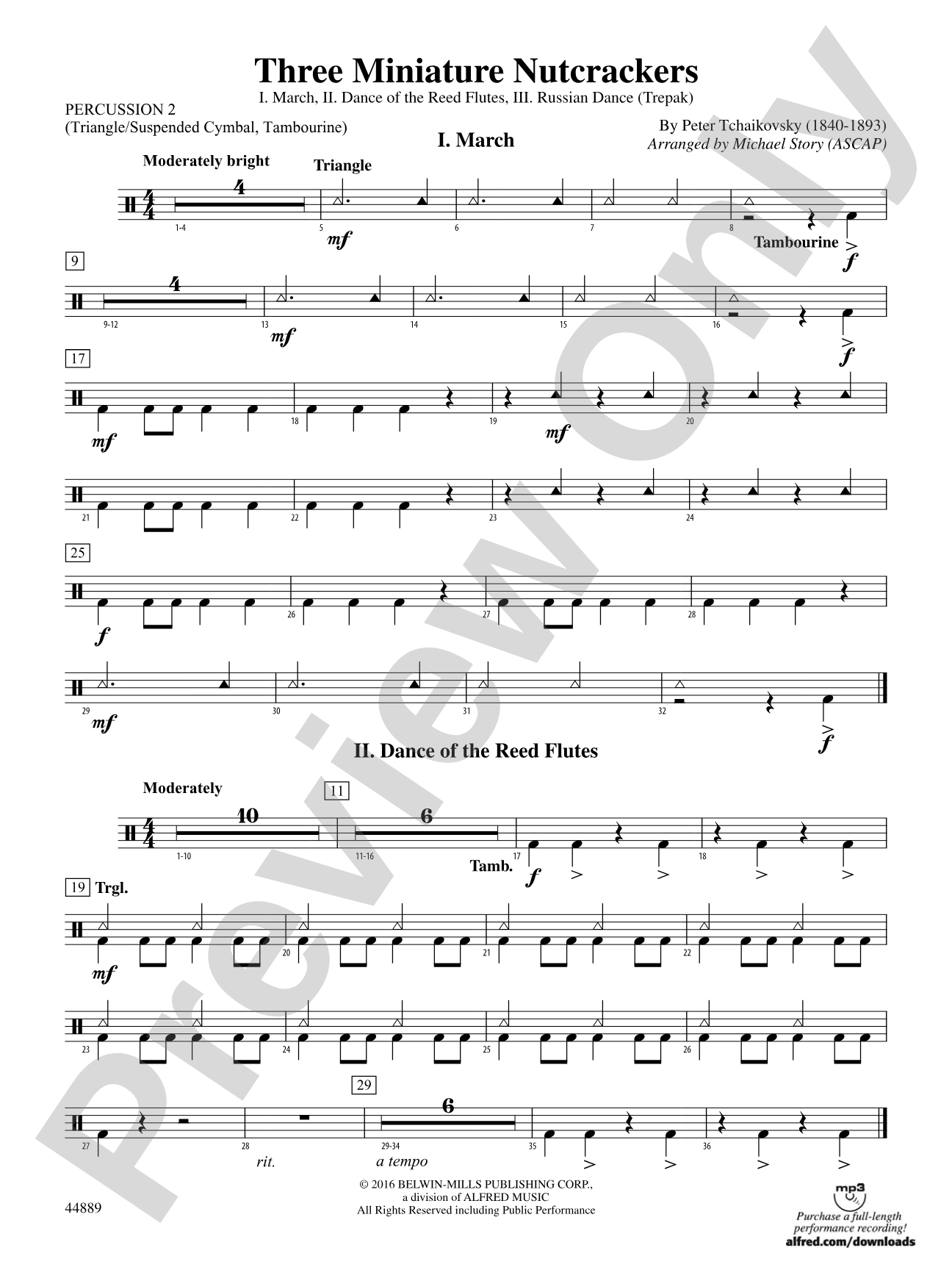

Three Miniature Nutcrackers: 2nd Percussion
I. March, II. Dance of the Reed Flutes, III. Russian Dance (Trepak)
By Peter Tchaikovsky / arr. Michael Story
Grade: 1 (Very Easy)
Item: 00-PC-0017385_PC2
$5.99
Pickup currently not available
Description
Based on Alexander Dumas' adaptation of E. T. A. Hoffman's story The Nutcracker and the Mouse King, the ballet premiered in December of 1892 in St. Petersburg, Russia. Tchaikovsky selected eight pieces from the ballet and created The Nutcracker Suite, which became an immediate success and to this day remains one of the most popular ballets, and contains some of the best-loved Christmas music. This suite of three selected short movements scored especially for beginners includes "March," "Dance of the Reed Flutes," and "Russian Dance (Trepak)." The movements can be performed individually or together. A superb classical transcription for teaching and performance to be programmed during the holidays or any time of the year. (3:45)


Don't just read it, hear it, play along with it, and watch your students grow with it. In MakeMusic Cloud, Three Miniature Nutcrackers: 2nd Percussion comes alive with professional accompaniment, adjustable tempo, and built-in practice tools that turn solo practice into real progress.
Open in the Player
Jump straight in and assign it today.
Start Your Free Trial
Open this title and explore the full library in minutes.
Sample Audio
No sample audio found.
Sample Video
Additional Details
Series:
Belwin Beginning Band
Publisher:
Alfred Music
Page Count:
272
SKU:
00-PC-0017385_PC2
More about this title
About the Composer: Peter Tchaikovsky
Peter Tchaikovsky (1840-1893) stands as one of the most performed composers in concert halls worldwide, and his ability to craft immediately memorable melodies remains unmatched in the Romantic era. Though trained in law, he pursued composition with fierce determination and became a towering figure in Russian music, bridging Western European forms with distinctly Russian character and emotion. His ballets, particularly The Nutcracker and Swan Lake, transcended their original theatrical context to become concert staples heard everywhere from holiday seasons to teaching studios.
Why we love this
Michael Story's arrangement captures the essence of Tchaikovsky's most recognizable melodies without overwhelming young players. Beginning bands get to perform genuine ballet music—not simplified exercises—and the three movements work beautifully as a connected suite or as individual selections for shorter programs. The result feels both authentic and achievable, which is precisely what students need to build confidence and genuine love for concert repertoire.
What to expect
Elegant and ceremonial in the March; delicate and whimsical in the Reed Flutes; spirited and folk-rooted in the Trepak. Together, these three movements convey the magic of the Nutcracker story itself, moving from grand entrance to intimate enchantment to wild celebration.
Who it's for
Beginning concert bands and young wind ensembles hungry for music that feels real rather than purely pedagogical. This suite works equally well for school band programs introducing students to classical masterworks and for community youth ensembles seeking holiday programming with genuine substance.
How to get the most out of it
- Balance the melody across your ensemble rather than concentrating it in one section. The reed flutes, for instance, shine brightest when the accompaniment remains transparent beneath them.
- Shape each phrase with clear direction even at a young band's tempo. Tchaikovsky's melodies are built for singing, so encourage players to listen to their own lines as continuous musical statements.
- Establish the rhythmic pulse firmly in the opening march; this foundation carries through the stylistic changes in the suite and keeps young musicians anchored.
- Give the Russian Dance its characteristic lift and energy. The meter and rhythm patterns require clean articulation and steady ensemble counting to land the character Tchaikovsky intended.
How to use it
The suite adapts to your concert needs. Open a holiday concert with the March for immediate impact, then use all three movements as an anchor work in a winter program alongside lighter fare. Alternatively, select the Reed Flutes alone for a shorter performance slot or as a contrasting lyrical moment between more substantial pieces.
Skills your students will build
- Playing sustained melodic lines with direction and shape
- Maintaining transparent accompanimental texture beneath featured voices
- Reading accidentals and chromatic passages at a manageable pace
- Responding to changes in style and character within a single piece
- Balancing individual section responsibility within ensemble texture