
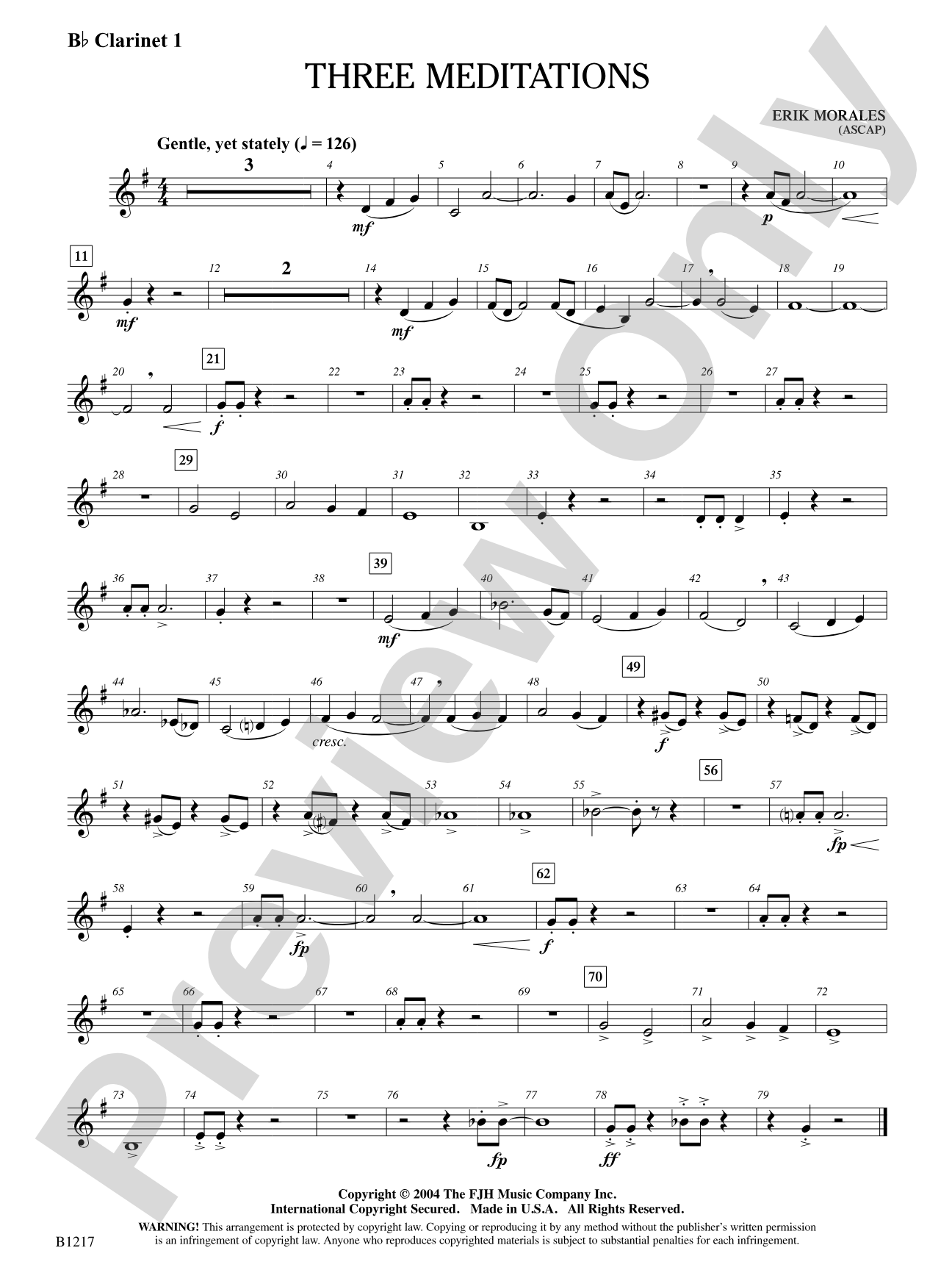

Three Meditations: B-flat Clarinet 1
By Erik Morales
Grade: 1.5
Item: 98-PC-DB1217_C1
$7.00
Pickup currently not available
Description
Abstract, musical, thought provoking - these all describe this innovative one-movement work by Erik Morales. Staggered entrances in the brass set the stage for the main theme, and the use of minor chords gives the work the sound of a fantasy film score. This is an excellent way to teach concepts of texture, tension, and release, while engaging your students with some extremely creative writing.


Three Meditations: B-flat Clarinet 1 isn't in MakeMusic Cloud just yet...but it could be. Let us know you'd like to see it, and you'll help shape what comes next. In the meantime, start a free trial and dive into thousands of interactive titles your students can play along with today.
Request This Title
Tell us you want it.
Start Your Free Trial
Explore everything that's ready to play right now.
Sample Audio
1
Audio File
--:--
0:00
0:00
Sample Video
No sample videos found.
Additional Details
Series:
FJH Developing Band
Publisher:
The FJH Music Company, Inc.
SKU:
98-PC-DB1217_C1
More about this title
About the Composer: Erik Morales

Erik Morales has built a prolific composing career spanning four decades, with more than 150 published works across wind, orchestral, jazz, and chamber settings. Based in New York City since his birth in 1966, he completed formal training at Florida International University and the University of Louisiana, Lafayette, but his real education came early when his high school band director hired him to arrange marching band charts in 1985. That opportunity launched him into the educational music publishing world and opened doors that would eventually take his work into classrooms and concert halls worldwide.
A trumpeter by trade, Morales has become particularly known for his contributions to the trumpet repertoire; his ensemble works won first place at the National Trumpet Competitions in 2006 and 2008. His commissions span schools and organizations across the country, and his work consistently balances artistic integrity with educational value. In 2016, he was inducted into the Louisiana Association for Jazz Education's Hall of Fame, a recognition of his sustained influence on music education and composition.
Why we love this
Morales writes with restraint and clear purpose. Rather than overwhelming young musicians with complex textures, he builds atmosphere through deliberate choices: staggered brass entries that create intrigue, minor harmonies that evoke cinematic depth. The pedagogical payoff is immediate. Your students will hear and feel the difference between tension and release without a lecture, and they'll understand how texture functions as a compositional tool simply by playing it.
What to expect
Like watching a film score unfold in real time. The writing has a meditative quality, with brass voices entering like thoughts building toward something significant, while minor harmonies cast a reflective, almost mysterious mood. There's beauty in the restraint, and a sense that something meaningful is unfolding beneath the surface.
Who it's for
Developing concert bands ready to engage with more sophisticated compositional thinking. This works well for groups that have solid fundamentals but haven't yet tackled pieces that use harmony and texture as primary storytelling devices.
How to get the most out of it
- Balance the staggered brass entrances so each voice registers distinctly; resist the urge to push dynamics early in the piece, as the effect depends on careful layering.
- Let the minor chords breathe. Young bands often rush through harmonic changes; mark spots where you want sustained tones to settle before the next idea arrives.
- Record a rehearsal and listen back as an ensemble. Hearing their own texture work in context will deepen their understanding of what the score is asking them to do.
How to use it
Pair this with a heavier or more rhythmically driven piece on a concert; its introspective character works as excellent contrast and gives audiences a moment to settle into listening. It's also ideal for young musicians participating in contests or festivals where the judges want to hear musical maturity beyond technical display.
Skills your students will build
- Controlling texture through controlled dynamic layering and voice independence
- Sustaining tone quality in minor-key harmonic progressions
- Listening critically to ensemble balance when multiple voices enter at different moments
- Understanding how compositional restraint creates emotional impact