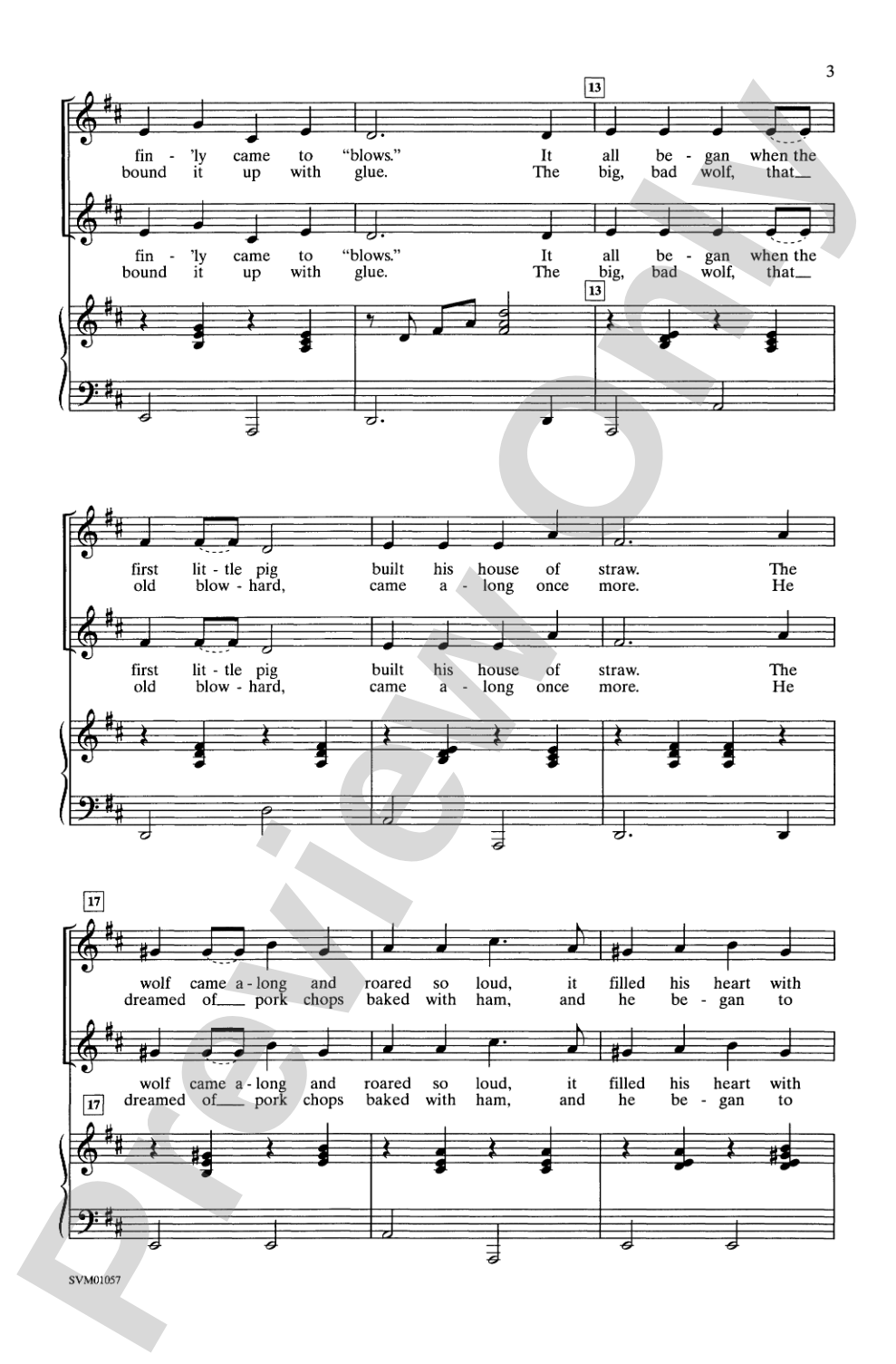
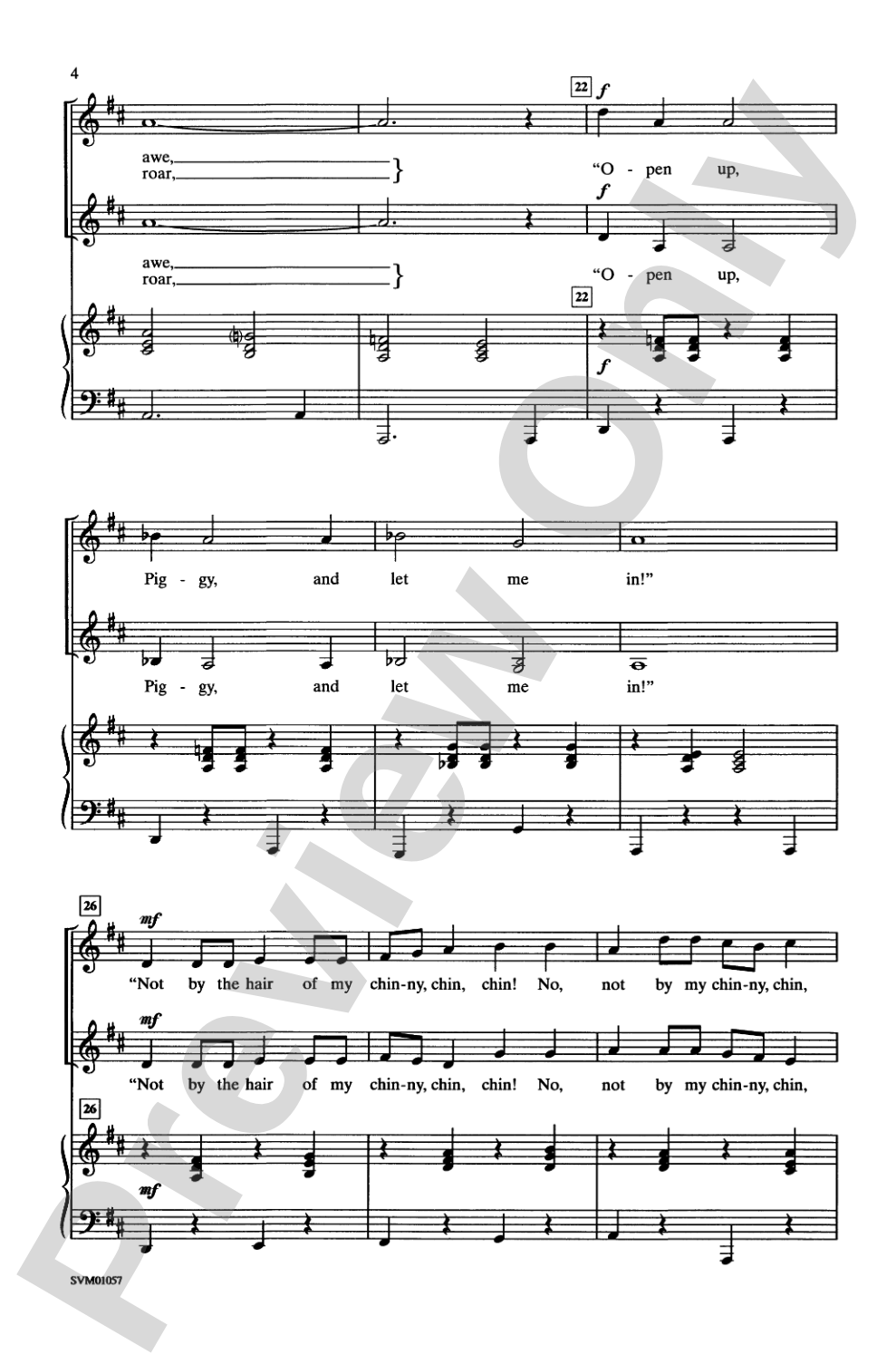
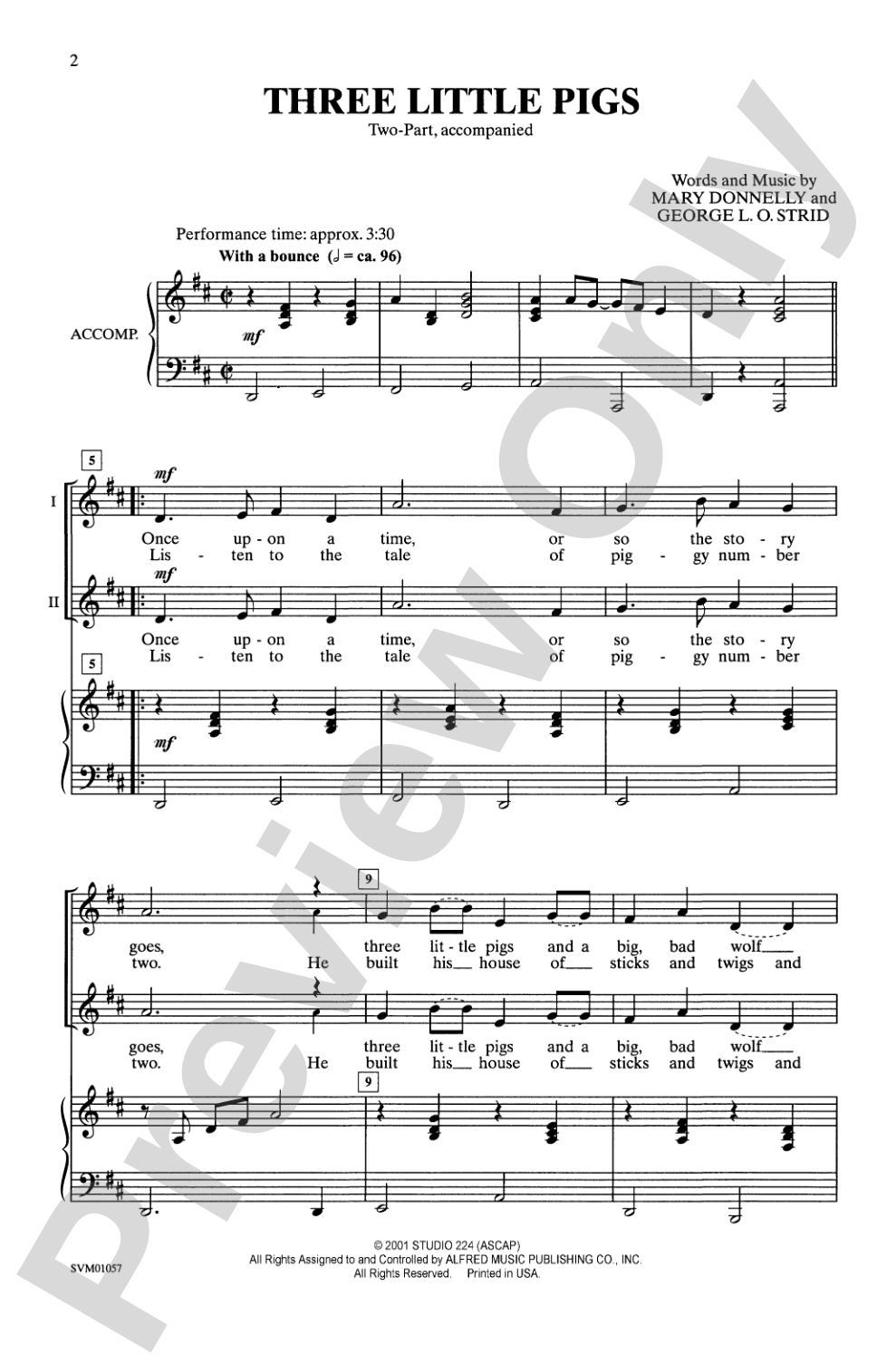
Three Little Pigs Sheet Music Preview

Three Little Pigs: 2-Part Choral Octavo

Words and music by Mary Donnelly and George L. O. Strid

Level: Easy

Item: 00-PO-0005343

Digital Download
$2.95

Minimum order quantity: 20 copies

Description
The classic fairy tale comes to life in this exciting version from Mary Donnelly and George Strid. It's a great way to reinforce classic children's literature to all your students. Don't miss this one!

Three Little Pigs: 2-Part Choral Octavo isn't in MakeMusic Cloud just yet...but it could be. Let us know you'd like to see it, and you'll help shape what comes next. In the meantime, start a free trial and dive into thousands of interactive titles your students can play along with today.

Sample Audio
No sample audio found.
Sample Video
Additional Details
Series: Alfred Archive Edition: Studio PR Catalog
Publisher: Alfred Music
Page Count: 16
SKU: 00-PO-0005343

More about this title

About the Composer: Mary Donnelly

Mary Donnelly

Mary Donnelly grew up in Reno, Nevada, and studied English and French at the University of Nevada, Reno. While still an undergraduate, she founded two children's choruses, which sparked her passion for music education. She went on to earn a Master's Degree in Education from Lesley College in Cambridge, Massachusetts, with a focus on integrating the arts across the curriculum. She taught general music and choir in elementary and middle schools throughout her thirty-year career in the Washoe County School District.

In 1985, Donnelly began a creative partnership with George L. O. Strid when their principal asked them to write a musical for Reading Week. Their first collaboration, The Million Dollar Mystery, launched a prolific writing team. Together they have created over two hundred songs and twenty-five musicals, establishing themselves as trusted voices in children's and young people's choral music. Donnelly is a member of ACDA, NEA, and ASCAP.

Why we love this

Donnelly and Strid understand exactly what elementary choirs need: music that connects directly to classroom learning while remaining genuinely engaging to sing. This setting brings a familiar story to life with accessible writing that lets young singers experience real joy in performance without musical barriers getting in the way.

What to expect

The music captures the playful energy and mounting tension of the classic tale. Donnelly and Strid's straightforward approach keeps the focus on the narrative arc rather than technical complexity, allowing singers to embody the three pigs and the wolf with genuine expression.

Who it's for

This piece is ideal for elementary choirs in grades 1-3 who are ready to explore two-part singing. It works equally well for general music classes integrating literature and music, or for choir ensembles building a year-end concert program that celebrates accessible, story-driven repertoire.

How to get the most out of it

  • Build confidence in the youngest singers by assigning parts according to comfort level rather than strict voice placement; many grade 1 students are still finding their singing voice.
  • Use the recorded accompaniment to establish tempo and harmonic support during rehearsals, then gradually reduce dependence so singers internalize the ensemble sound.
  • Highlight the storytelling moments through thoughtful dynamic shaping; let the three pigs' houses build in intensity to match the narrative drama.
  • Keep rehearsal time efficient by chunking the piece into 2-3 measure rehearsal units, especially for sections where both parts move independently.

How to use it

Program this during a literature or fairy tale unit to reinforce classroom reading across grade levels. It pairs naturally with concert themes celebrating classic stories, children's literature week, or spring concerts highlighting ensemble development.

Skills your students will build

  • Reading and singing in two-part harmony
  • Following a vocal line while supporting ensemble balance
  • Storytelling through vocal expression and dynamics
  • Breath control and sustaining phrases in early two-part writing

You May Also Like