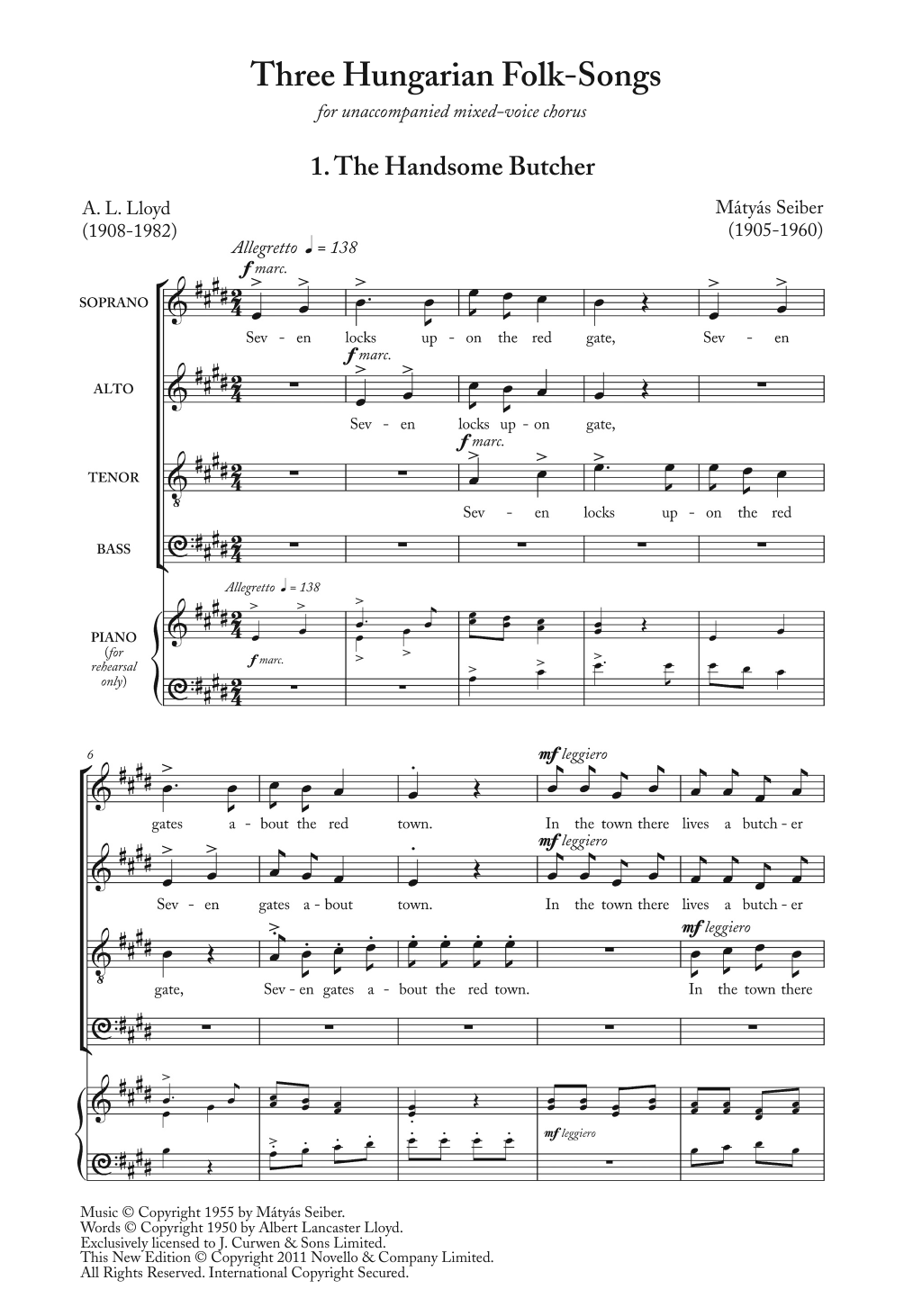
Three Hungarian Folk Songs Sheet Music Preview

Three Hungarian Folk Songs: Choral Octavo

As performed by Mátyás Seiber

Item: 35-DS00345750

Digital Download
$2.99
Description

Three Hungarian Folk Songs: Choral Octavo isn't in MakeMusic Cloud just yet...but it could be. Let us know you'd like to see it, and you'll help shape what comes next. In the meantime, start a free trial and dive into thousands of interactive titles your students can play along with today.

Sample Audio
No sample audio found.
Sample Video
Additional Details
Publisher: Hal Leonard
Page Count: 11
SKU: 35-DS00345750

More about this title

About the Artist: Mátyás Seiber

Mátyás Seiber (1905-1960) was a Hungarian composer and cellist whose work bridged modernist technique with deep roots in Central European folk tradition. His choral writing demonstrates sophisticated harmonic language while remaining accessible to performers, a balance that made him a significant voice in twentieth-century choral music. Seiber's arrangements of folk material reflect his commitment to preserving and elevating vernacular music through concert performance.

Why we love this

Seiber's settings capture the character and melodic integrity of Hungarian folk material without drowning them in arrangement. The writing sits naturally for voices, the harmonic language sounds fresh without becoming academic, and these three songs pack substantial musical interest into a compact, achievable package for groups working at the octavo level.

What to expect

Intimate and earthy. The arrangements preserve the storytelling quality of folk song while the sophisticated harmonic language adds emotional depth and modern sensibility. There's a quality of introspection here, even in moments of rhythmic vitality.

Who it's for

Choirs with secure four-part singers who want to expand their cultural and stylistic range beyond standard repertoire. These settings work equally well for collegiate ensembles, adult community choirs, and advanced high school groups seeking substantive concert material.

How to get the most out of it

  • Treat the folk melodies as the primary voice. Even when upper voices carry countermelody, the tune needs to sing through with clear projection and minimal vibrato.
  • Study a recorded performance or authentic folk version of each song before rehearsing. Your singers will connect more deeply to the harmonic language once they hear how it grows from the source material.
  • Pay attention to text clarity in the layered sections. Hungarian vowels and consonant clusters demand precise diction, especially when voices overlap.

How to use it

Ideal as a triptych for concerts exploring European folk traditions or twentieth-century nationalism in music. These three songs could anchor a concert section on choral arrangements, or they pair well with other Seiber works or contemporary Eastern European composers as a thematic block.

Skills your students will build

  • Reading four-part harmony with chromatic and modal inflection
  • Sustaining ensemble blend in slow-moving, contrapuntal passages
  • Approaching non-English text with linguistic and musical authenticity
  • Balancing independent melodic lines while maintaining harmonic coherence

You May Also Like