
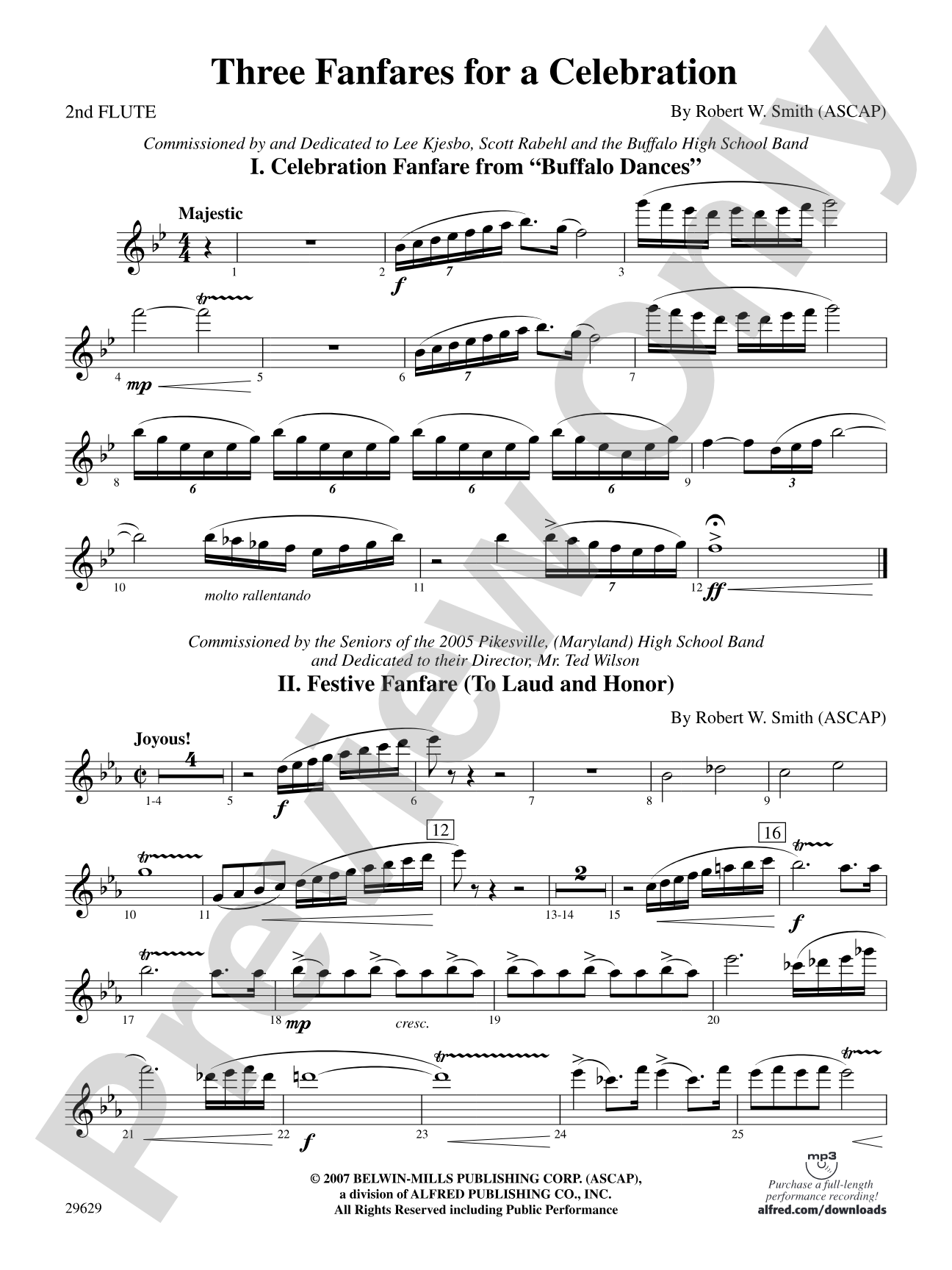

Three Fanfares for a Celebration: 2nd Flute
By Robert W. Smith
Grade: 4 (Medium)
Item: 00-PC-0001509_F2
$3.00
Pickup currently not available
Description
A bargain of fanfares that can open your symphonic band program for three separate concerts! Included fanfares are titled "Celebrations Fanfare," "Festive Fanfare" and "Dedicatory Fanfare." Start your concert with a bold musical statement! (4:36)


Don't just read it, hear it, play along with it, and watch your students grow with it. In MakeMusic Cloud, Three Fanfares for a Celebration: 2nd Flute comes alive with professional accompaniment, adjustable tempo, and built-in practice tools that turn solo practice into real progress.
Open in the Player
Jump straight in and assign it today.
Start Your Free Trial
Open this title and explore the full library in minutes.
Sample Audio
1
Audio File
--:--
0:00
0:00
Sample Video
No sample videos found.
Additional Details
Series:
Belwin Symphonic Band
Publisher:
Alfred Music
Page Count:
132
SKU:
00-PC-0001509_F2
More about this title
About the Composer: Robert W. Smith

Robert W. Smith has established himself as one of America's most frequently performed composers of concert band and orchestral music. With more than 400 published works primarily distributed through Alfred Music, he holds degrees in Music Education from Troy State University (Alabama) and a Master's degree from the University of Miami (Florida). His symphonic works, including The Divine Comedy and The Odyssey, have gained audiences across North America, Europe, Australia, and Asia.
Beyond the concert hall, Smith's music has reached national audiences through television broadcasts, Olympic ceremonies, the Macy's Thanksgiving Day Parade, and opening day festivities at Dodger Stadium. As both a conductor and clinician, he has worked extensively across the United States and internationally in Canada, Japan, Australia, Italy, Austria, and the United Kingdom. His arrangements and original compositions for developing ensembles, particularly The Tempest, have become foundational repertoire for band programs at all levels.
Why we love this
Opening concerts with strong instrumental writing sets the tone for the entire program, and Smith delivers exactly that here with three distinct fanfares that each carry genuine personality. You get genuine variety within a single purchase; "Celebrations Fanfare" brings one energy, "Festive Fanfare" another, and "Dedicatory Fanfare" a third, so you're not rotating the same piece across your season. Grade 4 arranging means your ensemble can execute something impressive without drowning in technical demands, freeing musicians to focus on ensemble balance, brass power, and theatrical control.
What to expect
Fanfares capture ceremony and celebration, and these three deliver that feeling through bold instrumental writing that respects both majesty and clarity. The percussion plays an active role in establishing the festive character, and the harmonic language feels modern enough to hold contemporary audiences without alienating traditionalists.
Who it's for
Band directors seeking repertoire that opens concerts with immediate impact and establishes the ensemble's technical capability early. Groups at the Grade 4 level with solid brass and woodwind sections will find these pieces accessible without compromising on professional sound and programming credibility.
How to get the most out of it
- Give the brass sections space to breathe between the opening declarations and secondary figures; this isn't about constant volume but rather clarity of line and articulation.
- Bring out the rhythmic precision in the middle sections without losing the ceremonial character; these pieces demand crisp ensemble alignment alongside warm tone production.
- Balance the impact of any doubling between brass and woodwinds so that neither family overwhelms the other, especially in passages where multiple instrumental colors combine.
- Record a solid tempo before the first rehearsal and bring a click for the band; the four and a half minute duration benefits from consistent pulse and confident conducting decisions.
How to use it
Each fanfare can anchor a different concert; "Celebrations Fanfare" works well for spring pops or community concert openers, "Festive Fanfare" for holiday programs, and "Dedicatory Fanfare" for formal concert openings or tribute events. Programming one of these three opening statements establishes the energy level of the entire evening and signals to your audience that the ensemble has arrived.
Skills your students will build
- Ensemble balance between brass and woodwind families in tutti passages
- Rhythmic precision and confident articulation in ceremonial contexts
- Dynamic control and sustained tone in fanfare-style writing
- Responding to clear conductor gesture and maintaining pulse awareness