
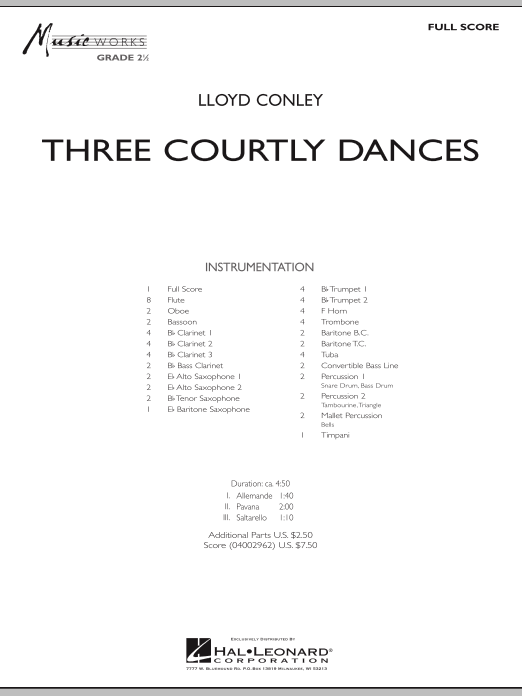

Three Courtly Dances: Concert Band Conductor Score & Parts
By Lloyd Conley
Grade: 2.5
Item: 35-PK00157723
$55.00
Pickup currently not available
Buy Extra Parts (Digital PDF Download)
Parts Added to Cart!
Description
Featuring distinctive sounds from the Renaissance period, here is an attractive suite of three dances skillfully scored for young bands. The stately "Allemande" uses full band passages alternating with statements by the woodwinds and brass. William Byrd's "Pavana" provides the lyric middle movement, while the lively dance "Saltarello" provides a rousing finish. Dur: 4:50 (Grade 2.5)


Three Courtly Dances: Concert Band Conductor Score & Parts isn't in MakeMusic Cloud just yet...but it could be. Let us know you'd like to see it, and you'll help shape what comes next. In the meantime, start a free trial and dive into thousands of interactive titles your students can play along with today.
Request This Title
Tell us you want it.
Start Your Free Trial
Explore everything that's ready to play right now.
Sample Audio
No sample audio found.
Sample Video
No sample videos found.
Additional Details
Publisher:
Hal Leonard
SKU:
35-PK00157723
More about this title
About the Composer: Lloyd Conley
Lloyd Conley has established himself as a composer and arranger with a gift for making historical musical styles accessible to young ensembles. His arrangements respect the integrity of source material while crafting scoring that builds band fundamentals without overwhelming developing musicians.
Why we love this
Conley's approach to Renaissance material avoids the trap of oversimplification. Each dance has genuine musical substance: the Allemande's contrasts between full band and sectional writing teach balance and texture, the Pavana (based on Byrd) offers lyrical depth that develops your wind players' phrase shaping, and the Saltarello closes with energy that leaves an audience satisfied. At Grade 2.5, this suite gives young ensembles real repertoire to own, not just exercises.
What to expect
Opening with stately courtliness in the Allemande, the suite then settles into the introspective beauty of the Pavana before quickening into the Saltarello's infectious rhythmic energy. The overall arc moves from formal to intimate to joyful, giving performers a genuine journey across the span of four and a half minutes.
Who it's for
Band directors building a Grade 2.5 program need repertoire that teaches musicianship alongside technique. This suite works for groups developing ensemble cohesion and sectional independence while exploring music beyond the contemporary concert band canon.
How to get the most out of it
- Let the Allemande's alternating textures breathe. The full band passages should feel weighted and deliberate, while the woodwind and brass statements work best when they step forward with presence rather than rushing the transitions.
- Shape the Pavana's melodic line with attention to how Byrd's voice leading moves; this isn't background music, and your soloists (whoever carries the main statement) benefit from thinking of themselves as singers rather than wind players.
- Anchor the Saltarello's rhythmic drive with a solid foundation in the low reeds and low brass; the liveness comes from that security, not from pushing the tempo.
How to use it
This three movement structure works perfectly as a standalone concert piece or as part of a thematic program exploring historical music. Consider pairing it with other Renaissance or early music arrangements to create a coherent set, or program it alongside contemporary works to highlight how musical forms and gestures echo across centuries.
Skills your students will build
- Balancing full ensemble sound with sectional entrances and exits
- Sustaining lyrical phrasing across longer melodic lines
- Clarity and precision in rapid rhythmic passages (Saltarello)
- Listening to and responding to textural changes within a movement
- Understanding Renaissance dance form and style through performance