
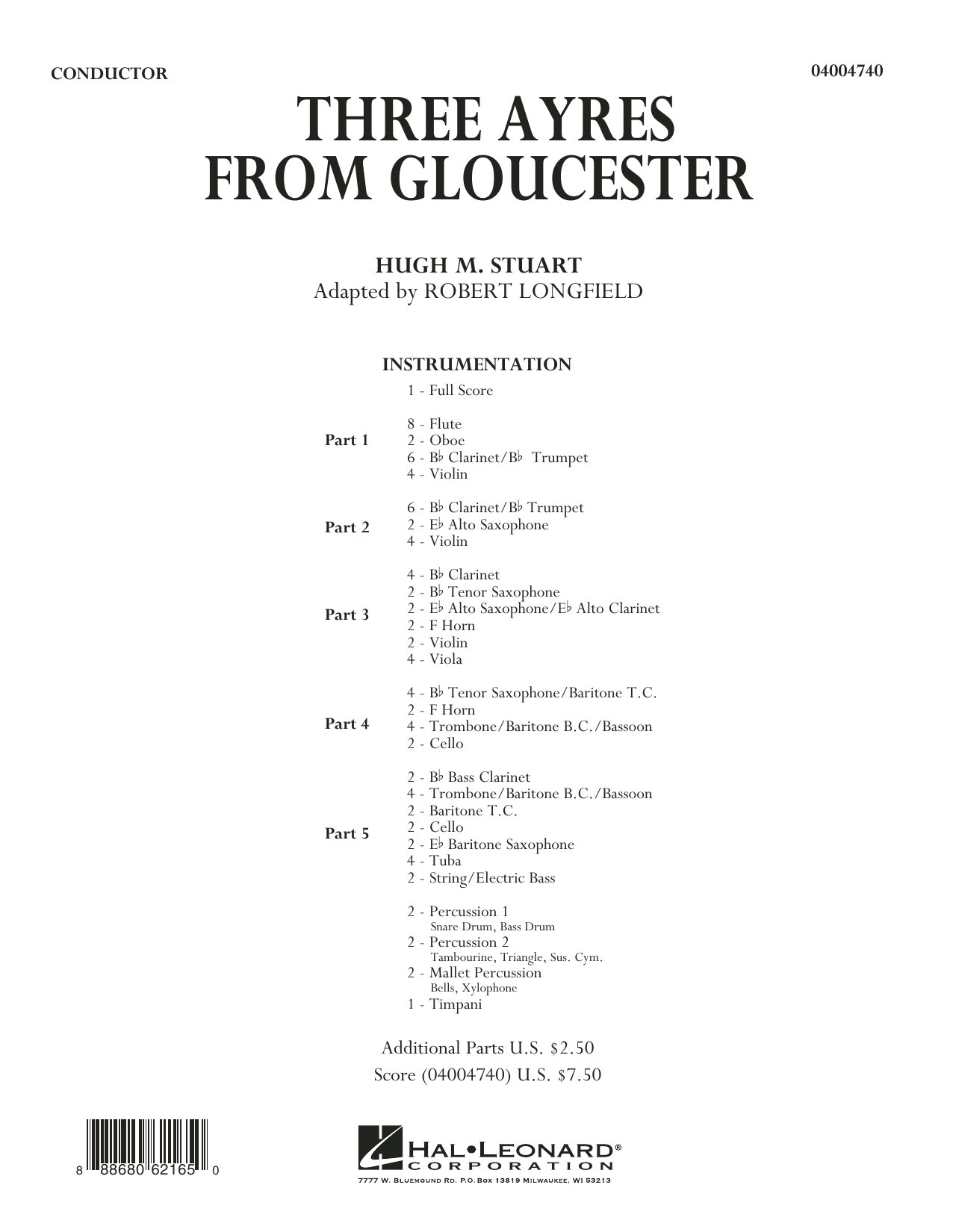

Three Ayres from Gloucester: Flex Ensemble Conductor Score & Parts
Arranged by Robert Longfield
Grade: 2-3
Item: 35-PK00335176
$65.00
Pickup currently not available
Buy Extra Parts (Digital PDF Download)
Parts Added to Cart!
Description
This playable yet musically rewarding three-movement suite was composed by Hugh M. Stuart in 1969 and continues to be a popular work for contest and festivals. Skillfully adapted here for flexible instrumentation, the music captures the early English folksong style with moods and dances of the common folk. Dur: 5:00


Three Ayres from Gloucester: Flex Ensemble Conductor Score & Parts isn't in MakeMusic Cloud just yet...but it could be. Let us know you'd like to see it, and you'll help shape what comes next. In the meantime, start a free trial and dive into thousands of interactive titles your students can play along with today.
Request This Title
Tell us you want it.
Start Your Free Trial
Explore everything that's ready to play right now.
Sample Audio
No sample audio found.
Sample Video
No sample videos found.
Additional Details
Publisher:
Hal Leonard
SKU:
35-PK00335176
More about this title
About the Arranger: Robert Longfield
Robert Longfield has built a reputation as an arranger who understands the pedagogical needs of young ensembles without compromising musical integrity. His work adapting existing compositions for flexible instrumentation has made substantial repertoire accessible to programs with varying instrumentation and skill levels.
Why we love this
Longfield's arrangement preserves Stuart's melodic charm while making the score genuinely playable for young musicians. The flexible instrumentation means you can perform this whether your ensemble shows up with strings, winds, or a combination of both, and the early English folksong idiom gives your concert a tasteful, accessible sound that audiences connect with immediately.
What to expect
The music evokes the open-air character of English village dances and celebrations. You'll find folk melodies that feel both familiar and fresh, simple harmonies that support rather than complicate the line, and rhythmic vitality that gives young players something energetic to sink their teeth into.
Who it's for
This suite works well for young concert bands, orchestras, and mixed ensembles at the Grade 2-3 level who want something substantial for festivals and contests. The flexible scoring makes it ideal for programs building instrumentation gradually or those with shifting student availability.
How to get the most out of it
- Balance the melodic material across sections. The folksong melodies need to sing clearly, so adjust your blend so the tune always projects above accompaniment figures.
- Shape phrases with gentle dynamic swells rather than sudden changes. Early English dances benefit from smooth, natural phrasing that lets the folk character breathe.
- Mark tempo relationships between movements so transitions feel intentional. Stuart's three-movement structure should feel like a cohesive suite rather than separate pieces.
- Use the parts' articulation markings to clarify the rhythmic character of each movement. The dance sections especially benefit from precise, unified tonguing or bowing.
How to use it
Place this in a concert where you want to establish a lighter, accessible tone early on, or use it as a bridge between a more contemporary opener and heavier classical work. At five minutes, it serves as an excellent anchor piece for a festival performance or as the centerpiece of a folk music themed concert.
Skills your students will build
- Sustaining legit melodic lines with proper phrase shaping
- Balancing melody and accompaniment texture
- Reading and executing simple folk-style rhythmic patterns across multiple sections
- Responding to flexible articulation marking conventions in classical-style parts
- Maintaining consistent tempo across section changes and movement transitions