

Though Philomela Lost Her Love: SSA Choral Octavo
Music by Thomas Morley / ed. and arr. Patrick M. Liebergen
Item: 00-PO-0000879
$1.80
Minimum order quantity: 20 copies
Pickup currently not available
Description
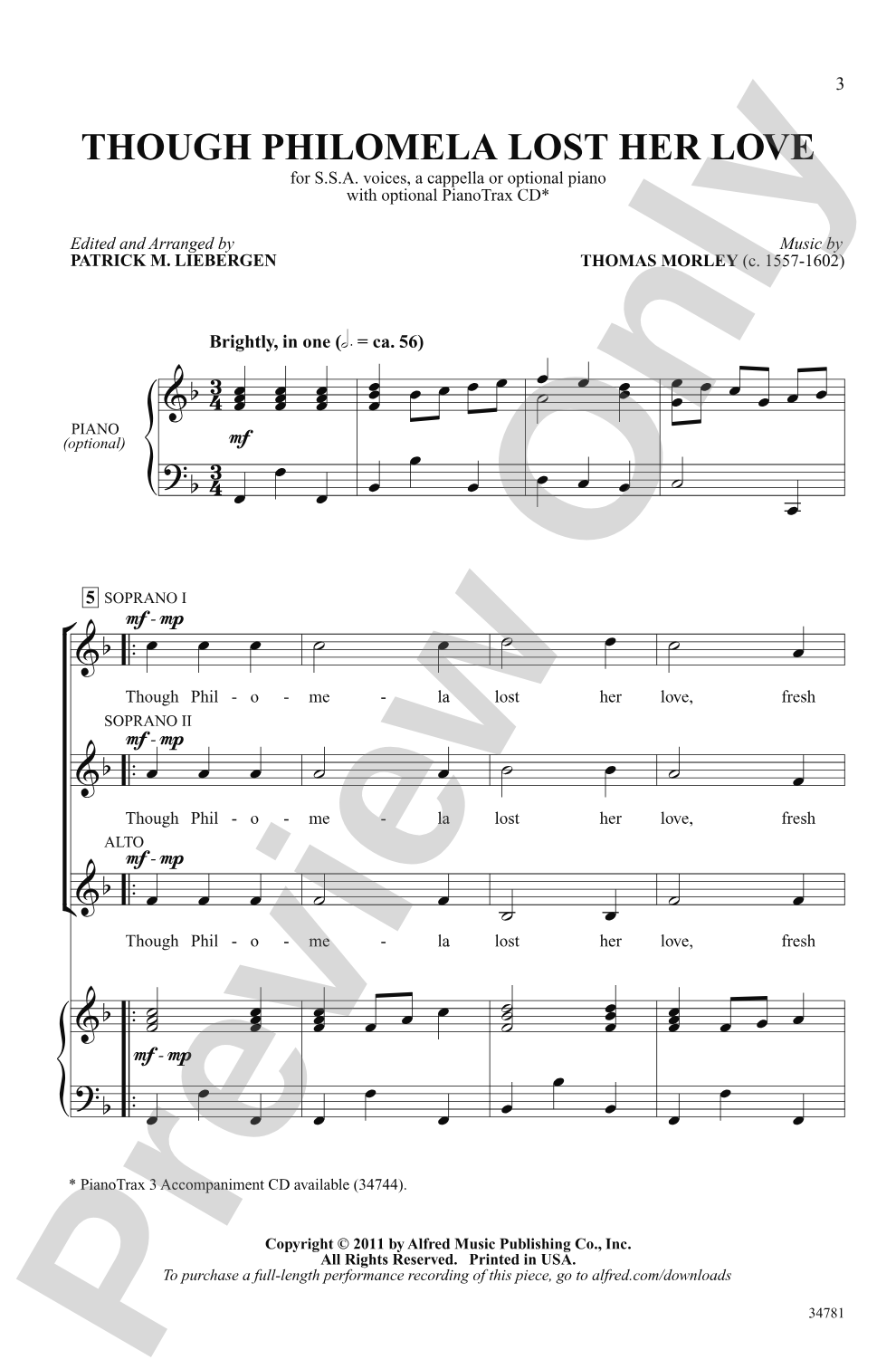
This well-prepared edition of Thomas Morley's 16th century madrigal may be performed a cappella or with the supportive keyboard accompaniment. Resounding homophonic phrases alternate with "fa la la" polyphony and are repeated at a softer dynamic. Solid repertoire for SSA choirs. Featured on PianoTrax 3 Accompaniment CD (00-34744).


Though Philomela Lost Her Love: SSA Choral Octavo isn't in MakeMusic Cloud just yet...but it could be. Let us know you'd like to see it, and you'll help shape what comes next. In the meantime, start a free trial and dive into thousands of interactive titles your students can play along with today.
Request This Title
Tell us you want it.
Start Your Free Trial
Explore everything that's ready to play right now.
Sample Audio
1
Audio File
--:--
0:00
0:00
Sample Video
No sample videos found.
Additional Details
Series:
Alfred Choral Designs
Publisher:
Alfred Music
Page Count:
12
SKU:
00-PO-0000879
More about this title
About the Composer: Thomas Morley
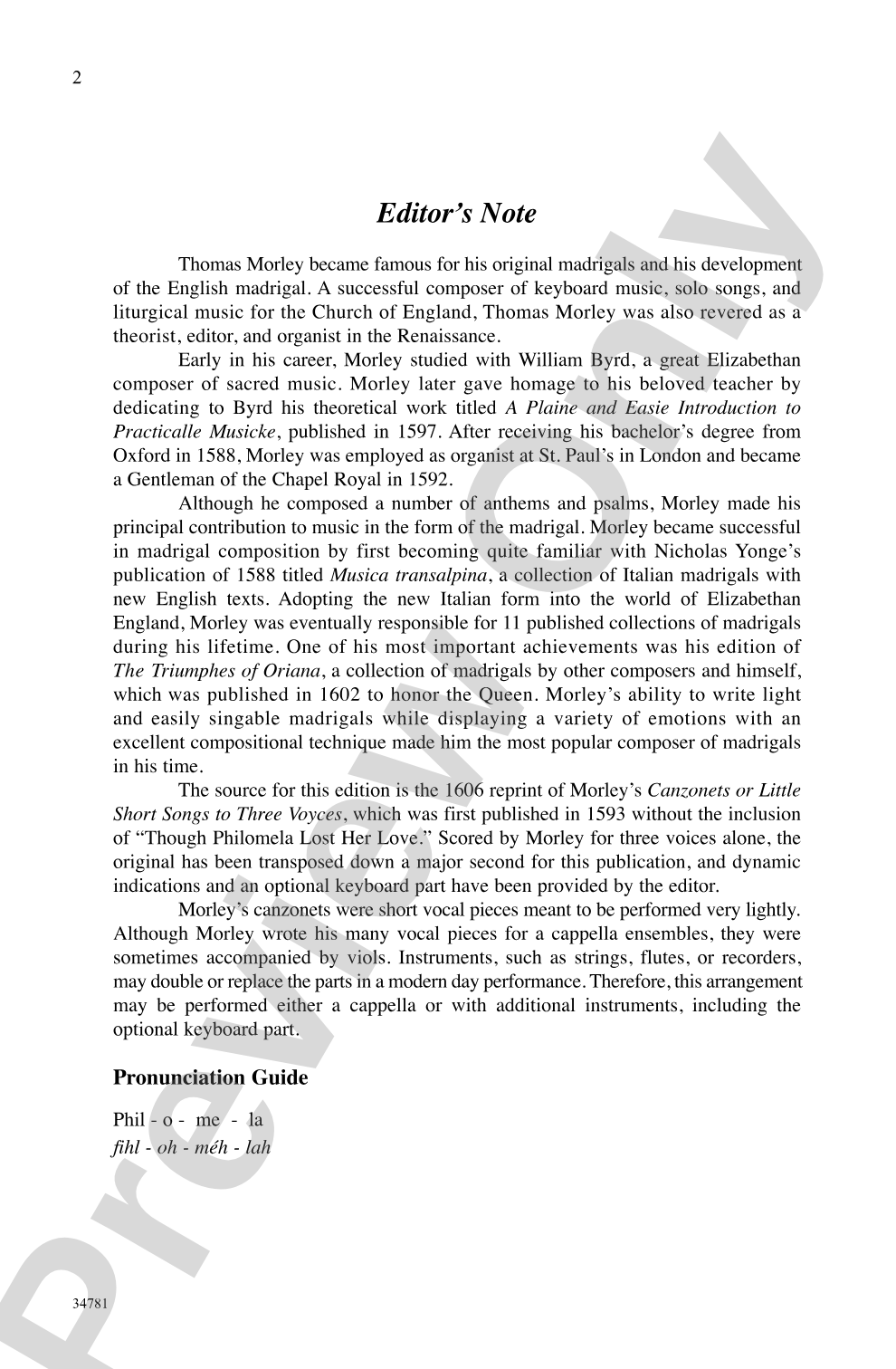
Thomas Morley (1557-1602) was the most prominent English composer of the Elizabethan era and a master of the madrigal tradition. He served as a gentleman of the Chapel Royal, held the post of organist at St. Paul's Cathedral, and was granted a monopoly on printing music in England—a remarkable position that reflects both his compositional standing and his business acumen. Morley's madrigals blend Italian models with English sensibility, combining sophisticated counterpoint with accessible, singable lines that made his works beloved across Europe.
His output includes over 100 vocal works, instrumental consorts, and sacred music. Morley was also a renowned teacher and theorist; his "A Plaine and Easie Introduction to Practicall Musicke" remains one of the most valuable pedagogical documents of the Renaissance. For modern choirs, his madrigals offer an entry point into authentic early music that rewards both performers and audiences with wit, charm, and genuine musical substance.
Why we love this
Morley's madrigals shine brightest when performed by singers who relish text clarity and rhetorical gesture, and this edition makes that joy accessible to SSA voicing. The contrast between homophonic directness and the lilt of the "fa la la" sections gives singers a real musical and emotional arc to shape, transforming what could be a simple historical exercise into something genuinely expressive. Programming a Morley madrigal signals repertoire literacy while delivering an evening's worth of genuine delight.
What to expect
Playful and poignant at once. The text traces a lover's lament, yet Morley's music refuses solemnity; instead, the alternating homophonic and polyphonic textures create a kind of emotional shimmer, as if the music is turning the sadness over and over in different lights. The recurring "fa la la" refrains inject brightness and buoyancy, making this feel like a song meant to be sung in company rather than suffered in isolation.
Who it's for
SSA choirs seeking authentic Renaissance madrigal literature that balances historical substance with accessibility. Directors of high school and community choirs will find this particularly valuable as a showcase for singers ready to move beyond simple part-song writing while maintaining musical joy and ensemble cohesion.
How to get the most out of it
- Balance the homophonic phrases as unified statements, keeping all three voices locked in clear articulation and rhythmic alignment before shifting into the more ornamental character of the polyphonic sections.
- Use the keyboard accompaniment to establish harmonic security during ensemble rehearsals, then gradually remove it as singers internalize the part relationships.
- Treat the repeated "fa la la" passages as moments to brighten tone and lift the energy; the repetition gives singers space to enjoy the refrains rather than labor through new material.
- Consider whether the softer dynamic repeats should drop in volume gradually or shift suddenly for effect; experiment in rehearsal to find what serves the text and your ensemble's blend.
How to use it
Feature this madrigal as part of a Renaissance or early music set, pairing it with other works from the same period to build a coherent historical arc. It also works beautifully as a contrasting secular interlude in a concert built around sacred choral music. The twelve pages and moderate difficulty make it suitable as a substantial concert opener that establishes both stylistic sophistication and audience warmth.
Skills your students will build
- Reading Renaissance text underlay and natural word stress
- Managing polyphonic independence while maintaining ensemble blend
- Executing clear diction in early English
- Shaping dynamic contrast within a single piece
- Balancing homophonic and imitative textures