
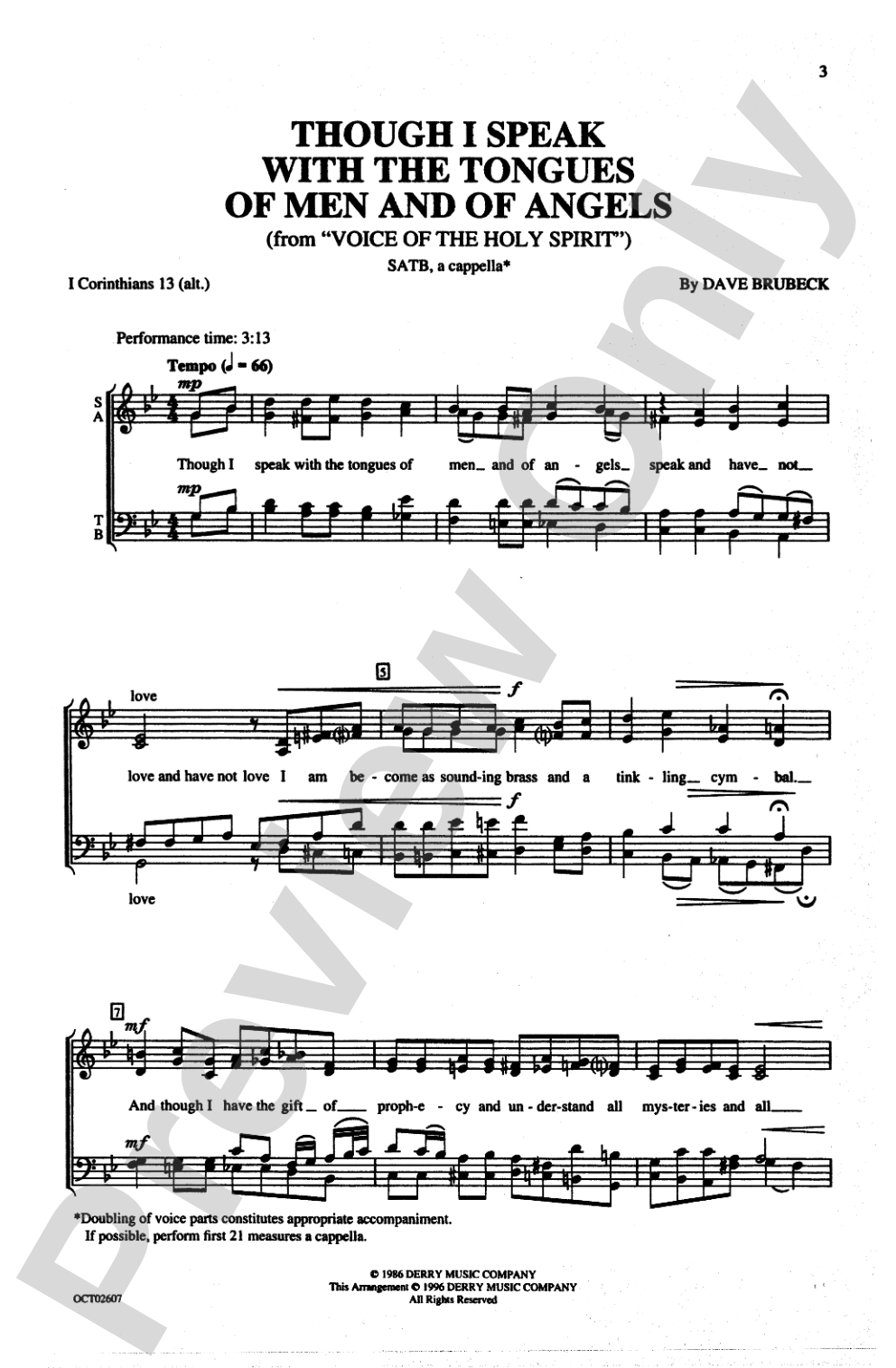

Though I Speak with the Tongues of Men and of Angels (from Voice of the Holy Spirit): SATB, a cappella Choral Octavo
From Voice of the Holy Spirit
By Dave Brubeck
Level: Moderately Difficult
Item: 00-PO-0005147
$2.25
Minimum order quantity: 20 copies
Pickup currently not available
Description
Using a text from I Corinthians, Dave creates an unusual web of musical lines -- he weaves in and out of dissonances before coming to rest at strategic points of the text. Although labeled for a cappella presentation, doubling of voice parts is also appropriate. A dramatic treatment of this well-known biblical text from Dave's larger work Voices of the Holy Spirit.


Though I Speak with the Tongues of Men and of Angels (from Voice of the Holy Spirit): SATB, a cappella Choral Octavo isn't in MakeMusic Cloud just yet...but it could be. Let us know you'd like to see it, and you'll help shape what comes next. In the meantime, start a free trial and dive into thousands of interactive titles your students can play along with today.
Request This Title
Tell us you want it.
Start Your Free Trial
Explore everything that's ready to play right now.
Sample Audio
No sample audio found.
Sample Video
No sample videos found.
Additional Details
Series:
Lawson-Gould: The Dave Brubeck Series
Publisher:
Alfred Music
Page Count:
8
SKU:
00-PO-0005147
More about this title
About the Composer: Dave Brubeck
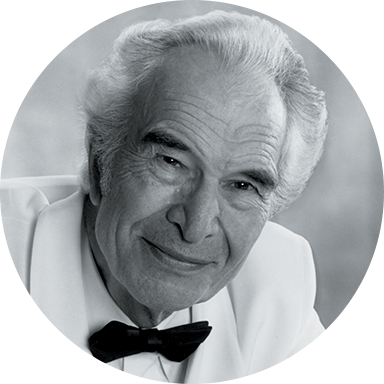
Dave Brubeck was a jazz pianist and composer whose dual mastery of improvisation and formal composition shaped twentieth-century music. Beyond his iconic work in jazz, including the album "Time Out" (the first jazz record to exceed one million copies sold) and the standard "Take Five," Brubeck wrote extensively across genres: choral works, hymns, orchestral pieces, chamber music, ballet suites, and large-scale choral-orchestral compositions. His studies with Darius Milhaud at Mills College after World War II deepened his classical training and encouraged him to synthesize jazz language with concert music idioms.
Brubeck's legacy extends beyond music to social leadership. He was instrumental in breaking racial barriers in mid-twentieth-century America and throughout his career received major honors including the Presidential Medal of the Arts, a Grammy Lifetime Achievement Award, and election to the American Classical Music Hall of Fame in 2003. His sacred choral works, including the mass "To Hope!" and the oratorio "The Voice of the Holy Spirit," have been recorded by ensembles ranging from the Cathedral Choral Society at the National Cathedral to the London Symphony Orchestra and London Voices.
Why we love this
Brubeck's harmonic language pulls your singers into genuine engagement with the text. Rather than settling into obvious tonal anchors, the piece moves through strategic dissonances that feel purposeful and expressive, making the rehearsal conversation about text-painting and harmonic function rich and collaborative. For a moderately difficult SATB ensemble, this strikes an ideal balance: the writing is sophisticated enough to reward careful study, yet achievable without requiring exceptional soloists.
What to expect
The piece unfolds like a meditation on Paul's famous words, weaving voice lines in and out of tension that mirrors the passage's arc from spiritual gift to love. Moments of dissonance feel searching, almost questioning, before resolving into points of stillness that anchor the text emotionally. The overall effect is introspective and dignified, rooted in classical choral tradition yet colored by Brubeck's jazz-informed harmonic sensibility.
Who it's for
Choirs at the upper-intermediate level seeking substantial sacred repertoire that challenges harmonic thinking without requiring virtuosic vocal technique. This works for concert or liturgical settings where a text-focused, contemplative approach resonates with your singers and audience.
How to get the most out of it
- Balance the web of independent lines by highlighting phrase entries in rehearsal; mark where each voice "wakes up" and begins its strand of the musical fabric. This clarity prevents the texture from becoming muddy when dissonances stack.
- Experiment with optional doublings if your ensemble size or confidence level benefits from reinforcement, but resist the urge to thicken every sonority. Save doublings for moments where the text demands weight or where unison passages naturally suggest it.
- Shape individual phrases through the dissonant passages with deliberate breath placement and dynamic contour. The piece's power comes from arriving at points of rest with earned resolution, so make the journey audible.
How to use it
This works beautifully as a centerpiece in a sacred concert or as part of a program exploring twentieth-century choral literature. Pair it with contrasting works in different harmonic languages—perhaps a Renaissance motet and a contemporary piece—to contextualize Brubeck's unique approach to harmony and form. It also serves well in a Sunday service or special liturgical occasion where the congregation needs music that rewards close listening.
Skills your students will build
- Reading and sustaining independent lines in a web of dissonance and consonance
- Understanding harmonic function beyond traditional tonal centers
- Interpreting phrase shape and text-setting decisions in modern sacred music
- Blending dissonant sonorities with accurate intonation
- Responding to rests and strategic points of harmonic arrival as structural signposts