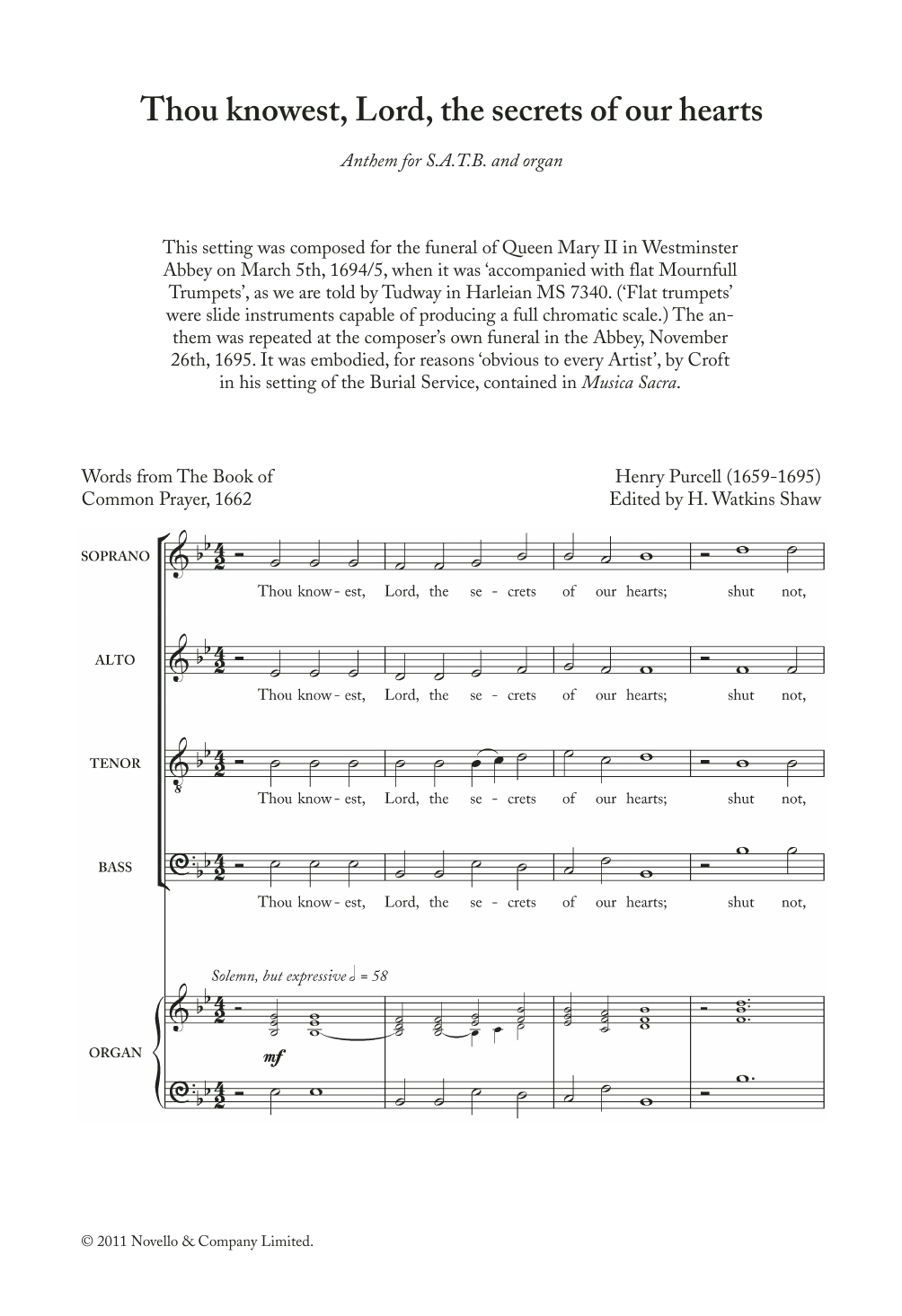
Thou Knowest, Lord, The Secrets Of Our Hearts Sheet Music Preview

Thou Knowest, Lord, The Secrets Of Our Hearts: Choral Octavo

By Henry Purcell / Arranged by Watkins Shaw

Item: 35-DS00339732

Digital Download
$2.99
Description

Thou Knowest, Lord, The Secrets Of Our Hearts: Choral Octavo isn't in MakeMusic Cloud just yet...but it could be. Let us know you'd like to see it, and you'll help shape what comes next. In the meantime, start a free trial and dive into thousands of interactive titles your students can play along with today.

Sample Audio
No sample audio found.
Sample Video
Additional Details
Publisher: Hal Leonard
Page Count: 4
SKU: 35-DS00339732

More about this title

About the Composer: Henry Purcell

Henry Purcell (1659-1695) stands as the greatest English composer of the Baroque era and a defining voice in the history of English music. His command of counterpoint, harmonic innovation, and text-setting made him equally comfortable writing anthems for the Chapel Royal, dramatic works for the stage, and intimate chamber pieces. Purcell's sacred music continues to anchor the choral repertoire because it combines technical sophistication with profound emotional directness.

This piece exemplifies Purcell's gift for setting English text with crystalline clarity. Rather than obscuring the words beneath elaborate counterpoint, he uses harmony and voice leading to illuminate meaning. For music educators, his sacred works offer students a window into how theological content shapes compositional choice and how restraint can be more powerful than display.

Why we love this

Purcell's setting cuts to the heart of the text without excess ornamentation, making it immediately moving even at modest vocal levels. The harmonic language feels both period-appropriate and emotionally direct, giving singers genuine expressive material to shape rather than decorative figurations to manage. Watkins Shaw's arrangement preserves the work's integrity while making it accessible to singers across ability levels.

What to expect

The piece settles into a space of quiet contemplation and gentle supplication. Harmonies move with purposeful restraint, creating moments of minor-key introspection interrupted by major-key affirmations. The overall effect is intimate and confessional, appropriate to text about divine knowledge of human secrets.

Who it's for

Intermediate to advanced choirs with solid blend and intonation can access this work's full expressive range. It suits singers who understand phrasing and have experience with Baroque harmonic language, though the straightforward four-part writing keeps it from being technically forbidding.

How to get the most out of it

  • Shape phrases around the text's natural breathing points rather than the written barlines. Purcell's punctuation often sits between measures, and respecting that architecture prevents the piece from sounding metrically rigid.
  • Balance transparency with resonance in the lower voices. Violas and tenors/basses support the harmonic structure, but if they're too prominent, they'll obscure the soprano line carrying the primary text declamation.
  • Lean into the harmonic shifts at cadences. Purcell's voice leading sometimes moves through unexpected chord qualities; letting those moments breathe makes the emotional arc clear.
  • Avoid mechanical uniformity across repeated text phrases. Small dynamic or agogic adjustments reinforce that these are meaningful utterances, not musical formulas.

How to use it

This works beautifully as part of a sacred or contemplative program section, pairing well with other Baroque anthems or with works spanning centuries of English choral tradition. Its brevity makes it suitable as a concert opener or as a moment of recalibration between larger dramatic works. It also serves as an excellent repertoire choice for teaching Baroque harmonic practice and text-setting principles.

Skills your students will build

  • Reading four-part Baroque harmonic writing and voice leading
  • Identifying and executing Baroque phrasing conventions
  • Balancing text clarity with harmonic complexity
  • Intonation precision in passages with chromatic voice movement
  • Interpreting English text with period-appropriate diction and articulation

You May Also Like