
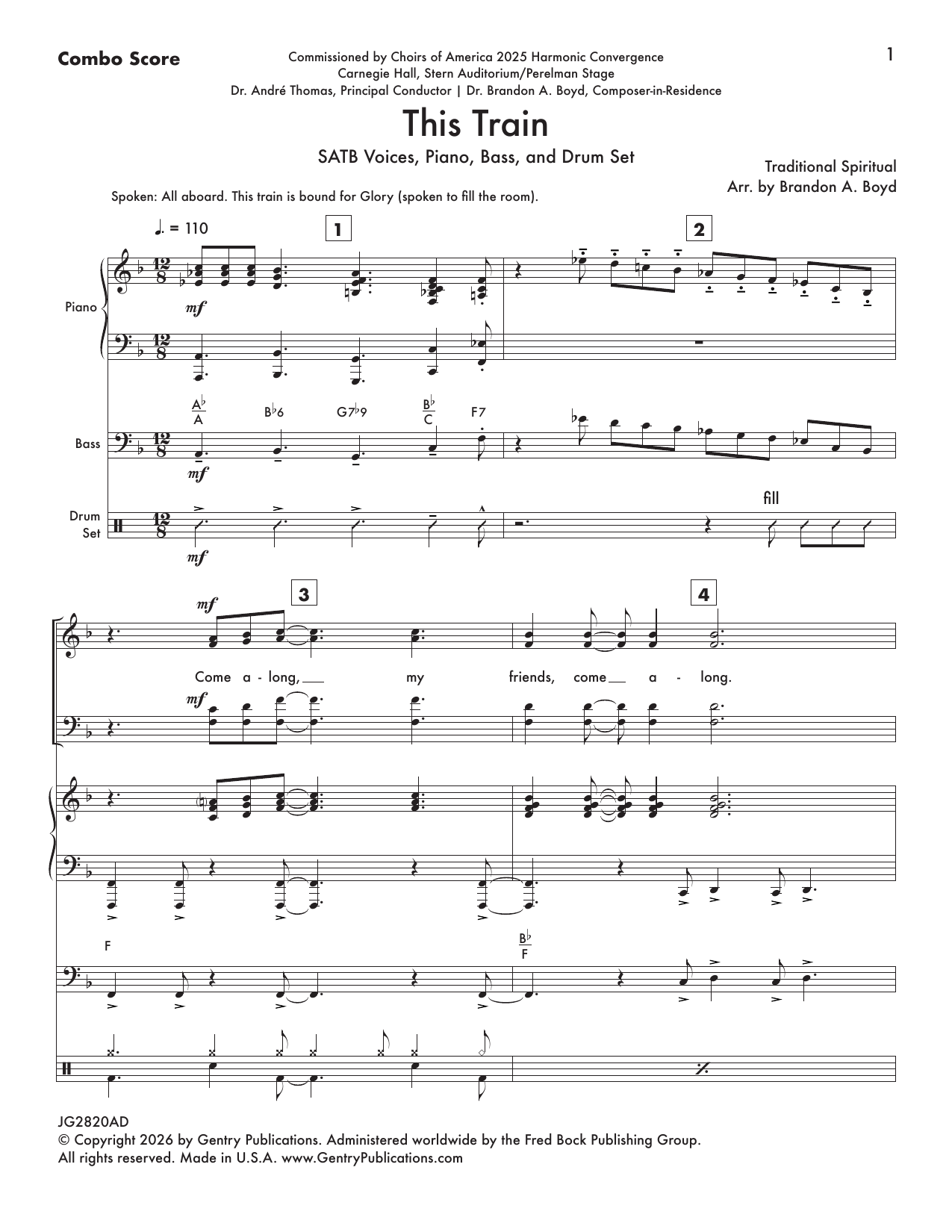

This Train: Choral Instrumental Pak
Arranged by Brandon A. Boyd
Item: 35-PK01912776
$25.00
Pickup currently not available
Buy Extra Parts (Digital PDF Download)
| Product | Price | Quantity |
|---|---|---|
| This Train - Full Score: Choral Instrumental Pak | $7.00 | |
| This Train - Bass: Choral Instrumental Pak | $7.00 | |
| This Train - Drum Set: Choral Instrumental Pak | $7.00 |
Parts Added to Cart!
Description
Part of the Brandon A. Boyd Choral Series, this vibrant SATB arrangement draws inspiration from beloved Negro spirituals and gospel songs rooted in the Black church tradition. Featuring the familiar chorus "Come Along, My Friends" - a coded call to freedom and a spiritual invitation -alongside "This Train" and the urgent vamp of "Got My Ticket, Can I Ride," the piece beautifully brings together themes of resilience, faith, and liberation. Your pianist will love the accompaniment. Perfect for festivals, competitions, church choirs, professional ensembles, youth and community groups, and both high school and college choirs, this work is sure to inspire singers and audiences alike.


This Train: Choral Instrumental Pak isn't in MakeMusic Cloud just yet...but it could be. Let us know you'd like to see it, and you'll help shape what comes next. In the meantime, start a free trial and dive into thousands of interactive titles your students can play along with today.
Request This Title
Tell us you want it.
Start Your Free Trial
Explore everything that's ready to play right now.
Sample Audio
No sample audio found.
Sample Video
No sample videos found.
Additional Details
Publisher:
Hal Leonard
SKU:
35-PK01912776
More about this title
About the Arranger: Brandon A. Boyd
Brandon A. Boyd is an accomplished arranger and composer whose work centers the rich musical heritage of the Black church and African American spiritual traditions. His arrangements honor these sacred roots while crafting pieces that resonate with contemporary choirs across concert halls, festivals, and worship spaces.
Why we love this
Boyd's treatment weaves three interconnected spirituals into a cohesive narrative arc that never feels forced or fragmented. The familiar refrain "Come Along, My Friends" anchors the piece while "Got My Ticket, Can I Ride" builds momentum with an infectious vamp that energizes both singers and audience. Your pianists will appreciate an accompaniment that's genuinely pianistic rather than merely functional, giving them real musical material to sink their teeth into.
What to expect
The piece carries the warmth and collective spirit of the Black church while maintaining the formal sophistication expected in concert settings. Moving from the plaintive beauty of the spirituals into the rhythmic propulsion of the vamp creates an arc of hope and determination that leaves audiences both reflective and uplifted.
Who it's for
This arrangement suits high school and college choirs seeking substantial repertoire with cultural weight, as well as professional ensembles and community choirs programming spirituals as part of a larger concert. It works equally well in church settings where the theological grounding matters as much as the musical artistry.
How to get the most out of it
- Let the vamp of "Got My Ticket, Can I Ride" breathe without rushing; the power lies in the singers' conviction and rhythmic precision, not tempo acceleration.
- Balance the spiritual's call and response passages so that the dialogue between sections registers clearly without any section overwhelming the others.
- Spend rehearsal time unpacking the historical and spiritual context of these three songs with your singers; this foundation transforms the piece from technically secure to genuinely moving.
How to use it
Pair this with other spirituals or African American art songs to create a thematic set that allows you to develop a substantial narrative within a single concert section. The energy of the closing vamp makes it particularly effective as a programming anchor that transitions audiences from a quieter segment into a more celebratory portion of your concert.
Skills your students will build
- Rhythmic independence in four-part SATB texture during syncopated vamp sections
- Stylistically informed phrasing rooted in Black church musical traditions
- Text clarity and emotional communication across spiritually coded language
- Ensemble cohesion when navigating call-and-response passage work
- Understanding of historical and cultural context as interpretive tool