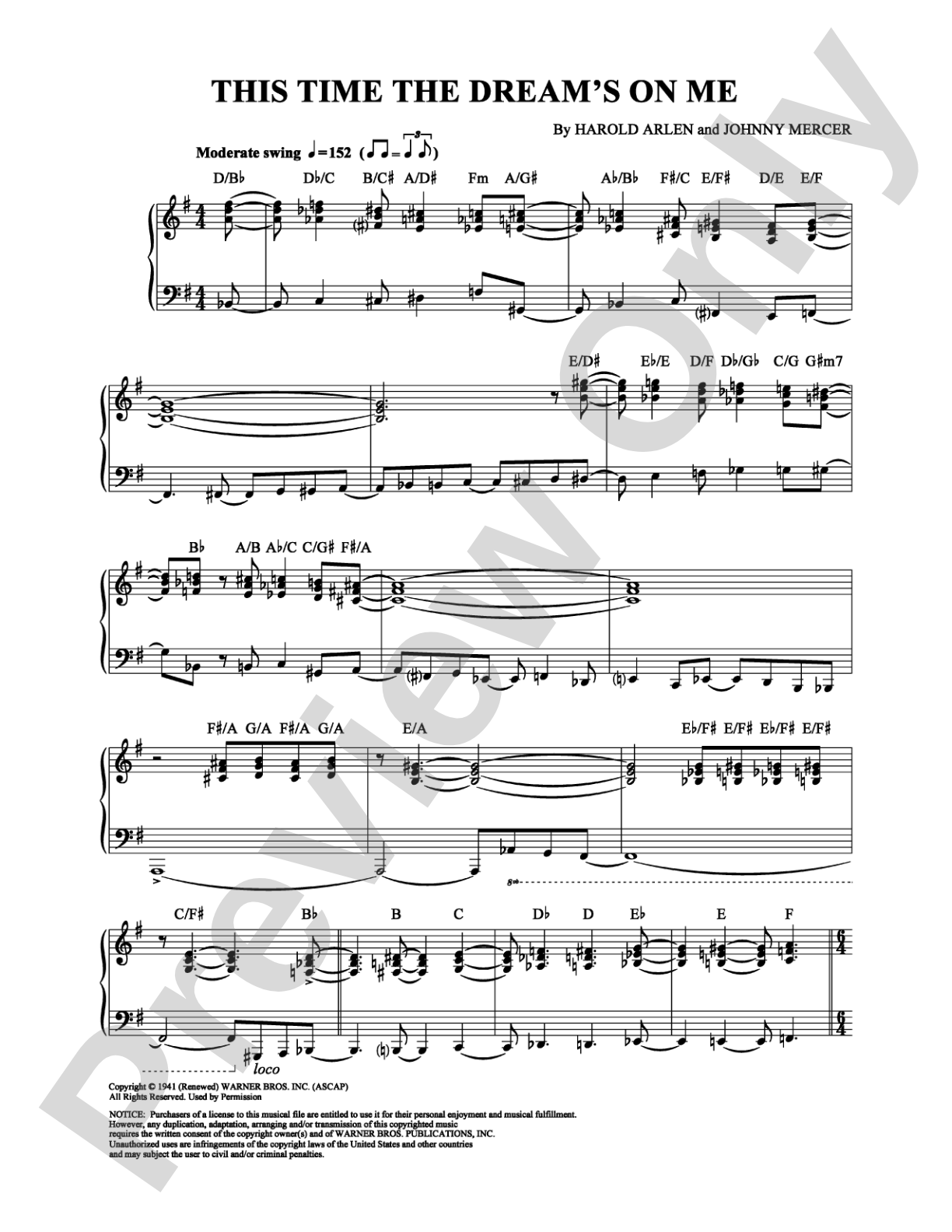
This Time the Dream's on Me: Piano Digital Sheet Music

This Time the Dream's on Me: Piano Digital Sheet Music

Johnny Mercer, Harold Arlen, Marian McPartland

Item: 00-PS-0002059

Digital Download
$3.99
Description

This Time the Dream's on Me: Piano Digital Sheet Music isn't in MakeMusic Cloud just yet...but it could be. Let us know you'd like to see it, and you'll help shape what comes next. In the meantime, start a free trial and dive into thousands of interactive titles your students can play along with today.

Sample Audio
No sample audio found.
Sample Video
Additional Details
SKU: 00-PS-0002059

More about this title

About the Artist: Marian McPartland

Marian McPartland (1918-2011) was a pioneering jazz pianist and bandleader whose career spanned seven decades. Born in Slough, England, she moved to the United States and became a central figure in modern jazz, known for her lyrical touch, harmonic sophistication, and ability to interpret standards with fresh perspective. She founded the influential Hickory House residency in New York, recorded prolifically across multiple decades, and hosted the radio program Piano Jazz for 37 years, interviewing countless musicians and showcasing the art of jazz improvisation.

Why we love this

McPartland's interpretation of this standard carries the mark of a musician who understood both the song's architecture and how to reshape it through her own sensibility. Her voicings and comping style offer pianists a masterclass in how to honor a tune while making it unmistakably their own.

What to expect

A quiet conversation with someone who has lived inside this song for years. McPartland brings an introspective warmth to this standard, with unhurried phrasing and intelligent voicings that feel both intimate and gently swinging. The piece has a reflective quality, as if the pianist is sharing a memory rather than performing a predetermined arrangement.

Who it's for

Jazz pianists seeking to study how a master interpreter approached the standards repertoire, and advanced students ready to move beyond literal melody playing into the harmonic sophistication and rhythmic freedom that characterize McPartland's style. This works equally well for those preparing recital material or exploring repertoire for jazz combo performance.

How to get the most out of it

  • Study the harmonic movement underneath the melody; McPartland's strength lay in rich, sophisticated chord extensions that reward careful listening to the recording.
  • Pay attention to touch and dynamics rather than speed; this is music that lives in nuance and the space between notes.
  • Explore the left-hand independence; her comping style often moves independently from the melody, creating conversational tension.
  • Allow for rubato in the opening and closing sections to capture the reflective quality McPartland brought to balladic material.

How to use it

Feature this in a jazz recital or concert celebrating American songbook standards, where it can anchor a set of balladic material. It also serves as an excellent study piece for jazz piano classes exploring interpretation and the relationship between melody and accompaniment.

Skills your students will build

  • Reading jazz chord symbols and understanding harmonic extensions
  • Developing independent left-hand comping that interacts with the melody rather than simply supporting it
  • Interpreting standards through personal expression while maintaining the song's essential character
  • Cultivating touch control and dynamic nuance as primary expressive tools

You May Also Like