
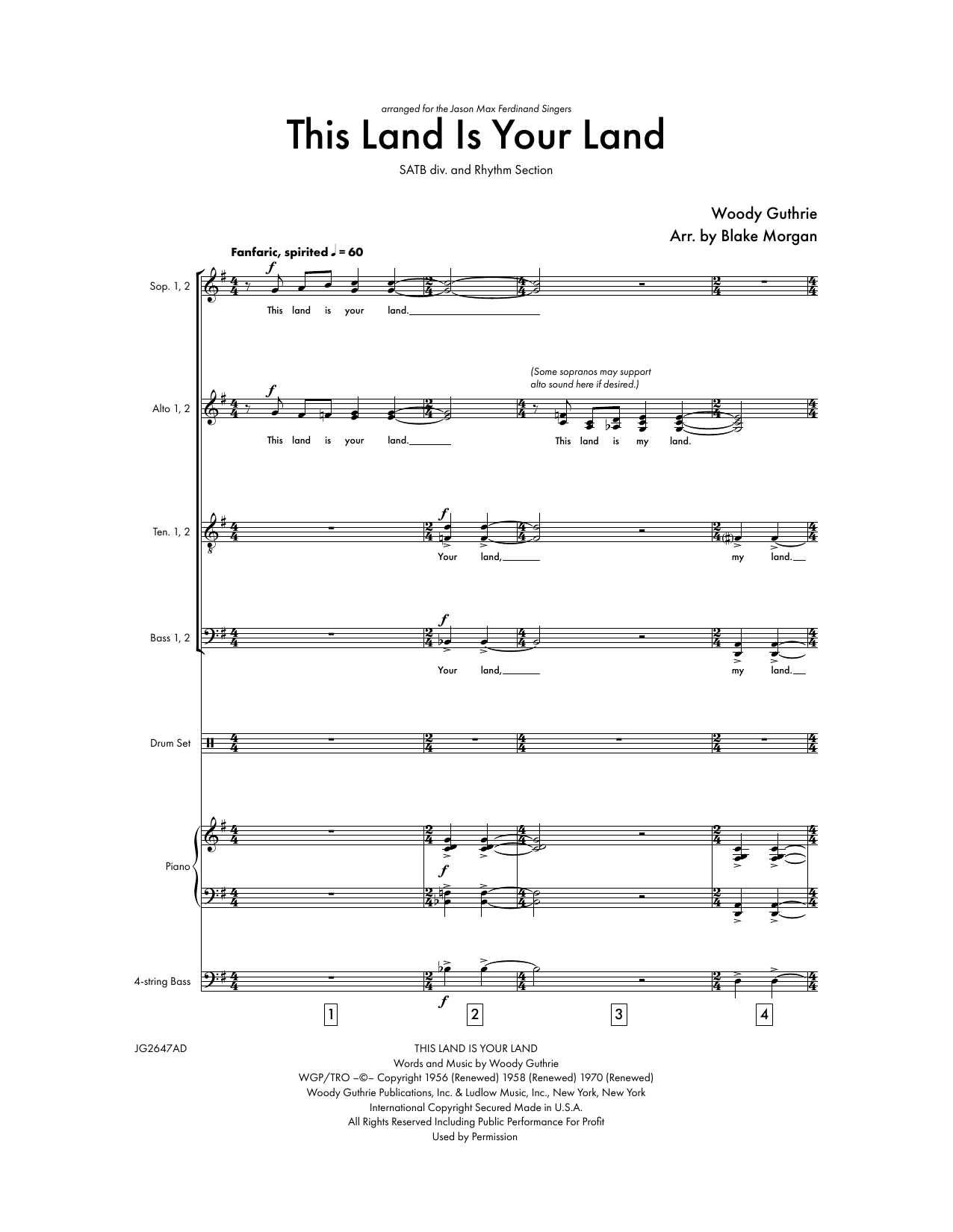

This Land Is Your Land (arr. Blake Morgan): Choral Instrumental Pak
By Woody Guthrie / Arranged by Blake Morgan
Item: 35-PK01726402
$35.00
Pickup currently not available
Buy Extra Parts (Digital PDF Download)
Parts Added to Cart!
Description
You have never heard an arrangement of "This Land Is Your Land" quite like this one. The arranger, Blake Morgan, said: "I felt it was fitting to illuminate one of Guthrie's original verses, placed at the heart of this new rendition for the Jason Max Ferdinand Singers. We all have unique stories of what this land means for us, but like the songwriter himself, I believe it was made-- and still can be made-- for you and me." The double-choir setting is accompanied by piano, percussion, and bass. This will be an audience favorite.


This Land Is Your Land (arr. Blake Morgan): Choral Instrumental Pak isn't in MakeMusic Cloud just yet...but it could be. Let us know you'd like to see it, and you'll help shape what comes next. In the meantime, start a free trial and dive into thousands of interactive titles your students can play along with today.
Request This Title
Tell us you want it.
Start Your Free Trial
Explore everything that's ready to play right now.
Sample Audio
No sample audio found.
Sample Video
No sample videos found.
Additional Details
Publisher:
Hal Leonard
SKU:
35-PK01726402
More about this title
About the Composer: Woody Guthrie
Woody Guthrie wrote "This Land Is Your Land" in 1940 as a response to "God Bless America," crafting a folk anthem that centered ordinary people's relationship to the land. His songwriting cut through sentimentality with direct language and unflinching social observation, creating music that worked equally well in union halls, classrooms, and around kitchen tables.
Guthrie's legacy in American music education rests on his belief that songs belonged to everyone. His compositions have become essential repertoire for teaching folk idiom, storytelling through melody, and the power of accessible music to carry meaning across generations.
Why we love this
Blake Morgan's arrangement honors the song's democratic spirit while creating something genuinely fresh. By placing one of Guthrie's lesser-known verses at the center and writing for double choir, Morgan transforms a singalong into a statement piece that still feels approachable rather than academic. The layered voices in a concert setting give audiences room to hear the song anew.
What to expect
Grounded and spacious at once. The double-choir writing creates room for reflection while maintaining the song's directness and folk integrity. There's warmth in the harmonies but no sentimentality, just voices joined around something true.
Who it's for
High school and college choirs seeking repertoire that speaks to contemporary conversations about belonging and place. Directors working with strong ensembles who can handle double-choir textures and want something that resonates beyond the concert hall.
How to get the most out of it
- Attend closely to the interplay between the two choirs. Morgan likely uses them to create dialogue or reinforce thematic material; clarity between sections matters more than blending them into one sound.
- The rhythm section (piano, percussion, bass) anchors the arrangement. Have the ensemble lock into the pulse established by these players during rehearsals rather than pushing or dragging against it.
- Treat the featured verse with the weight it deserves. Since Morgan centered this text, your singers should communicate its meaning through phrasing and dynamics, not rush past it.
- Balance the added verses against the familiar melody. If the arrangement includes new harmonic material, singers may need extra exposure to hear how it supports rather than obscures Guthrie's original melody.
How to use it
Position this as a cornerstone piece for a concert exploring American identity, folk traditions, or social consciousness in music. Its familiarity makes it an excellent entry point for audiences less accustomed to concert choral music, yet the arrangement reveals enough fresh detail to reward repeat listening. Consider programming it in the second half of a show, where the audience has settled in and can fully absorb both the melody and Morgan's interpretive choices.
Skills your students will build
- Singing in double-choir formations with independent lines
- Interpreting folk melody within contemporary harmonic language
- Balancing diction clarity across ensemble textures
- Responding to rhythm section accompaniment in a concert setting
- Understanding how arrangement choices shape a song's meaning