Douglas E. Wagner studied music at Butler University, earning both undergraduate and graduate degrees before spending three decades as a high school music director and administrator in Chicago. Since 1973, he has become one of the most prolific composers in American music education, with over 3,500 published works spanning choral repertoire for schools and churches, concert band, orchestra, handbell ensembles, and solo vocal music. His compositions have reached audiences globally through performances in concert halls, broadcast media, and educational settings; more than seventeen million copies of his music are currently in use.
Wagner now resides in Indianapolis, where he focuses exclusively on composition and arranging. His deep understanding of what works in rehearsal and performance, built from decades in the classroom, informs every piece he writes.
Why we love this
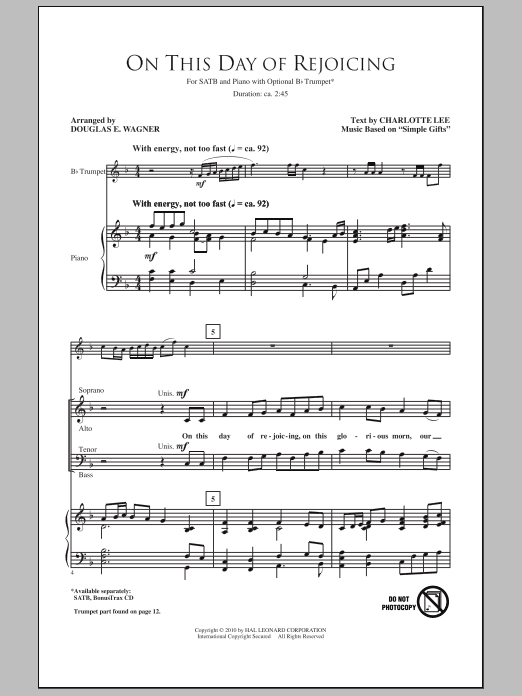
Wagner's Easter arrangements have the gift of sounding both accessible and substantial, which means your singers can prepare it without burning out while the music still rewards careful, musical interpretation. The SATB voicing sits naturally for mixed choirs of varying experience levels, and the harmonic language feels rooted in traditional hymn writing without ever becoming predictable.
What to expect
Bright and affirmative, with the warmth of traditional hymn harmony wrapped around a modern choral sound. The music invites singers and listeners into the spirit of the occasion without apology, combining reverence with genuine joy.
Who it's for
Mixed choirs serving Easter services or spring concerts who need music that speaks directly to the day's theological content without demanding advanced vocal technique. This works equally well for church musicians working with volunteer singers and for high school programs looking for sacred repertoire with real substance.
How to get the most out of it
Shape each phrase with legit breath support; the text about rejoicing should feel like genuine celebration rather than mere volume.
Attend to the inner voices (alto and tenor lines) in early rehearsals to prevent these parts from disappearing into the texture.
Let the soprano line breathe without holding back, especially if you plan to perform with organ or recorded accompaniment.
How to use it
Place this as a centerpiece for an Easter service or spring concert rather than as a filler piece. It pairs naturally with instrumental prelude and postlude music while also standing confidently on its own as the anchor of a program devoted to spring or seasonal themes.
Skills your students will build
Legit vowel consistency across SATB ranges
Part independence while maintaining harmonic blend
Text expression and interpretive phrasing in sacred music
Breath management in longer phrase structures
You May Also Like
Scan to Complete Your Purchase
Use your phone's camera to scan the code below
You'll log in on your phone and the order will be added to your account