
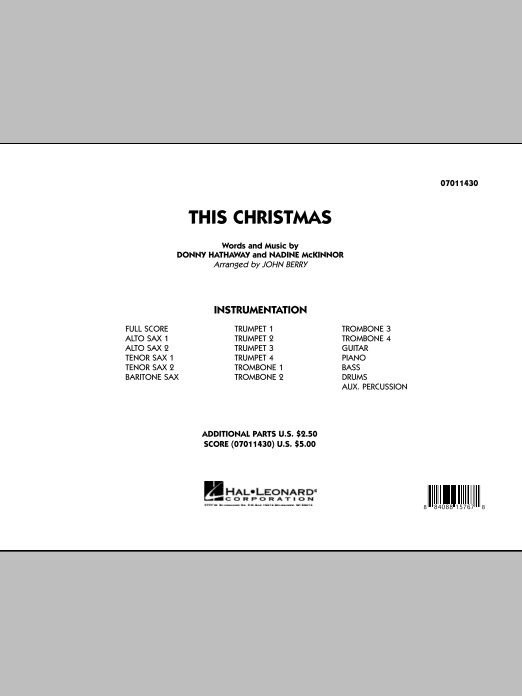

This Christmas: Jazz Ensemble Conductor Score & Parts
By Donny Hathaway / By Nadine McKinnor / Arranged by John Berry
Grade: 3
Item: 35-PK00160816
$55.00
Pickup currently not available
Buy Extra Parts (Digital PDF Download)
| Product | Price | Quantity |
|---|---|---|
| This Christmas - Full Score | $7.50 | |
| This Christmas - Alto Sax 1 | $6.00 | |
| This Christmas - Alto Sax 2 | $6.00 | |
| This Christmas - Tenor Sax 1 | $6.00 | |
| This Christmas - Tenor Sax 2 | $6.00 | |
| This Christmas - Baritone Sax | $6.00 | |
| This Christmas - Trumpet 1 | $6.00 | |
| This Christmas - Trumpet 2 | $6.00 | |
| This Christmas - Trumpet 3 | $6.00 | |
| This Christmas - Trumpet 4 | $6.00 | |
| This Christmas - Trombone 1 | $6.00 | |
| This Christmas - Trombone 2 | $6.00 | |
| This Christmas - Trombone 3 | $6.00 | |
| This Christmas - Trombone 4 | $6.00 | |
| This Christmas - Guitar | $6.00 | |
| This Christmas - Piano | $6.00 | |
| This Christmas - Bass | $6.00 | |
| This Christmas - Drums | $6.00 | |
| This Christmas - Aux Percussion | $6.00 |
Parts Added to Cart!
Description
Recorded by Donny Hathaway in 1970 and covered countless times since then, this appealing and enduring pop hit features a funky, upbeat rock style. John Berry's solid arrangement gives all sections a crack at the melody and includes a solo for alto sax. Great change of pace programming for the holidays!


This Christmas: Jazz Ensemble Conductor Score & Parts isn't in MakeMusic Cloud just yet...but it could be. Let us know you'd like to see it, and you'll help shape what comes next. In the meantime, start a free trial and dive into thousands of interactive titles your students can play along with today.
Request This Title
Tell us you want it.
Start Your Free Trial
Explore everything that's ready to play right now.
Sample Audio
No sample audio found.
Sample Video
No sample videos found.
Additional Details
Publisher:
Hal Leonard
SKU:
35-PK00160816
More about this title
About the Composer: Donny Hathaway
Donny Hathaway (1945-1979) was a soul and R&B virtuoso whose gifts as a pianist, singer, and arranger shaped the sound of early 1970s popular music. His approach combined sophisticated jazz harmonies with the emotional directness of soul music, creating songs that felt both contemporary and timeless. "This Christmas" became his signature holiday song, recorded when Hathaway was at the height of his powers as a musician and composer.
Hathaway's influence on music education extends beyond his recordings. His arrangements and compositions demonstrate how jazz vocabulary can serve accessible, joyful material without sacrificing harmonic or rhythmic sophistication. Teachers and musicians continue to draw from his work as a model for how popular music and jazz can coexist in the same artistic space.
Why we love this
John Berry's arrangement refuses to let one section sit idle while another plays the tune. The shared melody gives your ensemble ownership of the song rather than passive accompaniment roles, and the alto sax solo provides a natural showcase moment without requiring a specialist soloist. It's genuinely fun to rehearse and sounds polished after minimal run-throughs, which matters when you're juggling multiple holiday programs.
What to expect
Warm, funky, and genuinely joyful without a hint of saccharine. The arrangement pulses with energy and personality, moving between sections with enough variety to hold attention while staying rooted in that irresistible groove that made the original so enduring. You get the feeling everyone in the room is smiling while playing it.
Who it's for
Groups at the Grade 3 level who want a holiday piece that doesn't sound like a holiday piece. It works equally well for jazz ensembles looking for accessible, groovy repertoire with enough melodic interest to stay memorable, and for directors seeking a break from traditional seasonal arrangements.
How to get the most out of it
- Lock in the funk groove during the first read-through by having drums set the pocket clearly. Once the rhythm section sits comfortably, everyone else slots into the pocket automatically.
- Balance the alto sax solo by keeping the ensemble accompaniment light and laid back rather than driving hard underneath. The contrast between solo and section lets both breathe.
- Encourage the melodic sections to sing the line with swagger. This isn't precious or delicate music; it wants attitude and confidence.
- Use the rock/funk feel as your interpretive north star. Even the softer moments should groove rather than float.
How to use it
This sits beautifully between a traditional carol and a contemporary jazz selection on a winter concert, signaling that your group can swing as easily as they can play a standard. Consider opening a holiday set with more classical material, then shifting into this arrangement to show range and versatility. It also pairs well with other pop or R&B covers at the same difficulty level.
Skills your students will build
- Reading and executing funk/rock rhythmic figures with precision
- Playing with consistent groove and pocket in an ensemble setting
- Trading melody across different instrumental families while maintaining coherent phrasing
- Supporting a featured soloist with appropriate textural accompaniment
- Interpreting swing and straight eighth-note feels contextually