
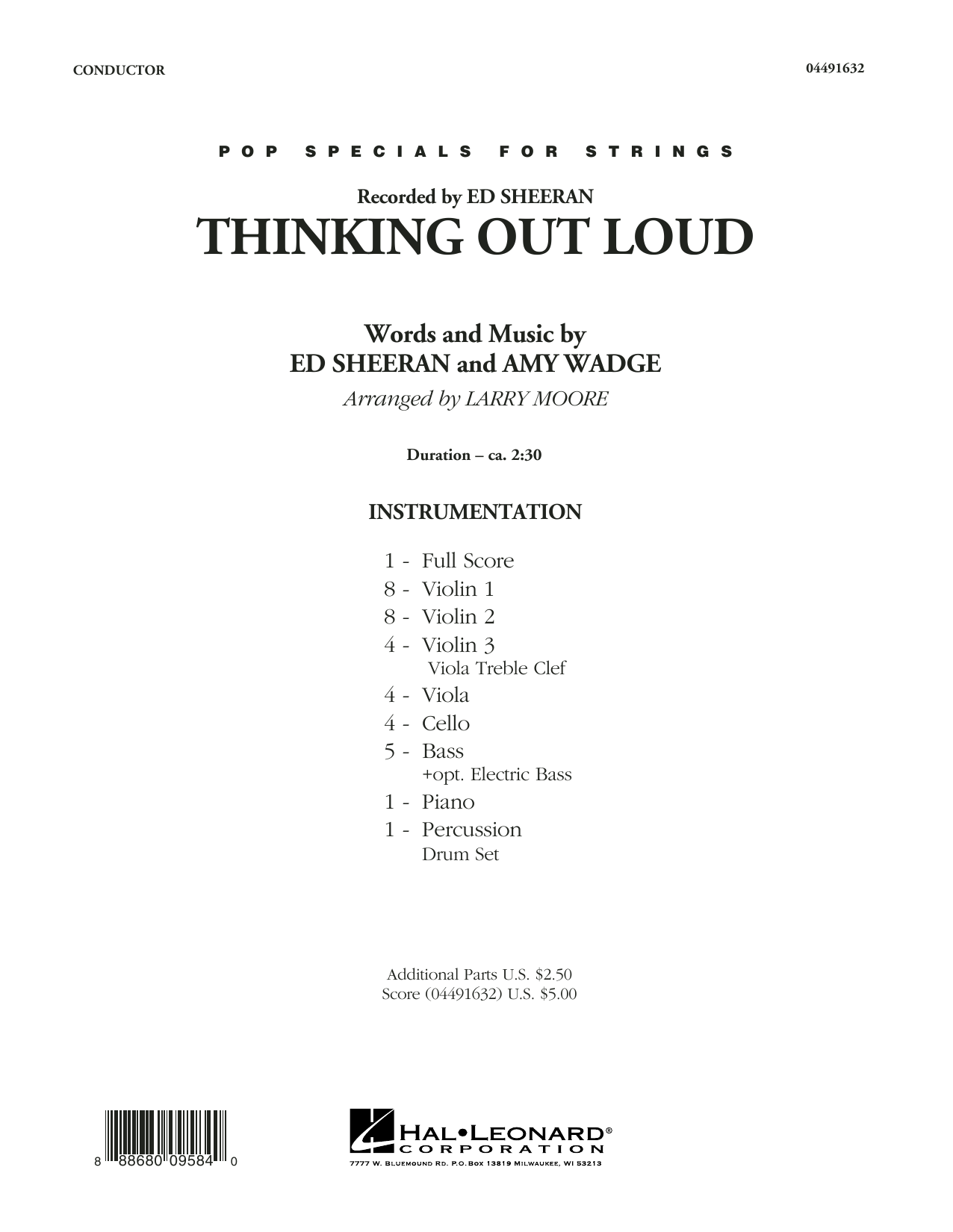

Thinking Out Loud: String Orchestra Conductor Score & Parts
As performed by Ed Sheeran / As performed by Amy Wadge / Arranged by Larry Moore
Grade: 3-4
Item: 35-PK00331241
$50.00
Pickup currently not available
Buy Extra Parts (Digital PDF Download)
| Product | Price | Quantity |
|---|---|---|
| Thinking Out Loud - Conductor Score (Full Score) | $6.00 | |
| Thinking Out Loud - Violin 1 | $7.00 | |
| Thinking Out Loud - Violin 2 | $7.00 | |
| Thinking Out Loud - Violin 3 (Viola Treble Clef) | $7.00 | |
| Thinking Out Loud - Viola | $7.00 | |
| Thinking Out Loud - Cello | $7.00 | |
| Thinking Out Loud - String Bass/Electric Bass | $7.00 | |
| Thinking Out Loud - Piano | $7.00 | |
| Thinking Out Loud - Percussion | $7.00 |
Parts Added to Cart!
Description
Dur: 2:30


Thinking Out Loud: String Orchestra Conductor Score & Parts isn't in MakeMusic Cloud just yet...but it could be. Let us know you'd like to see it, and you'll help shape what comes next. In the meantime, start a free trial and dive into thousands of interactive titles your students can play along with today.
Request This Title
Tell us you want it.
Start Your Free Trial
Explore everything that's ready to play right now.
Sample Audio
No sample audio found.
Sample Video
No sample videos found.
Additional Details
Publisher:
Hal Leonard
SKU:
35-PK00331241
More about this title
About the Artist: Ed Sheeran
Ed Sheeran emerged as one of the defining songwriters of his generation, building his reputation on intimate, lyric-driven compositions that balance pop accessibility with genuine emotional depth. His work across multiple genres has made him a relevant figure in music education, where his songs appear frequently in contemporary arrangements for student ensembles.
Why we love this
Larry Moore's arrangement captures the vulnerability of the original while giving string players genuinely musical lines to execute. At Grade 3-4, the writing stays accessible without sacrificing the emotional arc that makes this song resonate with audiences of all ages, making it a smart choice for spring concerts or wedding-themed programs.
What to expect
The arrangement unfolds with quiet intimacy, allowing the song's conversational quality to emerge through transparent textures and careful voice leading. There's a touching simplicity to the orchestration that respects the original's emotional directness while giving students the pleasure of playing something they recognize and care about.
Who it's for
String orchestras seeking contemporary material with genuine staying power in the rehearsal space and audience appeal without compromising musical integrity. Directors programming concerts that include pop or wedding repertoire alongside traditional classical selections will find this bridges both worlds effectively.
How to get the most out of it
- Balance the exposed melodic lines in the violins by keeping accompaniment voices transparent; this arrangement relies on clarity of texture rather than volume to convey warmth.
- Shape phrases toward the small moments of harmonic shift rather than pushing continuously forward; the song's power comes from stillness and space.
- Synchronize the ensemble through the fuller passages by having players listen internally to the harmonic foundation while maintaining their individual voice independence.
- Let the rubato emerge naturally from the string section's breath rather than imposing a metronomic pulse; this pop song gains character when players respond to the emotional content.
How to use it
This works beautifully as a bridge piece between classical and contemporary sections of a concert, or as a centerpiece for programs celebrating relationships and connection. Consider pairing it with other accessible contemporary arrangements or placing it early enough in a program to set an emotional tone without competing with heavier orchestral works.
Skills your students will build
- Shaping long melodic phrases with intentional phrasing and breath
- Blending within string sections to achieve transparent, balanced textures
- Responding to harmonic rhythm rather than relying solely on metric pulse
- Executing rhythmic precision in accompanying figures while maintaining musical warmth
- Sustaining intonation through exposed, slower-moving passages