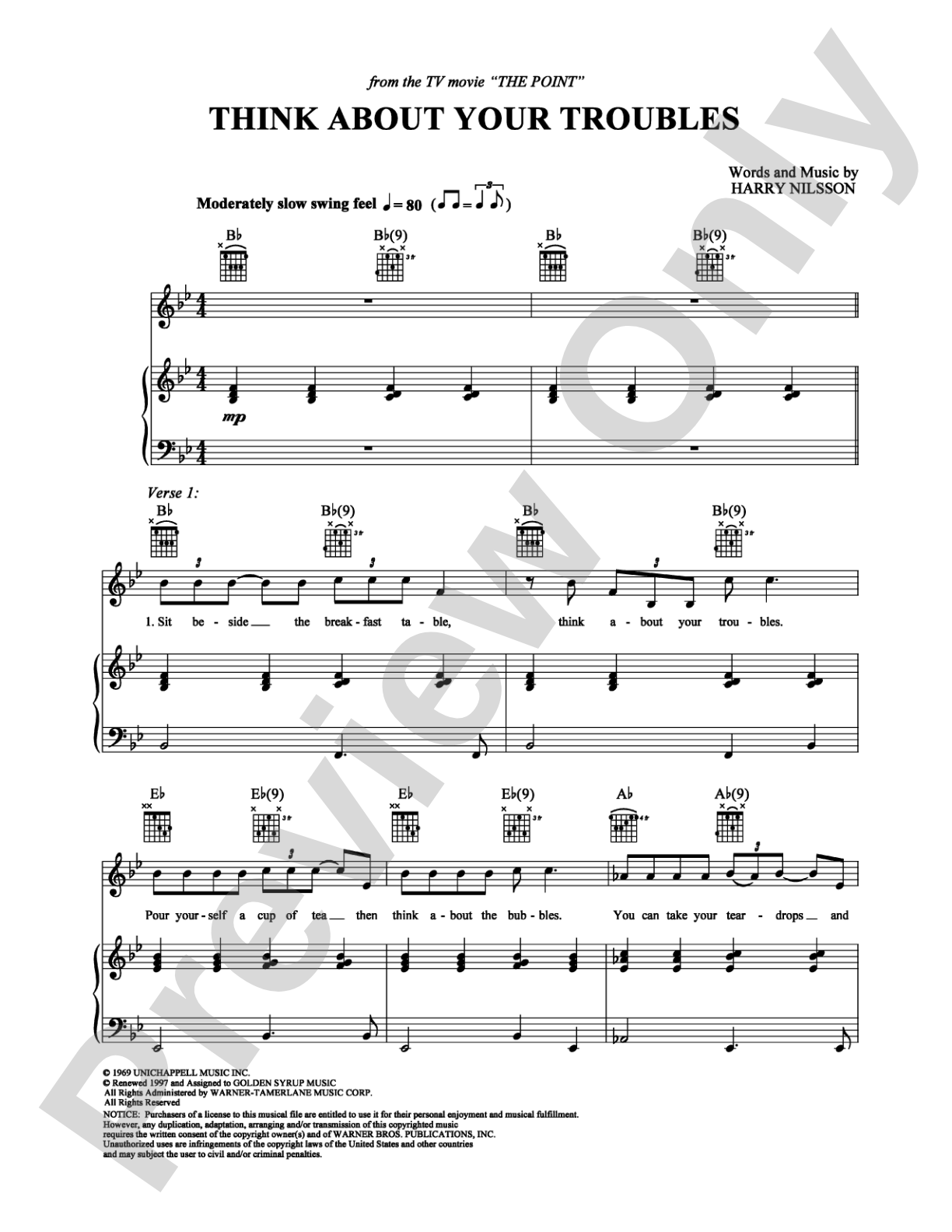
Think About Your Troubles: Piano/Vocal/Chords Digital Sheet Music

Think About Your Troubles: Piano/Vocal/Chords Digital Sheet Music

Harry Nilsson

Item: 00-PS-0004561

Digital Download
$3.99
Description

Think About Your Troubles: Piano/Vocal/Chords Digital Sheet Music isn't in MakeMusic Cloud just yet...but it could be. Let us know you'd like to see it, and you'll help shape what comes next. In the meantime, start a free trial and dive into thousands of interactive titles your students can play along with today.

Sample Audio
No sample audio found.
Sample Video
Additional Details
SKU: 00-PS-0004561

More about this title

About the Artist: Harry Nilsson

Harry Nilsson (1941, 1994) was a songwriter and performer who operated entirely outside Nashville and commercial pop conventions. His work ranged from whimsical children's songs to deeply introspective character studies, all marked by unconventional melodies, inventive arrangements, and lyrics that didn't follow predictable patterns. He won Grammy Awards and an Academy Award, and his influence on singer-songwriters and alternative music remains substantial.

For music educators, Nilsson's catalog offers a masterclass in how memorable melodies and harmonic sophistication can coexist with genuine emotional depth. His songs work equally well in voice lessons, piano classes, and ensemble contexts because they reward close listening without demanding virtuosity.

Why we love this

Nilsson's catalog gives jazz ensembles, cabaret programs, and pop-influenced choral groups access to sophisticated yet accessible material that listeners actually know and enjoy. The piano-vocal-chords format here supports both solo recitals and ensemble arrangements, and the song's conversational melody and harmonic landscape invite genuine interpretation rather than mechanical execution.

What to expect

The song carries a reflective, almost musing quality, inviting the listener into a moment of gentle philosophy. Its melody sits naturally in conversation, never pushing for dramatic effect, while the harmonies create subtle complexity that rewards close attention.

Who it's for

Solo singers preparing material for recitals, jazz combos arranging pop standards, and advanced singers looking to expand beyond traditional musical theater repertoire. Pianists accompanying vocalists will find this piece manageable yet musically substantial, with enough harmonic interest to remain engaging through multiple performances.

How to get the most out of it

  • Study the relationship between the melody and chord changes; Nilsson often places the tune slightly against the harmony, creating a modern feel that requires careful listening between voice and keyboard.
  • Experiment with rubato and phrasing to match the lyrical content; this song rewards a conversational delivery over metronomic precision.
  • Balance vocal vulnerability with the song's philosophical message; the emotional weight lives in understatement rather than oversinging.

How to use it

Include this in a cabaret-style concert pairing it with other introspective pop material, or feature it as a recital opener that establishes an intimate tone. It works well alongside jazz standards or contemporary art songs as part of a program exploring how popular songwriters approach melody and lyric.

Skills your students will build

  • Interpreting lyrics through phrasing and rubato
  • Understanding contemporary harmonic language (1960s-70s pop idioms)
  • Balancing vocal line against non-functional chord progressions
  • Accompanying singers with rhythmic flexibility and harmonic awareness

You May Also Like