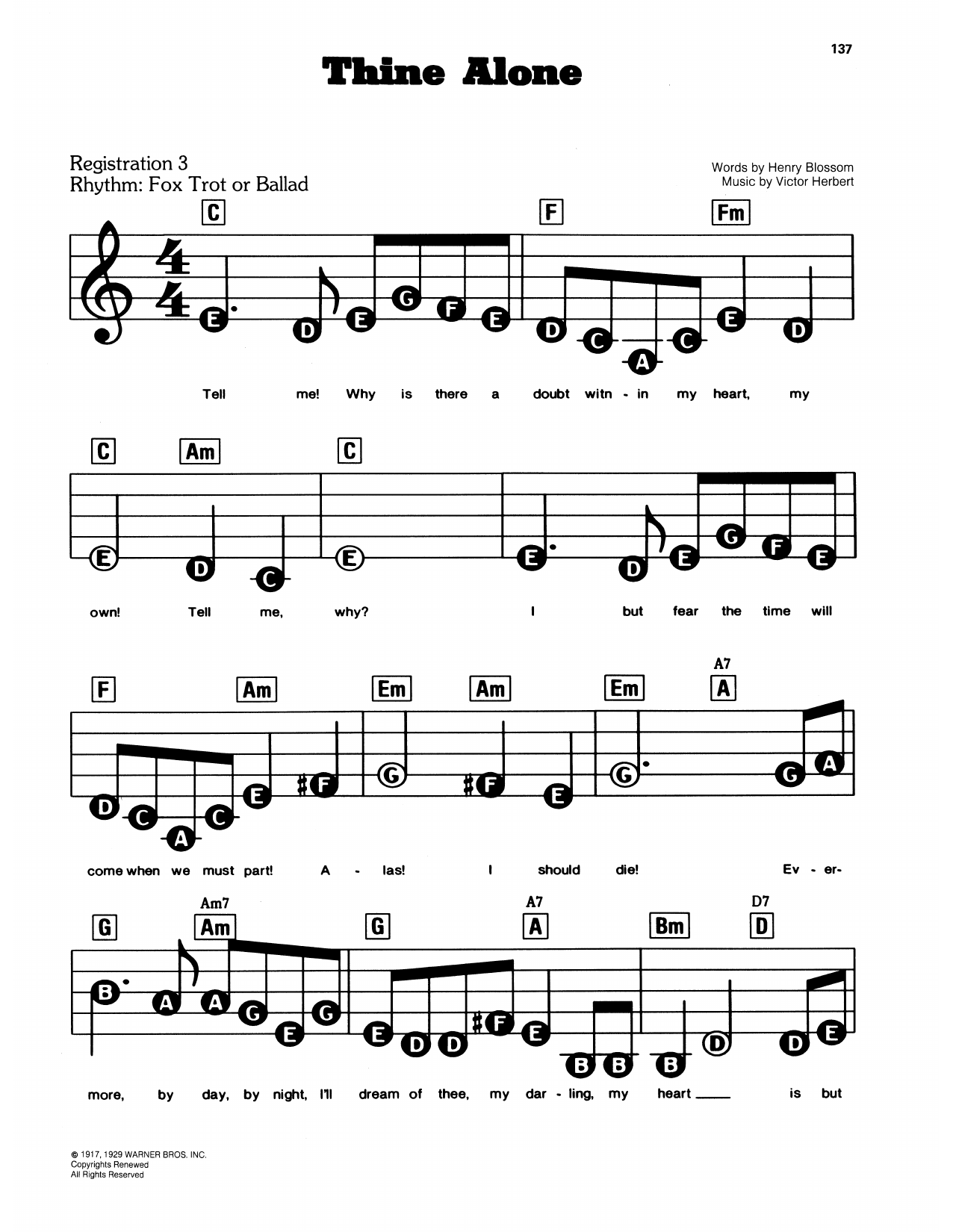
Thine Alone (from Eileen) Sheet Music Preview

Thine Alone (from Eileen): E-Z Play Today

As performed by Henry Blossom

Item: 35-DS01868458

Digital Download
$4.99
Description

Thine Alone (from Eileen): E-Z Play Today isn't in MakeMusic Cloud just yet...but it could be. Let us know you'd like to see it, and you'll help shape what comes next. In the meantime, start a free trial and dive into thousands of interactive titles your students can play along with today.

Sample Audio
No sample audio found.
Sample Video
Additional Details
Publisher: Hal Leonard
Page Count: 3
SKU: 35-DS01868458

More about this title

About the Artist: Henry Blossom

Henry Blossom (1861-1919) was an American librettist and lyricist who shaped the operetta landscape of the early 20th century. His witty, accessible texts for comic operas made him a fixture on Broadway and in concert halls, where his work balanced sophisticated musical comedy with genuine warmth and humor.

Why we love this

This operetta number carries the melodic generosity you'd expect from early American comic opera, and the E-Z Play format strips away unnecessary complexity so pianists can focus on bringing the character and style to life. It's a genuine crowd-pleaser that works equally well as a recital piece, an audition selection, or a program filler for mixed audiences.

What to expect

Sunny, charming, and gently comedic. The melody has the kind of singable grace that made operetta irresistible to audiences a century ago, with harmonies that sparkle without demanding virtuosity.

Who it's for

Piano students ready to move beyond classical etudes into repertoire with theatrical character. Teachers looking for accessible operetta material that doesn't require operatic vocals to perform well.

How to get the most out of it

  • Keep the tempo conversational and buoyant; operetta relies on clarity of text delivery, even when it's purely instrumental, so think of this as musical storytelling rather than pure technique.
  • Lean into the comedic intent by slightly exaggerating phrase shapes and dynamic contrasts; what feels obvious at the keyboard often reads just right from ten rows back.
  • Accompany any vocalist smoothly and without rushing the harmonic changes, which are often what carry the comedy in this style.

How to use it

This works beautifully in a recital pairing with other American musical theater repertoire, or as a solo piano interlude in a concert that includes art songs or classical material. It's also an excellent bridge piece when introducing students to styles beyond the standard solo piano canon.

Skills your students will build

  • Stylistic awareness in early American operetta
  • Maintaining conversational phrasing across longer melodic lines
  • Balance between lyrical melody and supporting harmonic texture
  • Executing period-appropriate articulation and rubato

You May Also Like