
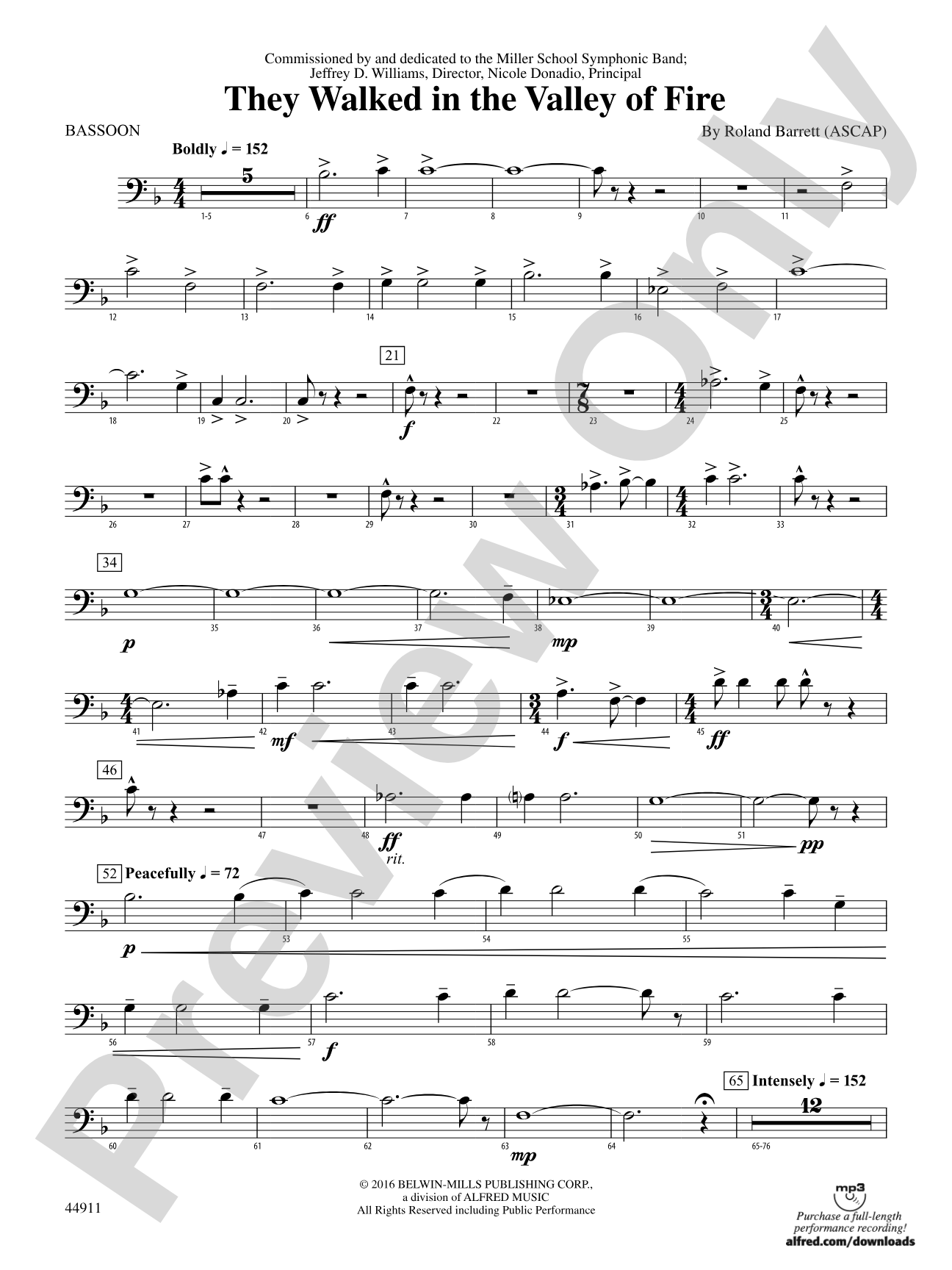

They Walked in the Valley of Fire: Bassoon
By Roland Barrett
Grade: 2.5 (Easy to Medium Easy)
Item: 00-PC-0017402_B1
$3.00
Pickup currently not available
Description
Inspired by the Valley of Fire state park in the southwest United States that boasts stunning red sandstone formations created more than 150 million years ago. Located in Nevada's oldest state park in the Mojave Desert, at certain times of the day, when reflecting the sun's rays, these brilliant sandstone formations create the visual illusion of actually being on fire. An emotional composition that is a perfect for concert and contest performances alike. Juxtaposing bold and peaceful musical statements, this compelling composition concludes with burning intensity. (4:00)


Don't just read it, hear it, play along with it, and watch your students grow with it. In MakeMusic Cloud, They Walked in the Valley of Fire: Bassoon comes alive with professional accompaniment, adjustable tempo, and built-in practice tools that turn solo practice into real progress.
Open in the Player
Jump straight in and assign it today.
Start Your Free Trial
Open this title and explore the full library in minutes.
Sample Audio
1
Audio File
--:--
0:00
0:00
Sample Video
Additional Details
Series:
Belwin Young Band
Publisher:
Alfred Music
Page Count:
268
SKU:
00-PC-0017402_B1
More about this title
About the Composer: Roland Barrett

Roland Barrett holds the position of music theory and composition faculty member at the University of Oklahoma, where he joined in 2001 following fifteen years as Assistant Director of Bands. His teaching encompasses 20th century music topics across undergraduate and graduate theory and composition courses, and he continues to arrange for the Pride of Oklahoma marching band.
With more than two hundred published compositions and arrangements for symphonic band, chamber ensembles, and marching band, Barrett has earned recognition as a composer whose works appear on programs across the country. His music has been performed by the Dallas Wind Symphony, numerous All-State and All-Region honor bands, and featured on NPR and at major conventions including the Midwest Band & Orchestra Convention and the International Trumpet Guild. He is a multiple recipient of the ASCAPlus award and a former Michael Hennagin memorial scholarship recipient in composition.
Why we love this
Barrett creates the ideal balance for this level: the writing is accessible enough for a solid Grade 2-3 band, yet compositionally sophisticated enough to hold directors' and adjudicators' attention. The programmatic anchor in Valley of Fire gives students a visual and emotional narrative to work toward, making rehearsal goals concrete and performances memorable.
What to expect
The music evokes the immensity and raw beauty of a desert landscape, moving between moments of stillness and passages of brilliant, shimmering intensity. As the sun strikes those ancient sandstone formations, the music shifts from contemplative and grounded to radiant and almost otherworldly, culminating in a vivid climax that captures fire itself.
Who it's for
This work suits bands that have solid fundamentals in intonation and ensemble balance but are still building independence in parts. It works equally well for concert performance and festival competition, making it ideal for programs balancing both performance opportunities.
How to get the most out of it
- Establish the landscape first. Take time in early rehearsals to help students visualize the red sandstone formations and understand how the piece's contrasting sections mirror different times of day and intensities of light. This context deepens their interpretive choices.
- Balance the bold and peaceful statements by clearly differentiating dynamic layers in each section. Ensure accompaniment voices maintain their supporting role without overshadowing the melody, especially during the quieter passages.
- Build toward the final "burning intensity" gradually across the final section. Resist the urge to rush; let the crescendo develop through clear articulation, gradually increasing energy, and unified ensemble response to small tempo adjustments.
How to use it
Program this as a centerpiece that showcases your band's range of musical expression, or open a concert with it to set a compelling tone. Its narrative arc and mid-level difficulty make it an excellent choice for festival competitions where both performance quality and repertoire selection earn consideration.
Skills your students will build
- Balancing melodic and accompaniment roles across sections
- Executing clear articulation within dynamic contrast
- Sustaining and shaping long phrases with ensemble unity
- Interpreting programmatic intent and translating it into musical choices