
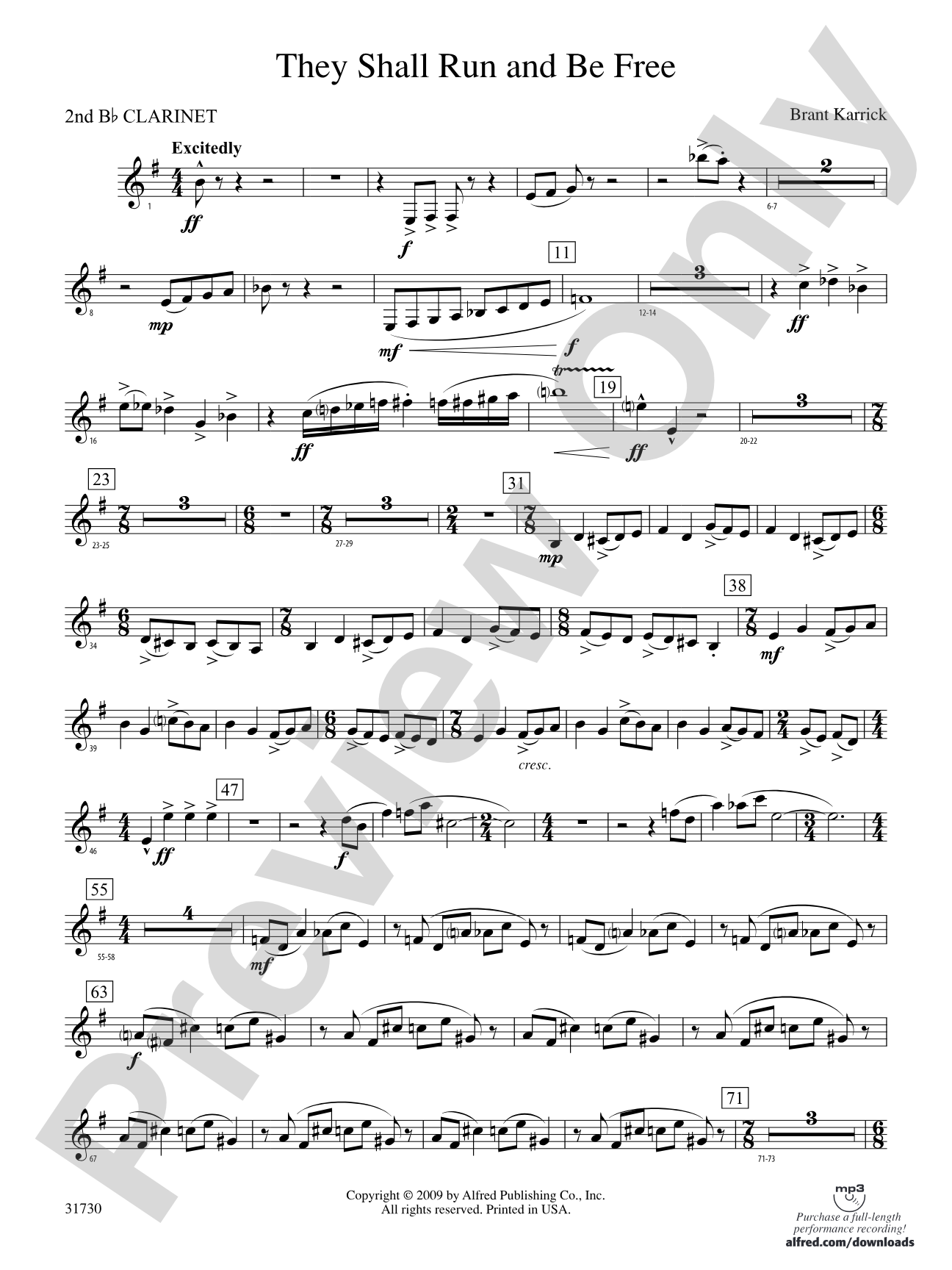

They Shall Run and Be Free: 2nd B-flat Clarinet
By Brant Karrick
Grade: 4 (Medium Difficult)
Item: 00-PC-0001819_C2
$3.00
Pickup currently not available
Description
This dramatic tone poem for concert band was written during the summer of 2007 after a moving visit to the National Underground Railroad Freedom Center in Cincinnati, Ohio. They Shall Run and Be Free portrays a daring and perilous slave escape. The opening main theme works its way through changing meters and dissonances and reflects running for one's life while being chased and never knowing what to expect. The slow, middle section includes a setting of the beautiful Negro spiritual Oh Freedom, the simple yet poignant lyrics undoubtedly reflecting the attitude and desperation of many slaves.
Oh freedom
Oh freedom
Oh freedom over me!
And before I'd be a slave
I'd be buried in my grave
And go home to my Lord and be free.


Oh freedom
Oh freedom
Oh freedom over me!
And before I'd be a slave
I'd be buried in my grave
And go home to my Lord and be free.
Don't just read it, hear it, play along with it, and watch your students grow with it. In MakeMusic Cloud, They Shall Run and Be Free: 2nd B-flat Clarinet comes alive with professional accompaniment, adjustable tempo, and built-in practice tools that turn solo practice into real progress.
Open in the Player
Jump straight in and assign it today.
Start Your Free Trial
Open this title and explore the full library in minutes.
Sample Audio
1
Audio File
--:--
0:00
0:00
Sample Video
No sample videos found.
Additional Details
Series:
Alfred Concert Band
Publisher:
Alfred Music
Page Count:
292
SKU:
00-PC-0001819_C2
More about this title
About the Composer: Brant Karrick

Brant Karrick has shaped wind band music as both educator and composer since earning his Bachelor of Music Education from the University of Louisville in 1982. He completed graduate studies at Western Kentucky University and earned his Ph.D. in music education from Louisiana State University in 1994, studying conducting with Frank Wickes and composition with David Livingston, Steve Beck, and Cecil Karrick. His work as Director of Bands at Northern Kentucky University since 2003 encompasses conducting the Symphonic Winds and Concert Band, teaching conducting and orchestration, and mentoring future music educators.
Beyond the university, Karrick maintains an active career as a guest conductor, adjudicator, and clinician whose compositions have been performed across North America, Europe, South Africa, South America, Japan, and Australia. His work balances administrative leadership of a comprehensive band program with ongoing creative output and service to the profession through ASCAP, CBDNA, and the Kentucky Music Educators Association.
Why we love this
This score balances musical substance with emotional purpose. The changing meters and dissonant language of the opening create genuine dramatic tension without sacrificing clarity, while the setting of 'Oh Freedom' in the middle section offers a moment of profound quiet that lets the spiritual's message resonate. Grade 4 ensembles rarely encounter repertoire that asks them to convey this kind of historical weight.
What to expect
Urgent and restless in its opening, with angular melody lines threading through unstable harmonies that capture the desperation of flight. The middle section strips away the frenzy to reveal a spiritual's quiet dignity, then the tension returns with renewed force. The overall arc moves from chaos toward a moment of grace without resolving neatly.
Who it's for
Conductors seeking repertoire that engages students with meaningful historical content and musical sophistication. Grade 4 concert bands with secure fundamentals in rhythm and intonation will find this piece both musically rewarding and historically important.
How to get the most out of it
- Establish the pulse clearly in the opening before the main theme enters; the changing meters and dissonances will feel purposeful only if the foundation is steady.
- Balance the texture so the melody can breathe through the instrumental layers; this piece works best when voices support rather than compete.
- Shape the 'Oh Freedom' section with restraint. Simplicity is its strength; avoid over-sentimentalizing the Negro spiritual setting.
- Attend to the written dynamics and articulations carefully. The dissonances and metric shifts need precision to communicate their dramatic intent rather than sounding merely confused.
How to use it
This works powerfully on a concert program examining American themes, particularly during Black History Month or in a season exploring music rooted in social justice. The dramatic arc supports pairing it with contrasting repertoire; a lighter work following it allows the audience to process the emotional weight.
Skills your students will build
- Reading and executing changing meters in an ensemble context
- Maintaining rhythmic clarity while navigating dissonant harmonies
- Balancing ensemble texture to support melodic lines through thick scoring
- Interpreting historical context through musical character and phrasing
- Sustaining focused sound quality and intonation during dissonant passages