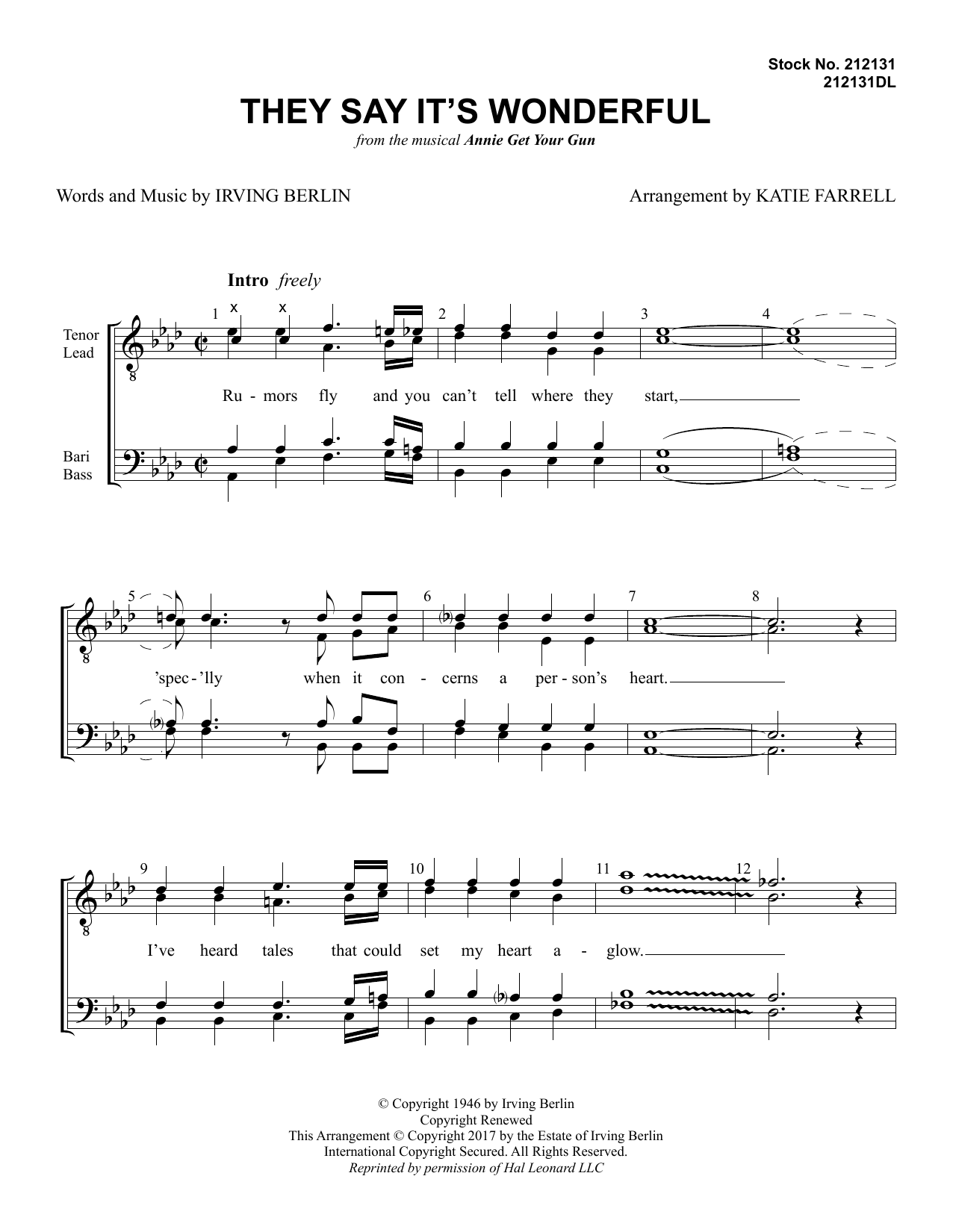
They Say It's Wonderful (from Annie Get Your Gun) (arr. Katie Farrell) Sheet Music Preview

They Say It's Wonderful (from Annie Get Your Gun) (arr. Katie Farrell): TTBB Choral Octavo

By Irving Berlin / Arranged by Katie Farrell

Item: 35-DS00472713

Digital Download
$3.20
Description

They Say It's Wonderful (from Annie Get Your Gun) (arr. Katie Farrell): TTBB Choral Octavo isn't in MakeMusic Cloud just yet...but it could be. Let us know you'd like to see it, and you'll help shape what comes next. In the meantime, start a free trial and dive into thousands of interactive titles your students can play along with today.

Sample Audio
No sample audio found.
Sample Video
Additional Details
Publisher: Hal Leonard
Page Count: 5
SKU: 35-DS00472713

More about this title

About the Composer: Irving Berlin

Irving Berlin (1888–1989) remains one of the most prolific and commercially successful songwriters in American history. A Russian-born immigrant with no formal training, Berlin wrote over 1,000 songs across stage musicals, film scores, and popular standards, creating the soundtrack to much of the twentieth century. His gift for melody and his instinctive understanding of what audiences wanted made him a titan of Broadway and American popular music.

Berlin's compositions are teaching tools in themselves. His songs prioritize singability and emotional directness, which is why they endure in choral settings. Teachers return to Berlin again and again because his melodies sit naturally in the voice, and his harmonic language rewards both simple and sophisticated interpretations.

Why we love this

Katie Farrell's arrangement makes this Berlin standard shine in TTBB voicing, which means you get warmth and blend without the need for female voices. The flexibility in voicing (TB/TTB/TBB options) lets you cast it for your actual ensemble, and at five pages, it's substantive enough to program as a featured selection without being a rehearsal burden.

What to expect

Playful sophistication. The song radiates charm and knowing humor about love and marriage, with a melody that bounces with optimism. Farrell's arrangement preserves that lightness while giving the harmonies real substance, so you get both the joy of singing a beloved standard and the satisfaction of navigating genuine musical architecture.

Who it's for

Treble or tenor-dominant choirs looking for a crowd-pleasing standard that doesn't rely on women's voices. This works for college men's choruses, high school male voice groups, and mixed choirs short on tenors but rich in basses. The arrangement is sophisticated enough to interest serious singers but approachable enough for singers building their jazz phrasing skills.

How to get the most out of it

  • Balance the top line so the melody sings through; this arrangement trusts the tenors to carry the tune, so they need just enough support from the other voices to prevent them from pushing.
  • Lean into the rubato that lives naturally in the phrasing. "They say it's wonderful" begs for a conversational delivery, not metronomic precision.
  • Shape the harmonic progressions with slight dynamic swells. The chords in a well-crafted arrangement like this one often suggest their own trajectory.
  • Let diction open up on vowels. The text is conversational and witty, so clarity matters, but avoid pinching the tone in service of articulation.

How to use it

Place this as a palate cleanser in a concert mixing heavier choral fare, or pair it with other Berlin standards to build a themed set. It also works as an encore or as part of a broadway/classic American songbook program. The modest length makes it ideal for filling a spot when you need something that lands immediately with an audience.

Skills your students will build

  • Jazz phrasing and rubato over a steady harmonic foundation
  • TTBB blend and balance across four distinct male voice parts
  • Singing through flexible voicing options (TB/TTB/TBB/TTBB configurations)
  • Diction clarity in conversational, lyric-driven text
  • Interpreting Berlin's characteristic harmonic language and melodic contour

You May Also Like