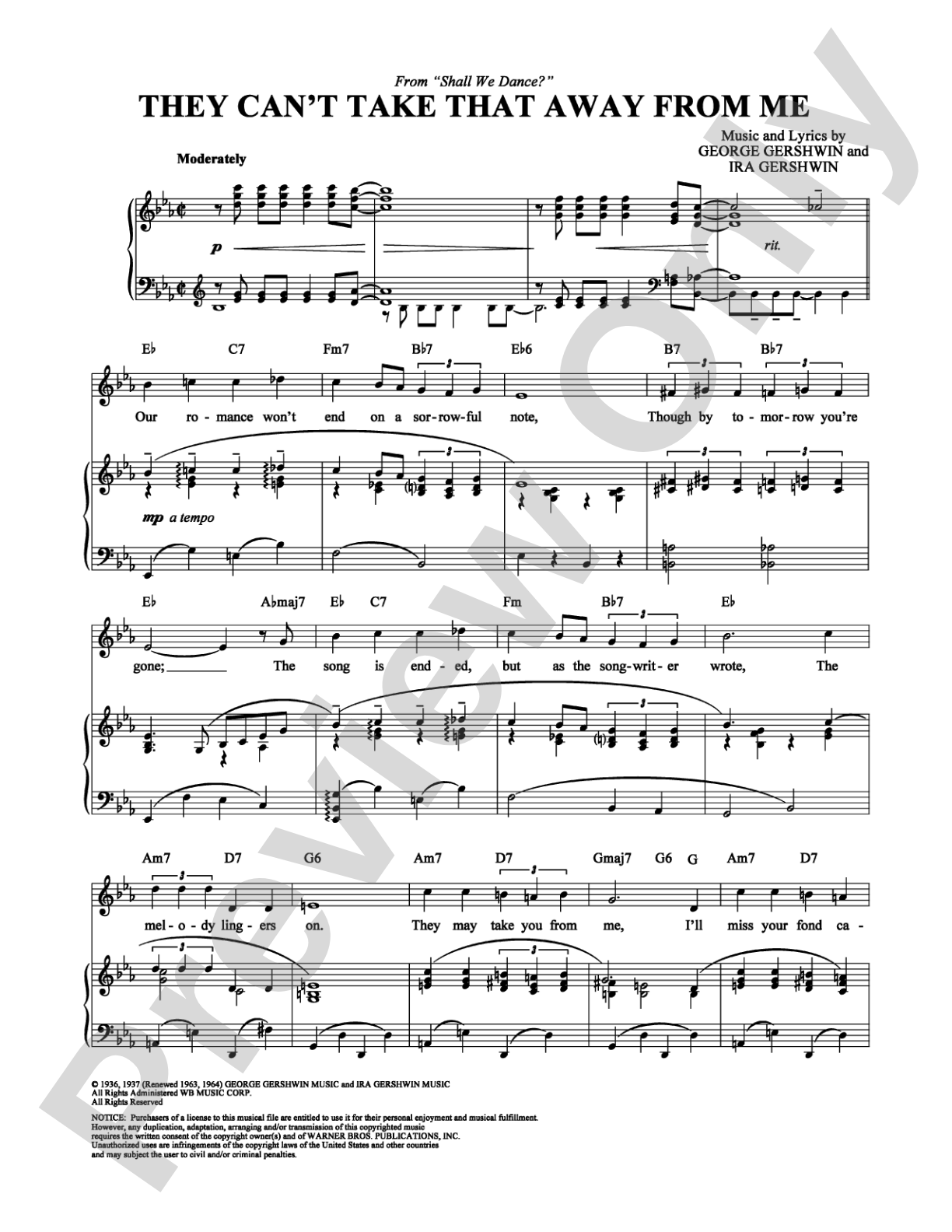
They Can't Take That Away From Me: Piano/Vocal/Chords Digital Sheet Music

They Can't Take That Away From Me: Piano/Vocal/Chords Digital Sheet Music

George Gershwin, Frank Sinatra, Tommy Dorsey, Billie Holiday, Fred Astaire

Item: 00-PS-0001168

Digital Download
$3.99
Description

They Can't Take That Away From Me: Piano/Vocal/Chords Digital Sheet Music isn't in MakeMusic Cloud just yet...but it could be. Let us know you'd like to see it, and you'll help shape what comes next. In the meantime, start a free trial and dive into thousands of interactive titles your students can play along with today.

Sample Audio
No sample audio found.
Sample Video
Additional Details
SKU: 00-PS-0001168

More about this title

About the Artist: Frank Sinatra

Frank Sinatra (1915-1998) redefined American popular song through his phrasing, interpretive depth, and technical mastery of the microphone. His influence on vocal music education extends far beyond jazz and standards; his approach to lyrical storytelling, breath control, and emotional authenticity has shaped how singers across genres understand song interpretation.

Why we love this

This standard offers singers and pianists a masterclass in swing era elegance without requiring advanced harmonic vocabulary. The Gershwin brothers' melody sits comfortably for intermediate voices, while the chord changes provide pianists enough sophistication to explore jazz voicings and comping techniques. It's a repertoire staple that actually rewards repeated study rather than feeling like a cliché.

What to expect

Warm nostalgia tinged with bittersweet reflection. The melody drifts unhurried through the changes, supported by the gentle sophistication of swing era harmony. There's an intimacy here—as if the singer is confiding a memory—that makes the song feel both elegantly crafted and deeply personal.

Who it's for

Intermediate and advancing vocalists seeking standards repertoire that develops phrasing control and emotional interpretation, paired with pianists comfortable with jazz voicings and flexible accompaniment. Voice students preparing audition material or recital programs will find this a reliable and musically substantive choice.

How to get the most out of it

  • Sit with the rubato. The melody invites flexibility in phrasing, especially at phrase endings; lock in the piano's harmonic rhythm while allowing the vocal line to breathe naturally.
  • Explore the chord symbols as a conversation between hands. Rather than playing block chords, build comping patterns that complement the vocalist's phrasing and leave space in the texture.
  • Shape the melody through vowel clarity and legit tone production. This song lives or dies on the ability to sustain legit vowels through the longer phrase shapes without forcing or tightening.
  • Balance intimacy with projection. The lyrical content is personal and close, but the venue and arrangement still require the voice to carry cleanly to the back of the room.

How to use it

Program this alongside other Gershwin or Cole Porter standards in a jazz or American songbook recital, or use it as a bridge piece between classical art song and contemporary popular music contexts. It also works well as a teaching demonstration of how interpretation and phrasing transform a melody across different performers.

Skills your students will build

  • Sustained legit singing through longer phrase shapes
  • Interpreting lyrics with emotional specificity and rubato
  • Reading and voicing jazz chord symbols
  • Accompanying singers with flexible, responsive comping patterns
  • Balancing intimacy with vocal projection in a small-ensemble setting

You May Also Like