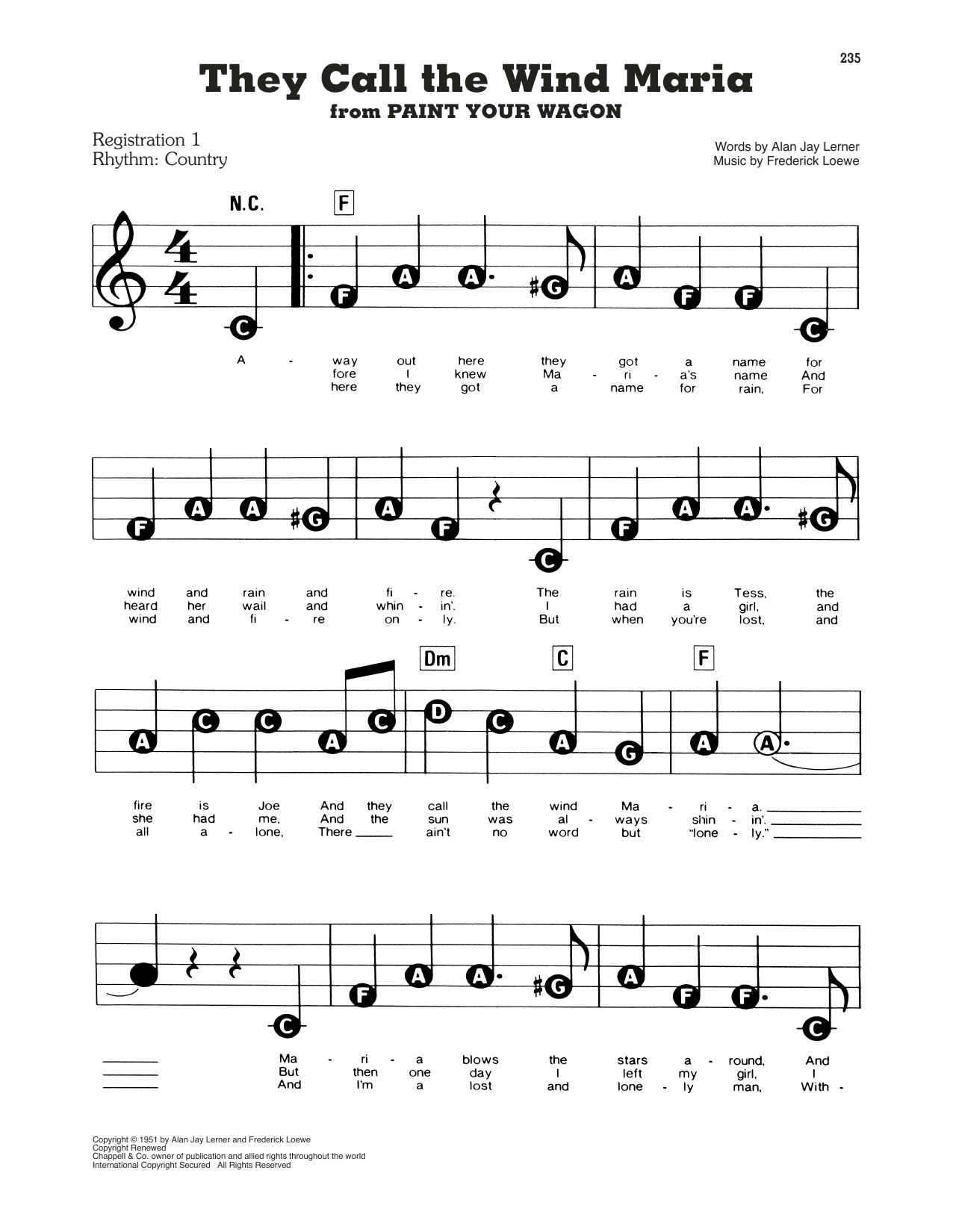
They Call The Wind Maria (from Paint Your Wagon) Sheet Music Preview

They Call The Wind Maria (from Paint Your Wagon): E-Z Play Today

As performed by Alan Jay Lerner

Item: 35-DS01827901

Digital Download
$4.99
Description

They Call The Wind Maria (from Paint Your Wagon): E-Z Play Today isn't in MakeMusic Cloud just yet...but it could be. Let us know you'd like to see it, and you'll help shape what comes next. In the meantime, start a free trial and dive into thousands of interactive titles your students can play along with today.

Sample Audio
No sample audio found.
Sample Video
Additional Details
Publisher: Hal Leonard
Page Count: 3
SKU: 35-DS01827901

More about this title

About the Artist: Alan Jay Lerner

Alan Jay Lerner stands as one of Broadway's most celebrated lyricists, crafting words that marry sophistication with accessibility across a seven-decade career. His partnership with composer Frederick Loewe produced some of theater's most enduring scores, including My Fair Lady, Gigi, and Camelot, works that continue to define the American musical theater canon and influence songwriting pedagogy worldwide.

Lerner's gift for storytelling through song emerges clearly in Paint Your Wagon, where vernacular language and emotional directness serve the narrative while maintaining melodic integrity. His approach to prosody and character voice makes his work particularly valuable for music students learning how lyrics and melody function as unified expression.

Why we love this

This arrangement captures the swagger and landscape-gazing openness that makes the song iconic, and the E-Z Play Today format strips away unnecessary complexity without sacrificing the tune's character. Students immediately recognize the melody and find themselves engaged with a piece that sounds sophisticated but remains approachable at the keyboard.

What to expect

Wind-swept and yearning, the song evokes open horizons and the pull of something just beyond reach. The melody has a folk-song quality despite its Broadway lineage, grounded and honest, with enough harmonic interest to keep the ear engaged across repeated phrases.

Who it's for

Students progressing beyond strictly classical repertoire who want to develop musical theater literacy and stronger song interpretation skills. This works equally well for pianists studying contemporary styles and singers looking for accompaniment that preserves the song's theatrical essence without demanding advanced technique.

How to get the most out of it

  • Shape the melody with slight rubato in the opening phrase to establish the song's reflective quality before settling into a steady tempo.
  • Balance the accompaniment to keep the singer's line visible; resist filling every beat with chordal motion.
  • Let the harmonic changes breathe, particularly where the key or chord function shifts, so the listener hears the structural progression.

How to use it

Pair this with other American musical theater selections in a recital that spans different eras and styles, or use it as an accessible entry point for students exploring how theatrical writing differs from classical song forms. It also serves well as a supplementary piece during rehearsals focused on interpretation and character-driven performance.

Skills your students will build

  • Distinguishing accompaniment textures between solo passages and ensemble moments
  • Singing or playing with dramatic intention rather than technical precision alone
  • Balancing legit melody with interpretive freedom in a theater context
  • Recognizing and executing common Broadway harmonic progressions

You May Also Like