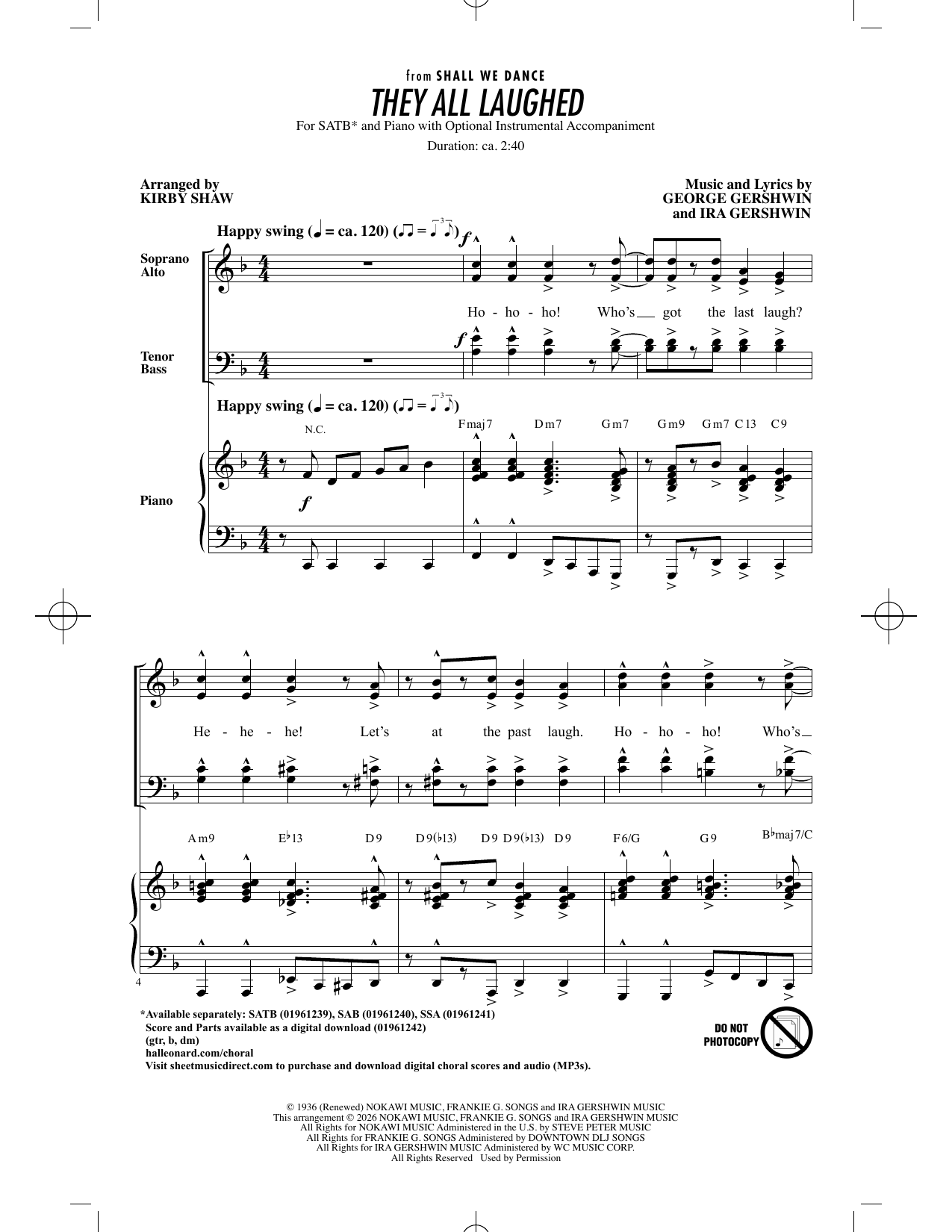
They All Laughed (arr. Kirby Shaw): SATB Choral Octavo
Arranged by Kirby Shaw
Item: 35-DS01986064
Digital Download
$2.75
Minimum order quantity: 10 copies
Please note: Under U.S. copyright law, you must purchase the exact number of copies needed for your ensemble. Printing, duplicating or sharing additional copies is strictly prohibited.
Pickup currently not available
Description
Discover MakeMusic Cloud: thousands of interactive titles your students can play along with today.
Kirby Shaw brings decades of choral expertise across multiple continents, having conducted and taught in 45 states plus Canada, Australia, and several European countries. He holds degrees in Music Education and Choral Composition from San Jose State University and earned his DMA in Choral Conducting from the University of Washington. His teaching style combines rigorous musicianship with infectious humor and genuine joy in sharing music. Shaw founded and directed the acclaimed COS Vocal Jazz Ensemble at College of the Siskiyous and went on to direct similar programs at Colorado State University and the University of Missouri at Kansas City. He currently directs the Jefferson State Choral Coalition at Southern Oregon University.
As a prolific composer and arranger with over 2500 works in print, Shaw's choral music has reached audiences worldwide and sold nearly 20 million copies, earning him multiple ASCAP awards. His vocal jazz credentials run deep, with mentoring from Bobby McFerrin, Mark Murphy, Chris Calloway, Al Jarreau, and Jon Hendricks. Beyond his arrangement work, he has overseen hundreds of educational recordings, produced multiple college and solo albums, and performs with Just 4 Kicks, a jazz a cappella ensemble. His most recent commission came from the Mormon Tabernacle Choir.
Why we love this
Shaw's arranging hand is immediately recognizable in this setting of the Gershwin standard. The writing feels conversational and alive, with the kind of inner-part independence that makes singers feel like individual voices rather than choir sections. It captures the witty, sophisticated energy of the original without demanding virtuosic vocal gymnastics from your ensemble.
What to expect
There's an elegance and playfulness woven throughout this arrangement. The Gershwin melody sits comfortably in the voices while the harmony moves with jazz sophistication, creating a piece that feels both intellectually engaging and genuinely fun to sing. It's the kind of arrangement that makes singers grin during rehearsal because they can feel themselves making real music.
Who it's for
High school, college, and adult choirs with solid reading skills and some jazz experience will get the most from this arrangement. Directors looking for a show choir or concert repertoire piece that lands with sophistication and humor will find this especially rewarding.
How to get the most out of it
Pay attention to the rhythmic precision in the swing feel. Accurate articulation of eighth notes (not too stiff, not too loose) sells the groove and keeps the ensemble locked together.
Balance the melody line carefully so it projects clearly without the supporting voices receding into accompaniment. Shaw's voicings are designed to be heard as equal conversation.
Explore the recorded accompaniment for rehearsals, but push your singers to feel the pulse independently rather than leaning on it during performance.
Shape the phrase endings with subtlety. The humor in this song comes partly from the articulation and phrasing choices, so let your singers mine the text for natural comedic timing.
How to use it
This works beautifully in a concert pairing Broadway standards with jazz arrangements, or as the anchor piece in a lighter second half that shifts the mood of your program. It's also a strong choice for show choir competition if you want sophisticated standard repertoire that stands apart from typical pop song covers.
Skills your students will build
Singing with a jazz swing feel and rhythmic precision in eighth-note articulation
Balancing individual voice lines within SATB harmony and maintaining textural independence
Interpreting text with comedic timing and subtle dynamic shaping
Reading jazz-influenced voicings with chromatic movement and extended harmonies
You May Also Like
Scan to Complete Your Purchase
Use your phone's camera to scan the code below
You'll log in on your phone and the order will be added to your account