
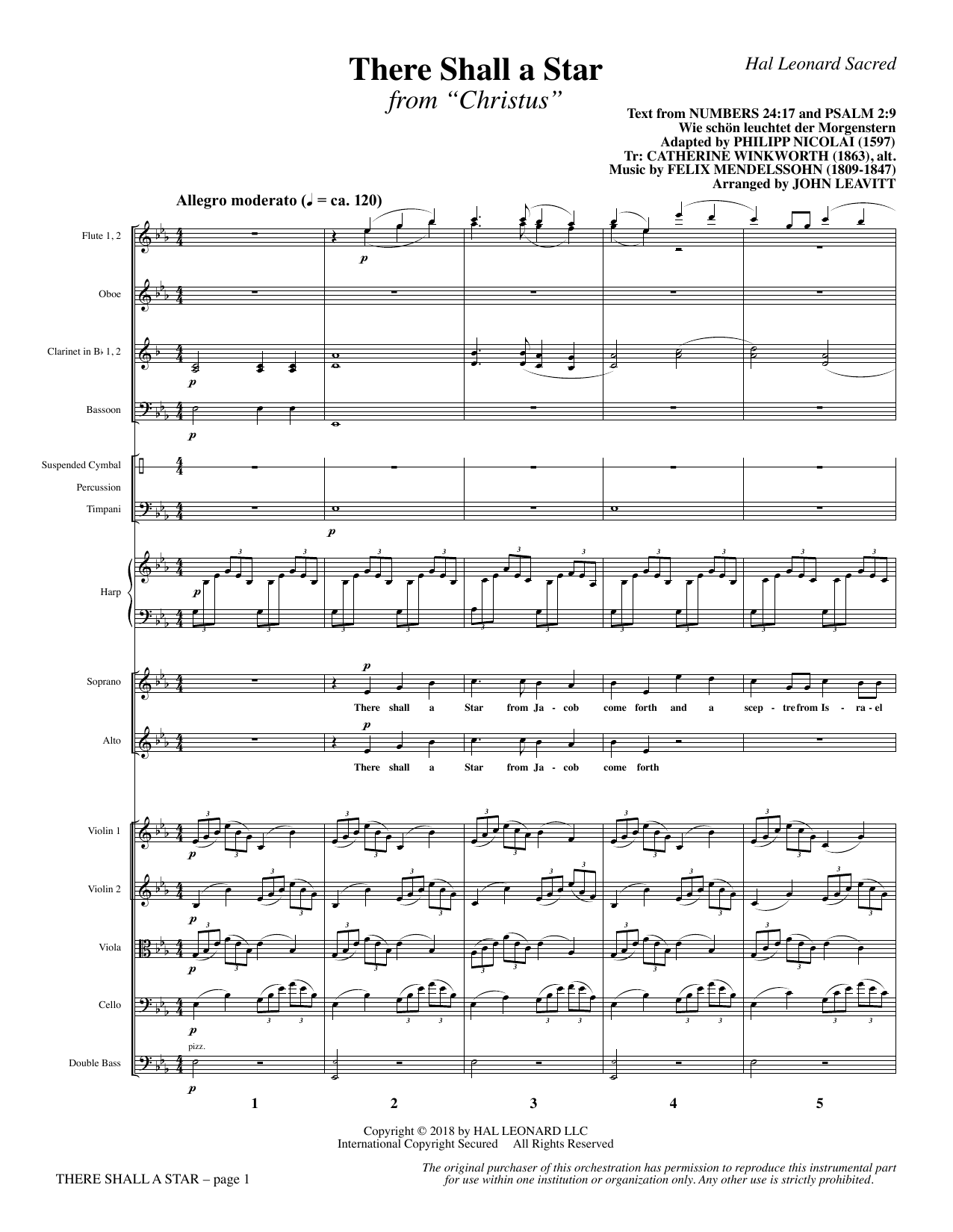

There Shall a Star: Choral Instrumental Pak
Arranged by John Leavitt
Item: 35-PK00420592
$60.00
Pickup currently not available
Buy Extra Parts (Digital PDF Download)
Parts Added to Cart!
Description
From Felix Mendelssohn's oratorio, "Christus," this masterwork adaptation tastefully presents a classical work for church and academic choirs. This chorus is from one of Mendelssohn's final works which was never completed. The rolling triplet accompaniment pushes the composition forward with wave-like arches, supporting the choir in all of its sonorous glory. A smooth contrapuntal style contrasts with dramatic accents and powerful crescendos, displaying the confident scripture-based text with appropriate excitement! John Leavitt has provided a new piano accompaniment as well as a new sparkling orchestration that supports the work while staying faithful to the Mendelssohn original.


There Shall a Star: Choral Instrumental Pak isn't in MakeMusic Cloud just yet...but it could be. Let us know you'd like to see it, and you'll help shape what comes next. In the meantime, start a free trial and dive into thousands of interactive titles your students can play along with today.
Request This Title
Tell us you want it.
Start Your Free Trial
Explore everything that's ready to play right now.
Sample Audio
No sample audio found.
Sample Video
No sample videos found.
Additional Details
Publisher:
Hal Leonard
SKU:
35-PK00420592
More about this title
About the Arranger: John Leavitt
John Leavitt has built a career as one of the most prolific arrangers and composers for choral ensembles, with a particular gift for adapting classical masterworks into accessible yet sophisticated versions for church and school choirs. His arrangements balance fidelity to the original composer's intent with the practical realities of rehearsal time and ensemble capability, making him a trusted voice in American choral music education.
Why we love this
Leavitt's hand here transforms an incomplete Mendelssohn oratorio into a fully realized performance piece without compromising the work's compositional integrity. The rolling triplet accompaniment creates genuine forward momentum, and the orchestration lets your choir shine rather than compete with instrumental color.
What to expect
The piece glides forward on those gentle triplet waves, creating an almost meditative quality even as the text demands confidence and declaration. Moments of intimate counterpoint suddenly ignite into powerful unison statements, giving singers the exhilaration of singing Mendelssohn at full voice.
Who it's for
Church choirs with solid sight-reading skills and intermediate to advanced ensemble technique will find this work sits comfortably in their repertoire. Academic choirs and advanced high school groups benefit from the legitimate classical provenance without needing college-level musicianship across all sections.
How to get the most out of it
- Shape the triplet accompaniment as a unified gesture across your orchestra or piano; these waves need to feel continuous, not choppy, to serve the choir's phrasing effectively.
- Prepare singers for the textural shift between flowing contrapuntal passages and those dramatic accents. The contrast lands only if both extremes are fully committed.
- Balance choir volume carefully against the accompaniment during crescendos. Mendelssohn's writing allows the text to project even at full ensemble volume if your sopranos and altos aren't buried.
- Let the final powerful passages breathe slightly before the crescendo begins. Singers sing crescendos better when they start from a defined dynamic, not from uncertainty about where they currently sit.
How to use it
Pair this with other Advent and Christmas works to anchor a concert in genuine classical material. It works equally well as a concert centerpiece in a program of Mendelssohn orchestral or chamber works, or as a sophisticated closer that sends audiences out with text-driven beauty rather than sentiment alone.
Skills your students will build
- Reading and executing smooth contrapuntal lines with independent voice independence
- Sustaining triplet-based rhythmic accompaniment without rhythmic drift
- Controlling dynamic crescendos and sudden accents in a coordinated ensemble
- Balancing individual voice part projection within choral blend
- Interpretation of classical style including period-appropriate phrasing and articulation