There's the Rub: 3rd B-flat Trumpet Sheet Music Preview

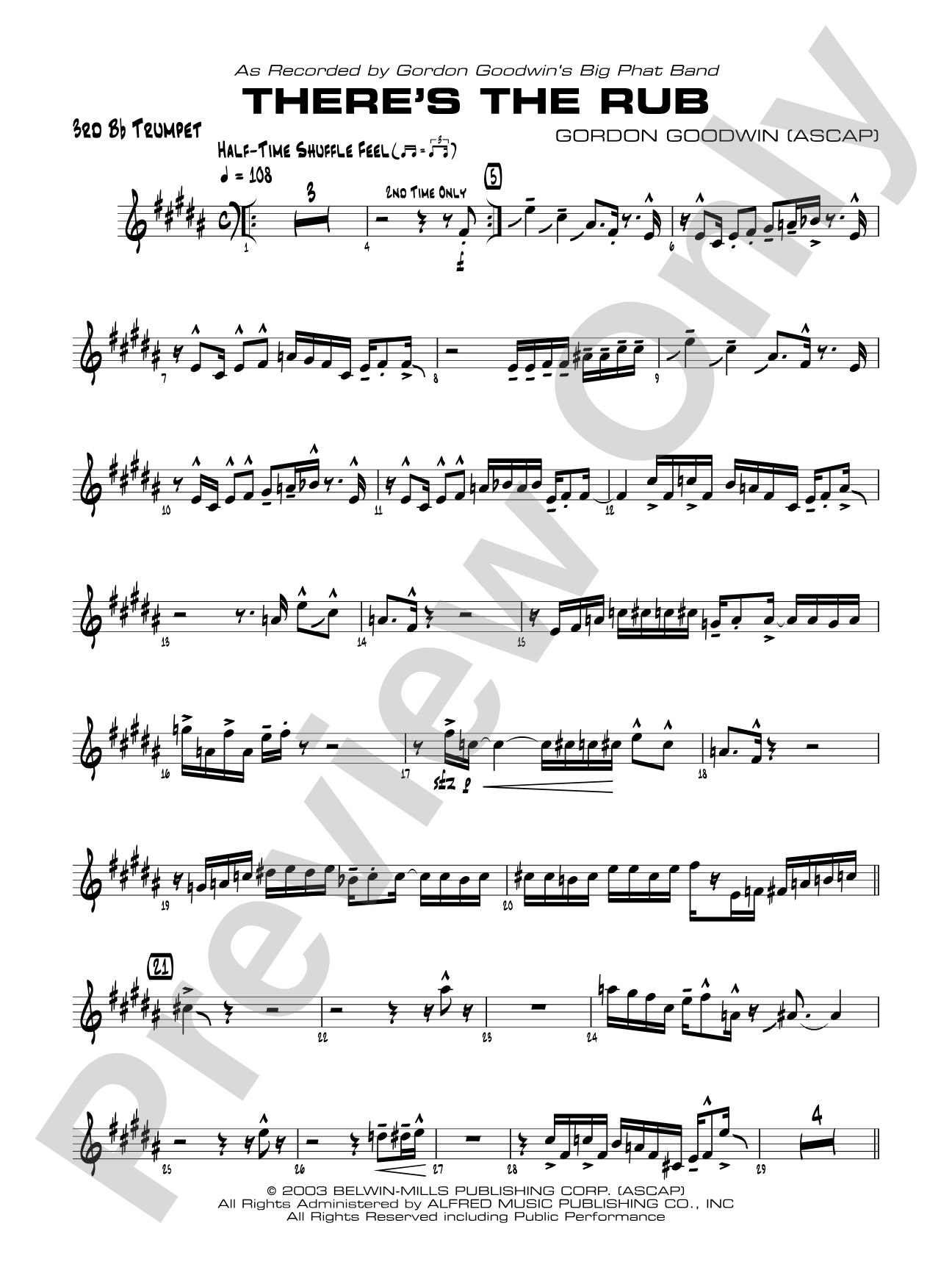
There's the Rub: 3rd B-flat Trumpet

By Gordon Goodwin

Grade: 5.5 (Advanced / Difficult)

Item: 00-PC-0017541_T3

Digital Download
$3.00
Description
Gordon Goodwin's stellar reputation as a writer is well deserved. A funky half-time shuffle groove for big band, Gordon's clever opening melody statement is played by altos and trumpets with solo space provided for piano, alto, or tenor sax. The burnin' shout chorus will make this an all time favorite chart for every library. Percussion part included. As recorded on Gordon Goodwin's Big Phat Band: Swingin' for the Fences. This chart grooves! This title is available in MakeMusic Cloud.

Don't just read it, hear it, play along with it, and watch your students grow with it. In MakeMusic Cloud, There's the Rub: 3rd B-flat Trumpet comes alive with professional accompaniment, adjustable tempo, and built-in practice tools that turn solo practice into real progress.

Sample Audio
0:00
0:00
Sample Video
Additional Details
Series: Gordon Goodwin Series
Publisher: Alfred Music
Page Count: 74
SKU: 00-PC-0017541_T3

More about this title

About the Composer: Gordon Goodwin

Gordon Goodwin

Gordon Goodwin began composing at five years old, writing complete pieces rather than fragments. His first big band chart, Hang Loose, came at age thirteen. This early mastery caught the attention of film and television producers, leading to three Emmy Awards and multiple Grammy nominations for his work on scores including Bad Boys II, Con Air, Remember the Titans, and Star Trek: Nemesis.

Beyond Hollywood, Goodwin has written for and performed alongside artists including Christina Aguilera, Quincy Jones, Ray Charles, and Sarah Vaughn. He has conducted major symphony orchestras across North America and Europe. Since 2000, he has led Gordon Goodwin's Big Phat Band, through which he continues to push the boundaries of contemporary jazz composition and big band arranging.

Why we love this

Goodwin writes with the confidence of someone whose big band work has been heard on major film soundtracks and recorded by world-class ensembles. The half-time shuffle groove and the sharp melodic writing in the opening section give students a chart that sounds polished and modern without sacrificing clarity of parts. The shout chorus delivers the payoff that makes this arrangement stick in listeners' ears long after the concert ends.

What to expect

A funky, propulsive big band sound that balances clever compositional detail with raw ensemble energy. The half-time shuffle gives the piece a relaxed but driving feel, while the shout chorus ignites sudden collective power that can electrify an audience.

Who it's for

Advanced high school and college jazz ensembles with solid musicianship across all sections and soloists capable of improvising within chord changes. Directors programming a concert that needs a contemporary chart with recorded credibility and genuine groove will find this title immediately appealing.

How to get the most out of it

  • Lock the half-time shuffle feel early in rehearsal; have the rhythm section establish the pocket together before layering in the written parts.
  • Balance the alto and trumpet opening melody so both sections are heard equally; this counterpoint is central to the arrangement's identity.
  • Give solo space to piano, alto, or tenor sax real rehearsal time; soloists should outline the changes confidently rather than tentatively filling the space.
  • The shout chorus builds impact through ensemble precision; mark articulation cues in pencil and rehearse section hits as unit blocks before putting the full sound together.

How to use it

Program this as a centerpiece of a jazz ensemble concert, particularly when you want to showcase soloists and the band's ability to lock into a contemporary groove. Its recorded pedigree from Swingin' for the Fences makes it an ideal choice when you want students to hear and learn from a professional reference recording.

Skills your students will build

  • Half-time shuffle feel and pocket awareness
  • Balancing written melody across sections (altos and trumpets in counterpoint)
  • Improvisation within changes for featured soloists
  • Ensemble articulation and shout chorus precision
  • Learning from and emulating recorded professional big band recordings

You May Also Like