There's A Law Sheet Music Preview

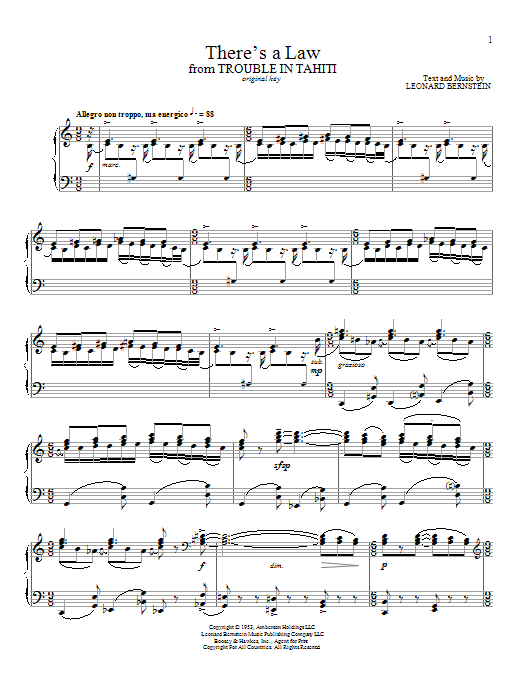
There's A Law: Piano Vocal

As performed by Leonard Bernstein

Item: 35-DS00249198

Digital Download
$5.99

One moment…

One moment…

Description

There's A Law: Piano Vocal isn't in MakeMusic Cloud just yet...but it could be. Let us know you'd like to see it, and you'll help shape what comes next. In the meantime, start a free trial and dive into thousands of interactive titles your students can play along with today.

Sample Audio
No sample audio found.
Sample Video
Additional Details
Publisher: Hal Leonard
Page Count: 13
SKU: 35-DS00249198

More about this title

About the Artist: Leonard Bernstein

Leonard Bernstein (1918–1990) was an American composer, conductor, and educator who fundamentally shaped how the world understood both classical music and musical theater. His gift for melody and orchestration made him equally comfortable writing symphonies, ballets, and Broadway scores; his works bridge the concert hall and the popular stage with remarkable fluency. As a teacher and communicator, Bernstein believed deeply in making music accessible without compromising artistic integrity, a philosophy evident in every score he created.

Why we love this

Bernstein's song writing cuts through with directness and emotional clarity. This piece carries the sophisticated harmonic language you'd expect from a major classical composer, yet it remains singable and dramatically engaging for performers at various levels.

What to expect

The piece has the conversational warmth of a character song, with Bernstein's hallmark blend of sophistication and directness. There's intelligence in the harmonic language, but the emotional core remains accessible and human.

Who it's for

This works for vocalists preparing art song or musical theater material, whether in voice lessons, recital classes, or performance contexts. It's equally suited to singers exploring Bernstein's theatrical output or classical performers seeking 20th century American repertoire with immediate appeal.

How to get the most out of it

  • Shape the vocal line with the natural speech rhythms of the text; Bernstein's setting respects language in a way that makes phrasing feel intuitive rather than imposed.
  • Balance the piano part so it supports rather than overwhelms the voice. The accompaniment is carefully written to frame the melody without competing for attention.
  • Attend to the harmonic shifts in the accompaniment. Bernstein often uses subtle chromatic movement and voice leading in the piano that enhance the emotional arc of the lyric.

How to use it

Pair this with other American song literature in a recital or concert focused on 20th century vocal writing. It also fits naturally into programs exploring musical theater composition or into a Bernstein retrospective alongside orchestral and chamber works.

Skills your students will build

  • Interpreting American song idiom and character work through music
  • Navigating chromatic harmony and voice leading in the piano part
  • Coordinating vocal phrasing with accompaniment textures
  • Understanding Bernstein's approach to setting English text with musical naturalness

You May Also Like