There Must Be a Better World Somewhere: Guitar TAB Digital Sheet Music

There Must Be a Better World Somewhere: Guitar TAB Digital Sheet Music

Doc Pomus, B.B. King, Dr. John, Mac Rebennack

Item: 00-PS-0002299

Digital Download
$2.99
Description

There Must Be a Better World Somewhere: Guitar TAB Digital Sheet Music isn't in MakeMusic Cloud just yet...but it could be. Let us know you'd like to see it, and you'll help shape what comes next. In the meantime, start a free trial and dive into thousands of interactive titles your students can play along with today.

Sample Audio
No sample audio found.
Sample Video
Additional Details
SKU: 00-PS-0002299

More about this title

About the Artist: B.B. King

B.B. King (1925-2015) stands as one of the most influential blues musicians and guitarists in American music history. His expressive playing style, characterized by precise bending and vibrato techniques, became a blueprint for generations of blues and rock guitarists. King's career spanned seven decades, during which he recorded hundreds of songs, earned induction into the Rock and Roll Hall of Fame, and mentored countless musicians who sought to understand the language of the blues.

For music educators, B.B. King's work offers invaluable study material. His recordings demonstrate how technical mastery serves emotional expression rather than virtuosity for its own sake. The deliberate phrasing, dynamics, and note selection in his playing reward close analysis and provide concrete examples of how blues vocabulary translates to other genres.

Why we love this

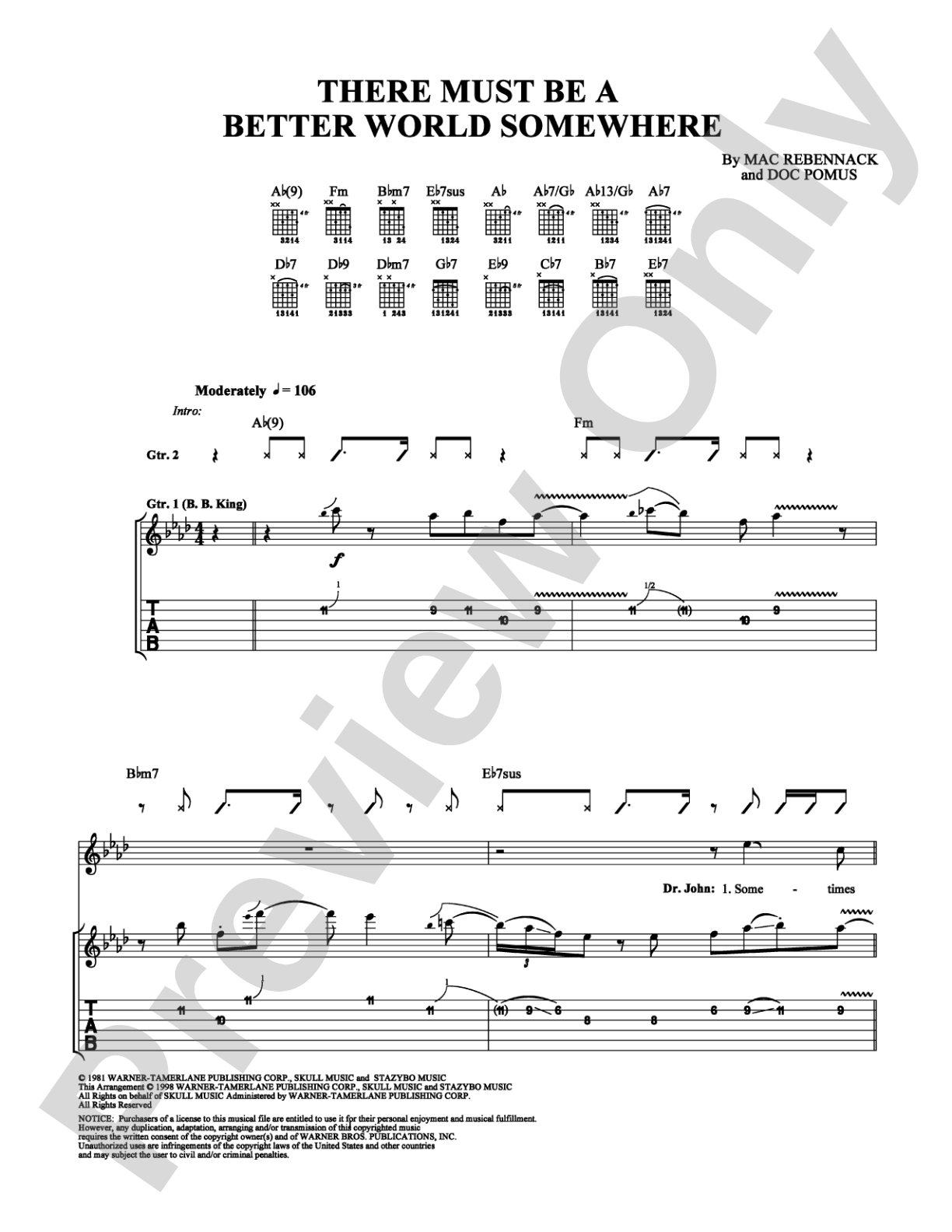
This collaboration between B.B. King and Dr. John captures the intersection of traditional blues guitar and New Orleans funk sensibility. Students gain access to a piece that works equally well as a study of blues phrasing, a model for comping over changes, and a vehicle for understanding how legendary artists approach arrangement and solo construction. The TAB format removes notation barriers and lets guitarists focus on the musical architecture itself.

What to expect

The piece settles into a deep, deliberate groove with room for introspection and call-and-response dialogue between guitar voices. B.B. King's approach feels conversational rather than flashy; the focus stays on the quality and timing of each note rather than speed or quantity. The collaboration with Dr. John brings an earthy funk undertone that anchors the blues tradition in a specific place and time.

Who it's for

Guitar students ready to study intermediate to advanced blues soloing and phrasing will find rich material here. This piece suits musicians who already read TAB fluently and have a working knowledge of blues changes and vocabulary. It works particularly well for guitarists interested in how blues masters construct solos and shape phrases for maximum expressive impact.

How to get the most out of it

  • Pay close attention to the vibrato width and speed in the main riff; B.B. King's signature technique relies on controlled hand movement rather than exaggerated wiggling
  • Study the dynamic contour of the solo section carefully. Notice where King sits behind the beat and where he pushes slightly ahead; this phrasing choice shapes the emotional weight of the performance
  • Lock the rhythm guitar part to the bass and drums before attempting the solo. The solo's effectiveness depends entirely on a steady, groove-oriented foundation underneath
  • Work on bending accuracy by comparing your pitch to the backing track. Blues bends require both precision and a sense of taste about how far to bend for different emotional effects

How to use it

Feature this in a blues history unit or a program dedicated to American roots music and its influence on contemporary styles. It also serves as a masterclass study piece during private lessons or in ensemble settings where students analyze professional recordings alongside notation. Consider pairing it with other King classics or contemporary blues artists to show continuity and evolution within the genre.

Skills your students will build

  • Blues bending technique and vibrato control
  • Reading and interpreting TAB notation accurately
  • Solo phrasing and dynamics within a 12-bar structure
  • Listening for and replicating nuanced timing and feel
  • Understanding chord-tone soloing and approach notes in a blues context

You May Also Like