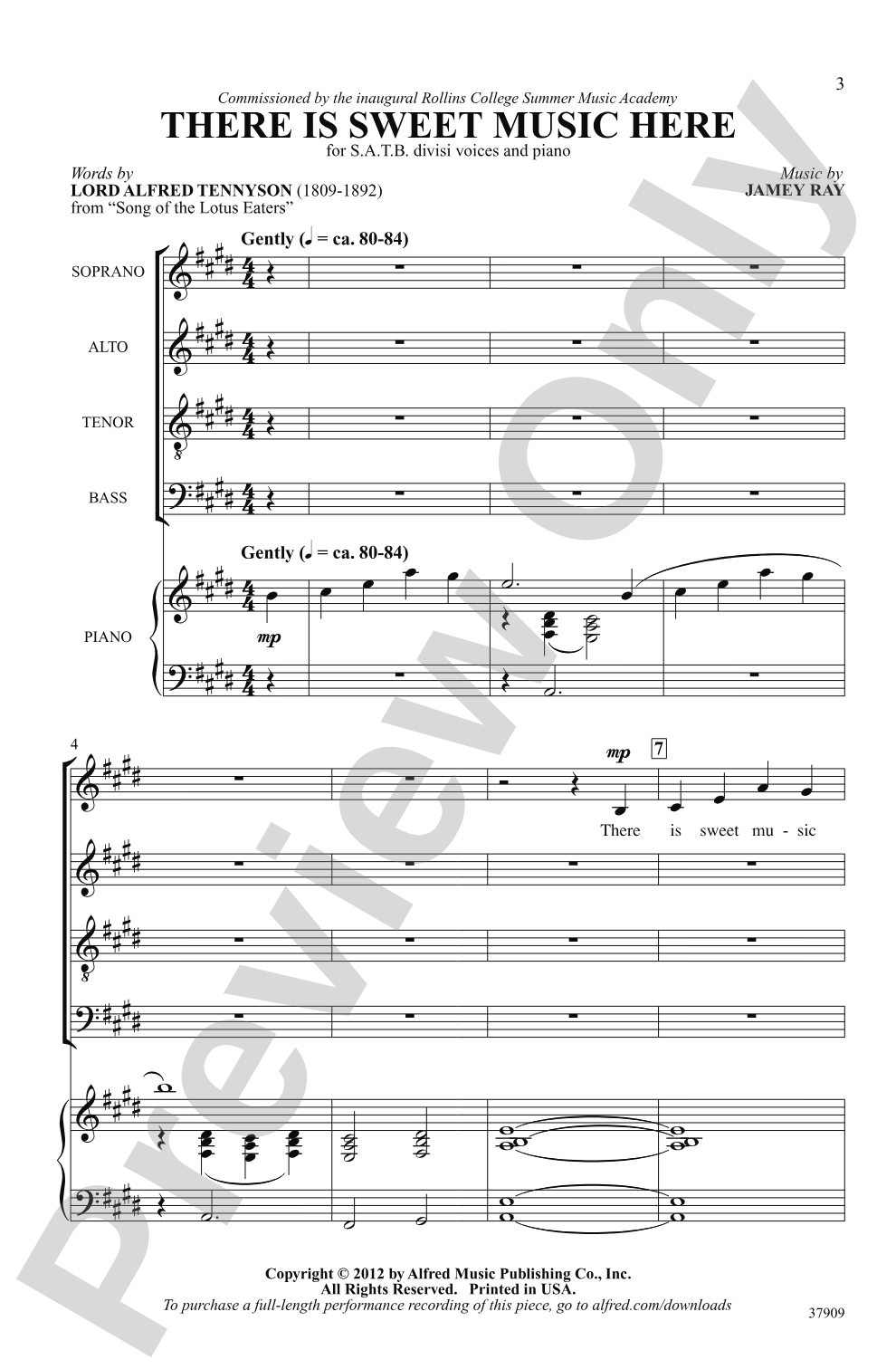
There Is Sweet Music Here Sheet Music Preview

There Is Sweet Music Here: SATB divisi Choral Octavo

Word by Alfred Lord Tennyson, music by Jamey Ray

Item: 00-PO-0001264

Digital Download
$1.80

Minimum order quantity: 20 copies

Description
This magnificent and musical setting of the famous Tennyson text flows, rises, and falls so wonderfully with the text. Expressive and dramatic.

There Is Sweet Music Here: SATB divisi Choral Octavo isn't in MakeMusic Cloud just yet...but it could be. Let us know you'd like to see it, and you'll help shape what comes next. In the meantime, start a free trial and dive into thousands of interactive titles your students can play along with today.


Sample Audio
0:00
0:00
Sample Video
Additional Details
Series: Lawson-Gould
Publisher: Alfred Music
Page Count: 12
SKU: 00-PO-0001264

More about this title

About the Composer: Jamey Ray

Jamey Ray

Jamey Ray holds degrees from Rollins College in Vocal and Piano Performance and Computer Science, and earned a Master of Music in Music Technology from New York University. His career spans singing, conducting, arranging, and session work with accomplished Florida ensembles including The Bach Festival Choir of Winter Park and The Liberty Voices, while also serving as an adjudicator.

Based in Clearwater, Florida, Ray continues to develop an innovative web-based music theory teaching platform alongside his work as a composer and pianist. His background in both performance and technology informs his approach to choral writing.

Why we love this

Ray's setting captures the luxurious, philosophical mood of Tennyson's poetry without sentimentality. The divisi writing allows you to sculpt dynamic layers and textural shifts that mirror the text's emotional arc, making this piece rewarding to shape across rehearsals. The expressive and dramatic qualities give singers real dramatic work to do beyond note-reading.

What to expect

The piece unfolds like a reverie, with musical moments that swell and recede in response to Tennyson's meditation on beauty and escape. There is weight and contemplation to the harmonic language, balanced by passages of lyrical grace that feel almost ethereal.

Who it's for

This octavo suits choirs with secure blend and musicianship who thrive on text-driven interpretation. Singers comfortable with divisi voicing will find expressive depth here. Directors seeking substantial secular literature that showcases choral maturity will find a thoughtful vehicle.

How to get the most out of it

  • Shape the harmonic movement through subtle dynamic tapering rather than sudden changes; let the text's phrasing guide where the music naturally breathes.
  • Use the divisi passages to highlight the interaction between independent vocal lines. Balance transparency between sections so no single part disappears into the ensemble.
  • Explore the dramatic moments by asking singers to consider what Tennyson's speaker is asking emotionally at each turning point, then let that intention deepen their vocal engagement.

How to use it

Pair this with other Romantic or post-Romantic secular texts for a concert celebrating nineteenth-century poetry set to music. Its dramatic pacing also works well alongside shorter, lighter pieces, where it can serve as a substantial centerpiece. Consider programming it late in a concert when audiences are settled and ready for introspective listening.

Skills your students will build

  • Balancing independent divisi lines while maintaining ensemble cohesion
  • Interpreting dramatic and expressive shaping in response to text
  • Managing harmonic language and voice-leading across complex choral textures
  • Sustaining musical line through sectional form changes

You May Also Like