There Is No Rose Sheet Music Preview

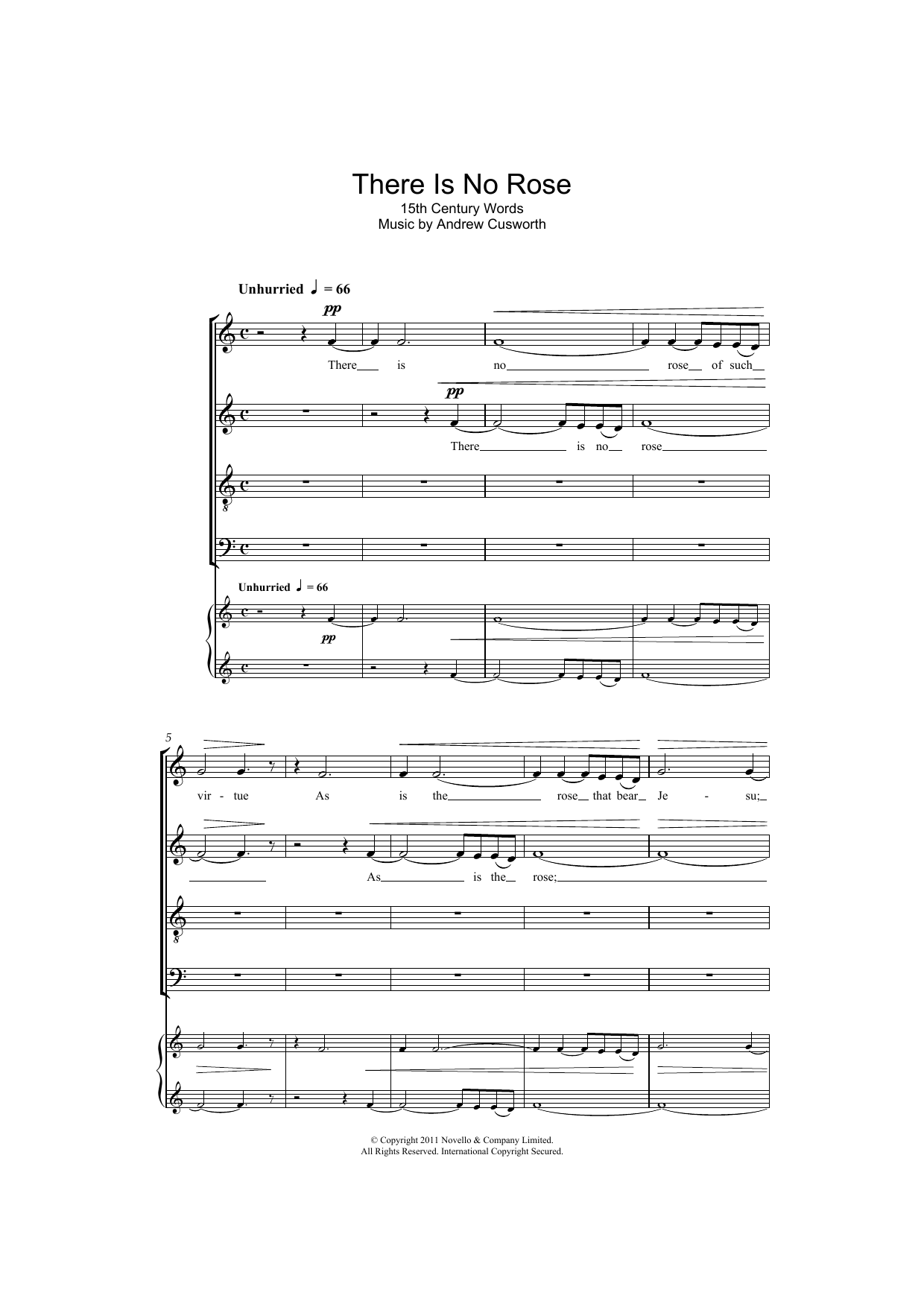
There Is No Rose: SATB Choral Octavo

As performed by Andrew Cusworth

Item: 35-DS00365661

Digital Download
$2.99
Description

There Is No Rose: SATB Choral Octavo isn't in MakeMusic Cloud just yet...but it could be. Let us know you'd like to see it, and you'll help shape what comes next. In the meantime, start a free trial and dive into thousands of interactive titles your students can play along with today.

Sample Audio
No sample audio found.
Sample Video
Additional Details
Publisher: Hal Leonard
Page Count: 7
SKU: 35-DS00365661

More about this title

Why we love this

Cusworth's setting respects the medieval text while bringing it into a contemporary harmonic language that keeps singers engaged without overwhelming them. The piece sits in that productive middle ground where SATB choirs can sound genuinely polished within a reasonable rehearsal timeline, and the writing suggests genuine affection for what these four voices can accomplish together.

What to expect

There is a quiet reverence woven through this setting, anchored in the medieval poem but expressed through modern harmonic thinking. The piece invites listeners into contemplation rather than display, creating moments of genuine stillness even as the four voices maintain their distinct identities.

Who it's for

SATB choirs with solid fundamentals and enough rehearsal time to achieve good voice independence. The piece works well for high school advanced choirs, college community choirs, and semi-professional ensembles looking for repertoire that sounds substantial without requiring advanced techniques.

How to get the most out of it

  • Balance the texture by letting each voice line breathe independently, particularly in passages where the voices move at different rhythmic rates. Avoid blending everything into homophony.
  • Shape the phrase arcs with attention to text stress and natural speech patterns, even within a sacred context. This prevents the setting from sounding too static.
  • Pay particular attention to blend in unison or octave sections. Intonation and vowel consistency matter more than volume here.

How to use it

This works beautifully in a mixed program where you want a moment of reflection or a bridge between more energetic works. Consider pairing it with other sacred or secular medieval texts for a thematic concert segment, or use it as the opening piece in a program designed around seasonal or liturgical themes.

Skills your students will build

  • Voice independence within four-part harmony
  • Balancing texture across SATB ranges
  • Sustaining sustained melodic lines with appropriate phrasing
  • Blending vowels across parts in unison passages
  • Text expression in modern harmonic contexts

You May Also Like