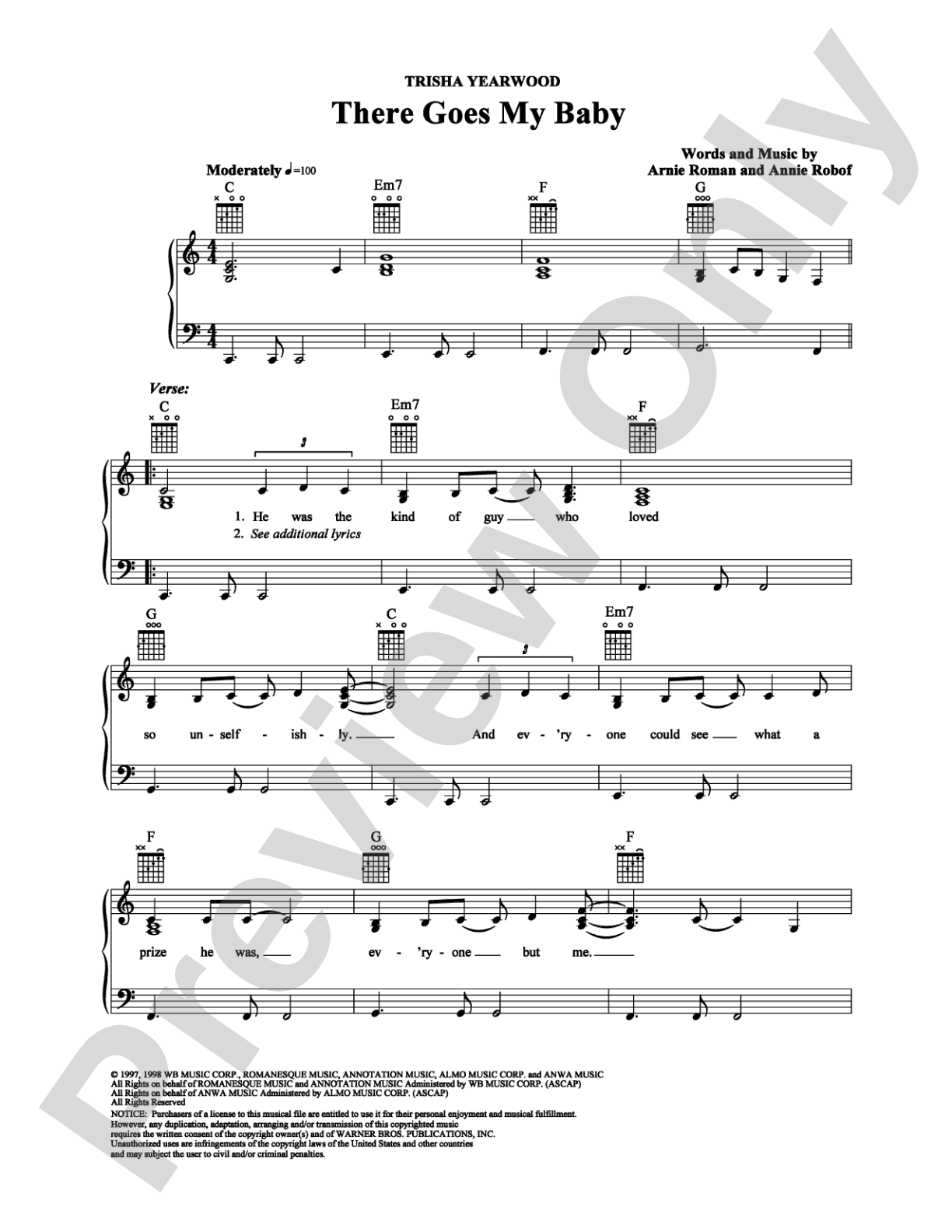
There Goes My Baby: Piano/Vocal/Chords Digital Sheet Music

There Goes My Baby: Piano/Vocal/Chords Digital Sheet Music

Trisha Yearwood, Annie Roboff, Arnie Roman

Item: 00-PS-0007986

Digital Download
$3.99
Description

There Goes My Baby: Piano/Vocal/Chords Digital Sheet Music isn't in MakeMusic Cloud just yet...but it could be. Let us know you'd like to see it, and you'll help shape what comes next. In the meantime, start a free trial and dive into thousands of interactive titles your students can play along with today.

Sample Audio
No sample audio found.
Sample Video
Additional Details
SKU: 00-PS-0007986

More about this title

About the Artist: Trisha Yearwood

Trisha Yearwood has been a defining voice in country music since the late 1980s, known for her ability to deliver emotionally direct performances across ballads, uptempo narratives, and standards. Her interpretive style draws on deep country roots while maintaining broad crossover appeal, making her recordings accessible teaching material for students exploring contemporary country vocal approaches.

Why we love this

Yearwood's vocal phrasing and emotional clarity make this arrangement ideal for students learning how to shape a country ballad without oversinging. The piano/vocal/chords format gives you flexibility to accompany students at various ability levels or to transpose for different voice types, while the song's structure rewards thoughtful interpretation of dynamics and breath placement.

What to expect

The song carries a tender, intimate quality that sits somewhere between regret and reflection. It's the kind of tune that requires restraint rather than big gestures, rewarding a singer who can find power in vulnerability and a pianist who understands when to step back.

Who it's for

Solo singers and pianist collaborators learning to accompany country vocal repertoire, as well as pianists seeking contemporary material that develops stylistic awareness beyond classical contexts. Voice students exploring country interpretation will find the straightforward melody and emotional narrative accessible for building vocal flexibility and control.

How to get the most out of it

  • Listen to Yearwood's original recording to absorb the rhythmic subtlety and rubato she uses; her phrasing often sits slightly behind the beat in ways that won't be obvious from the chart alone.
  • Experiment with the chord voicings rather than playing them literally; country piano often benefits from sparse, well-spaced voicings that give the vocal room to breathe.
  • Pay attention to where the vocal line sits against the piano part; mark phrases where you'll need to pull back or add space for the singer's emotional moments.
  • Use the chord symbols to explore comping variations that fit the style; country ballads typically favor a lighter touch than jazz, with space between harmonic statements.

How to use it

Include this in a solo recital exploring contemporary country standards, or program it as a contrast within a mixed-genre student showcase. It works particularly well in settings where you're introducing instrumental music students to the work of accompanying singers, since the melodic clarity makes it easier to hear how accompaniment supports rather than overwhelms.

Skills your students will build

  • Accompanying a vocal line with appropriate dynamic support and space
  • Applying country stylistic elements (rubato, sparse voicings, rhythmic feels) to chord symbols
  • Reading and interpreting chord charts in a popular music context
  • Shaping phrase endings and breath placement in coordination with a vocalist
  • Transposing or adjusting voicings to accommodate different voice ranges and abilities

You May Also Like