
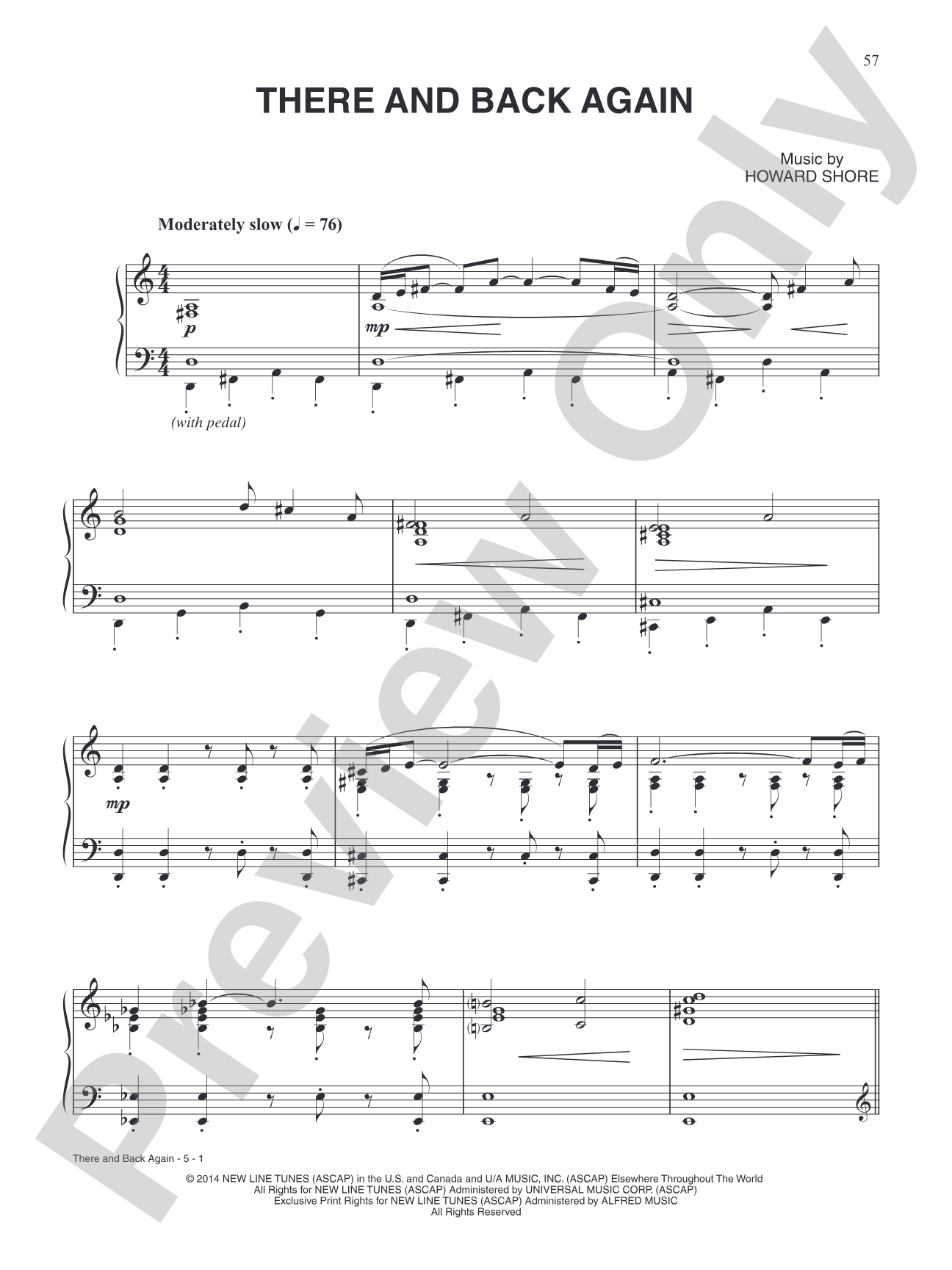

There and Back Again (from The Hobbit: The Battle of Five Armies): Piano
Sheet Music Selections from the Original Motion Picture Soundtrack
Music composed by Howard Shore
Item: 00-PS-0015978
$4.99
One moment…
Related Items
Shores of the Long Lake (from The Hobbit: The Battle of Five Armies): Piano/Vocal |
$4.99
|
View | |
Beyond Sorrow and Grief (from The Hobbit: The Battle of Five Armies): Piano/Vocal |
$4.99
|
View | |
The Gathering of the Clouds (from The Hobbit: The Battle of Five Armies): Piano |
$4.99
|
View | |
The Ruins of Dale (from The Hobbit: The Battle of Five Armies): Piano |
$4.99
|
View | |
Mithril (from The Hobbit: The Battle of Five Armies): Piano/Vocal |
$4.99
|
View | |
The Darkest Hour (from The Hobbit: The Battle of Five Armies): Piano/Vocal |
$4.99
|
View | |
Sons of Durin (from The Hobbit: The Battle of Five Armies): Piano/Vocal |
$5.99
|
View | |
The Fallen (from The Hobbit: The Battle of Five Armies): Piano/Vocal |
$5.99
|
View | |
To the Death (from The Hobbit: The Battle of Five Armies): Piano/Vocal |
$5.99
|
View | |
Courage and Wisdom (from The Hobbit: The Battle of Five Armies): Piano/Vocal |
$4.99
|
View | |
The Return Journey (from The Hobbit: The Battle of Five Armies): Piano |
$4.99
|
View | |
The Last Goodbye (from The Hobbit: The Battle of Five Armies): Piano/Vocal/Chords |
$4.99
|
View | |
Ironfoot (from The Hobbit: The Battle of Five Armies): Piano/Vocal |
$5.99
|
View | |
The Hobbit: The Battle of the Five Armies: Piano/Vocal Book |
$19.99
|
View |
Description
Fans, pianists, and composers will love this faithfully transcribed collection featuring awesome piano/vocal renditions of 14 selections from Howard Shore's brilliant score to The Hobbit: The Battle of the Five Armies. In addition to the piano arrangements, this beautifully produced souvenir folio features an array of colorful photos from the film. Titles: Shores of the Long Lake * Beyond Sorrow and Grief * The Gathering of the Clouds * The Ruins of Dale * Mithril * The Darkest Hour * Sons of Durin * The Fallen * To the Death * Courage and Wisdom * The Return Journey * There and Back Again * The Last Goodbye * Ironfoot.


There and Back Again (from The Hobbit: The Battle of Five Armies): Piano isn't in MakeMusic Cloud just yet...but it could be. Let us know you'd like to see it, and you'll help shape what comes next. In the meantime, start a free trial and dive into thousands of interactive titles your students can play along with today.
Request This Title
Tell us you want it.
Start Your Free Trial
Explore everything that's ready to play right now.
Sample Audio
No sample audio found.
Sample Video
No sample videos found.
Additional Details
Publisher:
Alfred Music
Page Count:
76
SKU:
00-PS-0015978
More about this title
About the Composer: Howard Shore
Howard Shore has composed and conducted film scores for over four decades, earning three Academy Awards for his work on The Lord of the Rings trilogy. His approach to film music emphasizes thematic development and orchestral storytelling, creating leitmotifs that deepen character and narrative. Shore's compositions for The Hobbit trilogy extend this philosophy into a new Middle-earth story, building on the musical language he established while crafting distinct material that reflects the different tone and scope of these films.
Why we love this
Shore's piano/vocal arrangements maintain the grandeur and emotional weight of his orchestral writing while remaining idiomatic to the piano. These pieces offer pianists a chance to explore film scoring's structural elegance and thematic sophistication without requiring an orchestra, making sophisticated cinematic music accessible for solo performance and study.
What to expect
These arrangements capture the sweeping scope and emotional depth of Middle-earth's final chapter in The Hobbit trilogy, moving between moments of quiet introspection and dramatic declaration. The music evokes both loss and triumph, with Shore's characteristic use of modal harmony and rhythmic subtlety creating an atmosphere that feels both intimate at the keyboard and epic in resonance.
Who it's for
Pianists interested in film music and compositional technique will find substantial material for recital or study in this collection. Singers preparing art song recitals or themed programs centered on cinema will appreciate having professional-quality accompaniments that reflect Shore's distinctive harmonic voice.
How to get the most out of it
- Listen closely to the original film score to internalize Shore's harmonic language and understand how each theme functions within the larger narrative; this context shapes phrasing and pedal choices.
- Pay attention to the balance between melody and accompaniment, especially in arrangements that layer thematic material; the piano must support vocal passages without overwhelming them.
- Approach tempo and rubato conservatively at first, then gradually shape phrases once you have the harmonic progression secure; Shore's themes benefit from subtle breathing rather than dramatic reinterpretation.
- Use the dynamic markings deliberately to underscore the emotional arc within each piece; these arrangements rely on nuanced control rather than extremes.
How to use it
This collection works beautifully as a thematic recital or as a series of selections within a larger program exploring music from literature and film. Individual pieces can anchor a concert around a particular emotion or narrative moment, or a pianist might perform several consecutive selections as a suite that traces the dramatic arc of the film.
Skills your students will build
- Translating orchestral textures and harmonic colors into idiomatic piano writing
- Sustaining long-line melody while managing complex accompanimental figures
- Interpreting film music's thematic structure and leitmotif development
- Coordinating piano accompaniment with vocal line in diverse vocal ranges and styles