
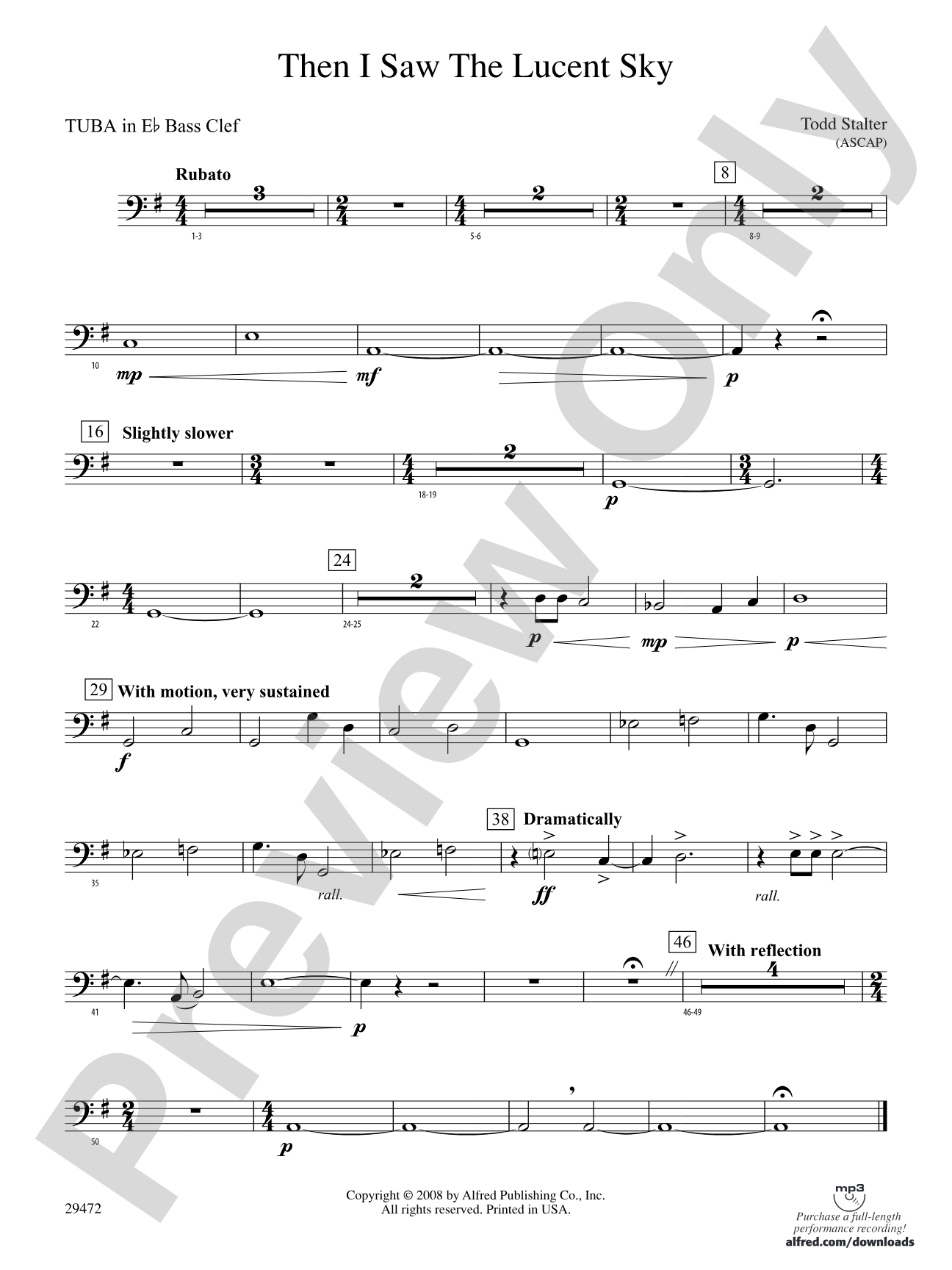

Then I Saw the Lucent Sky: (wp) E-flat Tuba B.C.
By Todd Stalter
Grade: 2 (Medium Easy)
Item: 00-PC-0001428_wpTBEBC
$3.00
Pickup currently not available
Description
This work was inspired by the music of Hildegaard von Bingen, a medieval Benedictine nun whose chant melodies are remarkable for their soaring passages and simple beauty, and whose theological and visionary writings were unique for her time. The title comes from one of her writings: Then I saw the lucent sky, in which I heard different kinds of music, marvelously embodying all the meaning I had heard before. (3:15)


Don't just read it, hear it, play along with it, and watch your students grow with it. In MakeMusic Cloud, Then I Saw the Lucent Sky: (wp) E-flat Tuba B.C. comes alive with professional accompaniment, adjustable tempo, and built-in practice tools that turn solo practice into real progress.
Open in the Player
Jump straight in and assign it today.
Start Your Free Trial
Open this title and explore the full library in minutes.
Sample Audio
1
Audio File
--:--
0:00
0:00
Sample Video
No sample videos found.
Additional Details
Series:
Young Symphonic
Publisher:
Alfred Music
Page Count:
134
SKU:
00-PC-0001428_wpTBEBC
More about this title
About the Composer: Todd Stalter

Todd Stalter built his reputation over 34 years as Director of Bands at Eureka High School in Illinois, where his ensembles earned 16 Class 1A State Marching Band Championships and consistent Superior ratings at IHSA contests. His bands performed at Orchestra Hall in Chicago and Walt Disney World, and he was inducted into the Illinois State Marching Band Championships Hall of Fame.
Beyond the high school podium, Stalter has conducted All-State Bands in Georgia and Delaware, adjudicated at Solo & Ensemble and Large Group festivals across multiple states, and led clinics on music education and composition at regional and state conferences. His compositions for band and string orchestra have earned widespread adoption on state contest lists and recognition in the GIA publication "Teaching Music Through Performance in Band." He holds degrees from Illinois State University in music education and trumpet performance.
Why we love this
Stalter captures the essence of Hildegard von Bingen's medieval chant without resorting to mere imitation, creating something that feels both timeless and immediately accessible to young players. The work moves naturally between soaring melodic passages and moments of contemplative simplicity, giving conductors a piece that rewards musical phrasing while remaining playable at Grade 2. Its modest length (3:15) and concert/festival designation make it an ideal vehicle for building ensemble maturity without overwhelming a developing band.
What to expect
Serene and luminous, with the quality of light streaming through stained glass. The music unfolds in long, breathing lines reminiscent of Gregorian chant, alternating between moments of transcendent simplicity and richer harmonic textures that deepen without overwhelming the listener.
Who it's for
Concert bands in grades 2 through 4 looking for repertoire that combines accessibility with genuine musical substance. Directors seeking a piece that can program successfully at festivals and contests while also serving as a teaching tool for phrasing and ensemble balance.
How to get the most out of it
- Shape the soaring passages with long-line phrasing that honors the chant-inspired melodic writing; resist the urge to over-articulate, letting the melody float across the band.
- Balance inner voices carefully during the quieter, contemplative sections to preserve the work's meditative quality and allow the thematic material to emerge clearly.
- Use the score's dynamic and textural contrasts as your guide for ensemble blend; transitions between solo sections and fuller scoring should feel organic rather than abrupt.
- Give your low reeds and brass time to anchor the harmonic foundation, especially where the writing is sparse; their steady support allows the soloistic elements above to sing freely.
How to use it
Position this as a centerpiece for a concert devoted to sacred or contemplative music, or pair it with other Grade 2 works that share similar aesthetic qualities. Its moderate duration and suitable difficulty level make it a strong contest or festival entry that demonstrates a band's ability to sustain musical line and handle transparent scoring.
Skills your students will build
- Sustaining long melodic lines with musical phrasing rather than mechanistic articulation
- Balancing inner voices and harmonic texture in sparse orchestrations
- Responding to dynamic and textural contrast as guides for ensemble blend
- Intonation and blend in both full ensemble and sectional writing