
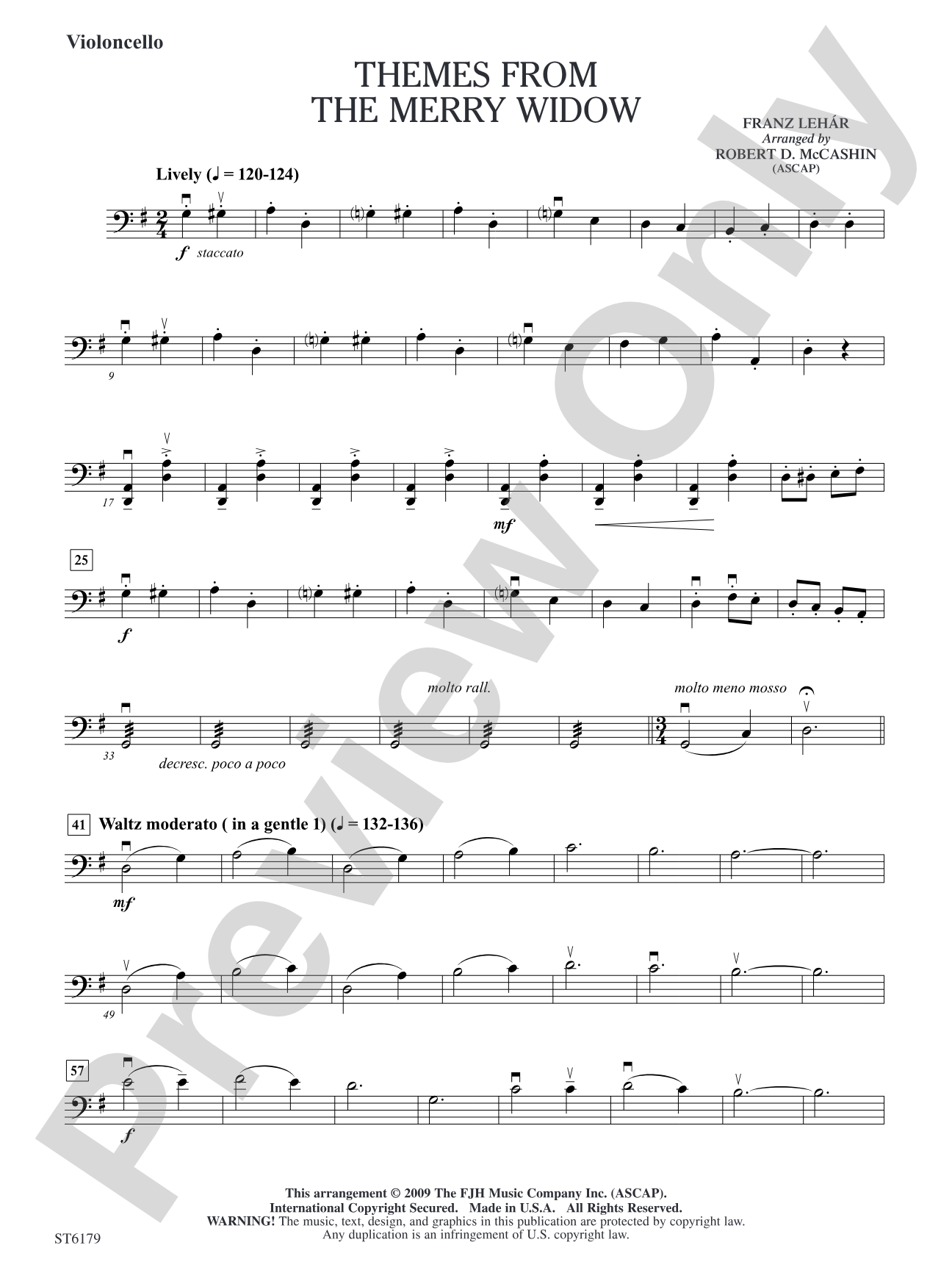

Themes from The Merry Widow: Violoncello
By Franz Lehar / arr. Robert D. McCashin
Grade: 4
Item: 98-PC-DST6179_VC1
$7.00
Pickup currently not available
Description
Based on Lehár's famous opera that received nearly 5,000 performances worldwide in its first year alone, this delightful arrangement includes the most notable themes. Portraying both the comical and heartwarming angles of the opera, McCashin has gone to great lengths to preserve the integrity of the original. A wonderful addition to your next program.


Themes from The Merry Widow: Violoncello isn't in MakeMusic Cloud just yet...but it could be. Let us know you'd like to see it, and you'll help shape what comes next. In the meantime, start a free trial and dive into thousands of interactive titles your students can play along with today.
Request This Title
Tell us you want it.
Start Your Free Trial
Explore everything that's ready to play right now.
Sample Audio
1
Audio File
--:--
0:00
0:00
Sample Video
No sample videos found.
Additional Details
Series:
FJH String Orchestra
Publisher:
The FJH Music Company, Inc.
SKU:
98-PC-DST6179_VC1
More about this title
About the Composer: Franz Lehar
Franz Lehár (1870-1948) was a Hungarian composer whose operettas defined the Silver Age of Viennese musical theater. His gift for melody and sophisticated orchestration made him a rival to the operetta traditions of earlier decades, and his works remain central to the operetta repertoire worldwide. The Merry Widow, premiered in 1905, became his masterpiece and one of the most performed operettas of all time, establishing Lehár's reputation across Europe and beyond.
Lehár's music bridges classical and popular idioms with ease. His themes are immediately memorable yet harmonically rich, and his orchestrations reveal a deep understanding of instrumental color. For string players and conductors, his work offers the opportunity to explore operatic storytelling through orchestral writing that is both accessible and musically substantial.
Why we love this
McCashin's arrangement captures what makes The Merry Widow so enduringly popular: infectious melodies paired with genuine warmth and humor. A Grade 4 string orchestra piece that sounds sophisticated without overwhelming younger ensembles, it gives conductors a crowd-pleasing program selection that students genuinely enjoy performing. The arrangement respects Lehár's original intent while sitting perfectly in the middle of the string orchestra repertoire.
What to expect
The Merry Widow sparkles with Viennese charm and elegant wit. McCashin's arrangement preserves both the comedic lightness and the genuine tenderness of Lehár's original, allowing string players to experience the full emotional range of operatic storytelling. From playful character dances to lush romantic passages, the music captures the essence of a world-famous love story told through irresistible melody.
Who it's for
String orchestras at the intermediate level who want to explore operatic literature and build ensemble musicianship through charming, singable material. Conductors seeking repertoire that appeals to both audience and students alike will find this arrangement ideal for concert or festival programming. The Grade 4 difficulty ensures accessibility while maintaining musical integrity.
How to get the most out of it
- Balance the lyrical passages by allowing the melody line to sing above the harmonic foundation; resist the urge to let accompaniment figures overwhelm the main theme.
- Shape each theme with subtle dynamic shaping and rubato to highlight the operatic character. Lehár's melodies benefit from breathing room and expressive phrasing rather than metronomic precision.
- Pay attention to articulation contrast between staccato accompaniment figures and sustained melodic lines; this distinction gives the arrangement lift and character.
- Use section tuning strategically during the lyrical themes to ensure the romantic passages feel lush without becoming muddy.
How to use it
Program this as a concert centerpiece or festival selection that complements both classical and contemporary work. The thematic material and moderate difficulty make it suitable for educational concerts where you want to introduce students and audiences to operetta without sacrificing musical substance. Consider pairing it with other Romantic-era orchestral arrangements to build a coherent concert theme.
Skills your students will build
- Playing with operatic phrasing and long-line singing style
- Balancing melody and accompaniment textures in ensemble context
- Responding to conductor's expressive gestures and dynamic shaping
- Sustaining tone quality across multiple theme statements
- Reading and executing articulation contrasts (legato vs. staccato)