
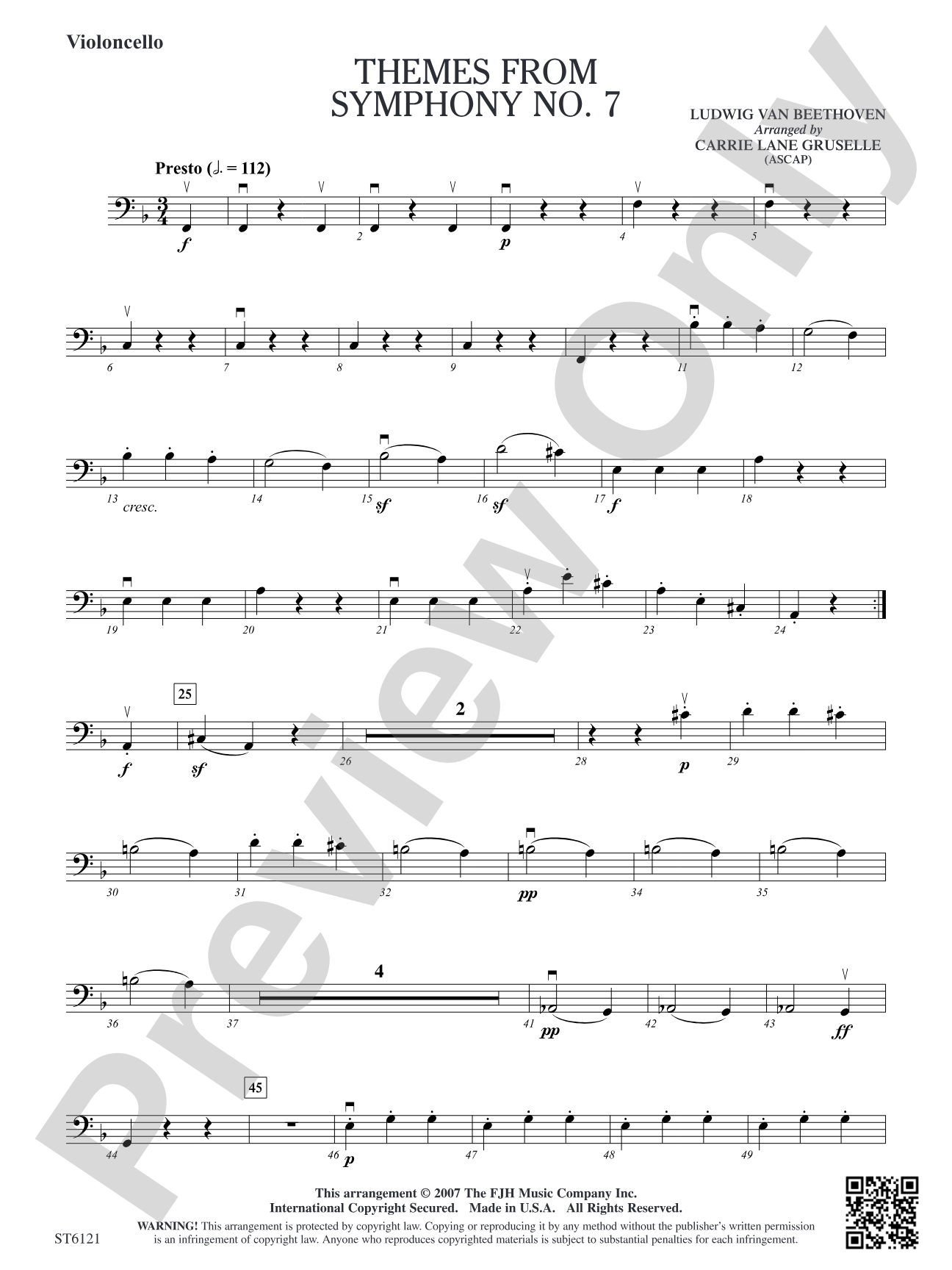

Themes from Symphony No. 7: Violoncello
By Ludwig van Beethoven / arr. Carrie Lane Gruselle
Grade: 4
Item: 98-PC-DST6121_VC1
$7.00
Pickup currently not available
Description
Since its initial performance in 1813, Beethoven's Symphony No. 7 has retained a prominent place among his great works. This masterful arrangement highlights material from the first three movements, including the famous Allegretto movement in A minor. Essential repertoire for young musicians!


Themes from Symphony No. 7: Violoncello isn't in MakeMusic Cloud just yet...but it could be. Let us know you'd like to see it, and you'll help shape what comes next. In the meantime, start a free trial and dive into thousands of interactive titles your students can play along with today.
Request This Title
Tell us you want it.
Start Your Free Trial
Explore everything that's ready to play right now.
Sample Audio
1
Audio File
--:--
0:00
0:00
Sample Video
No sample videos found.
Additional Details
Series:
FJH String Orchestra
Publisher:
The FJH Music Company, Inc.
SKU:
98-PC-DST6121_VC1
More about this title
About the Composer: Ludwig van Beethoven
Ludwig van Beethoven (1770–1827) fundamentally transformed the symphony from a courtly entertainment into a vehicle for profound emotional and philosophical expression. His nine symphonies span nearly four decades and chart the evolution of Western classical music, moving from Classical clarity toward Romantic intensity and scope. Beethoven's influence on music education remains immense; his works appear in curricula worldwide because they reward deep study at every level, from student arrangements to professional performances.
Why we love this
Carrie Lane Gruselle's arrangement captures the symphonic weight and drama of Beethoven's original while remaining genuinely playable for developing string musicians. The inclusion of the Allegretto—one of music history's most recognizable melodies—gives young players immediate access to repertoire they'll encounter throughout their musical lives. This is the kind of arrangement that doesn't dilute the composer's vision but instead opens the door to it.
What to expect
The Allegretto unfolds with a haunting, introspective quality that contrasts sharply with the vigor of the outer movements. There's an immediacy to Beethoven's material that makes these themes feel urgent and vital rather than historical, even in adaptation. The arrangement preserves the sense of a large musical architecture unfolding, giving young players the experience of being part of something substantial and coherent.
Who it's for
This arrangement works for string orchestras at the Grade 4 level seeking repertoire that balances technical accessibility with genuine musical substance. Young musicians benefit from encountering Beethoven's structural thinking and melodic invention in an arrangement scaled to their current abilities. Directors preparing students for solo and ensemble contests or festivals will find this piece both musically rewarding and appropriately leveled.
How to get the most out of it
- Shape the famous Allegretto melody with the same care a vocalist would apply to singing; resist the urge to separate the sixteenth-note patterns and instead connect them as a single, lyrical phrase.
- Balance tutti sections between first and second violins early in rehearsal so the arrangement's counterpoint emerges clearly rather than creating a muddy mass of sound.
- Use the conductor score to identify which instruments carry the primary melodic material in each section; this clarity helps distribute rehearsal focus efficiently across your string sections.
- Attend to the dynamic contrasts marked in the score, particularly the shifts between the energetic outer movements and the contemplative Allegretto, as these shape the overall emotional arc.
How to use it
Program this as a centerpiece for a concert devoted to Beethoven or masterwork arrangements, pairing it with contemporary pieces to show how later composers built upon his innovations. It also serves exceptionally well in festival or competition settings where judges expect to hear ambitious repertoire performed with care. Consider using it midway through the concert year, once your section coordination has solidified and your musicians can handle the interpretive demands.
Skills your students will build
- Sustaining legato phrasing across longer melodic lines
- Balancing independent voice parts in a contrapuntal texture
- Reading and executing dynamic markings that shape larger structural sections
- Responding to a conductor's interpretive choices in a major classical work
- Understanding symphonic form and the relationship between movements