
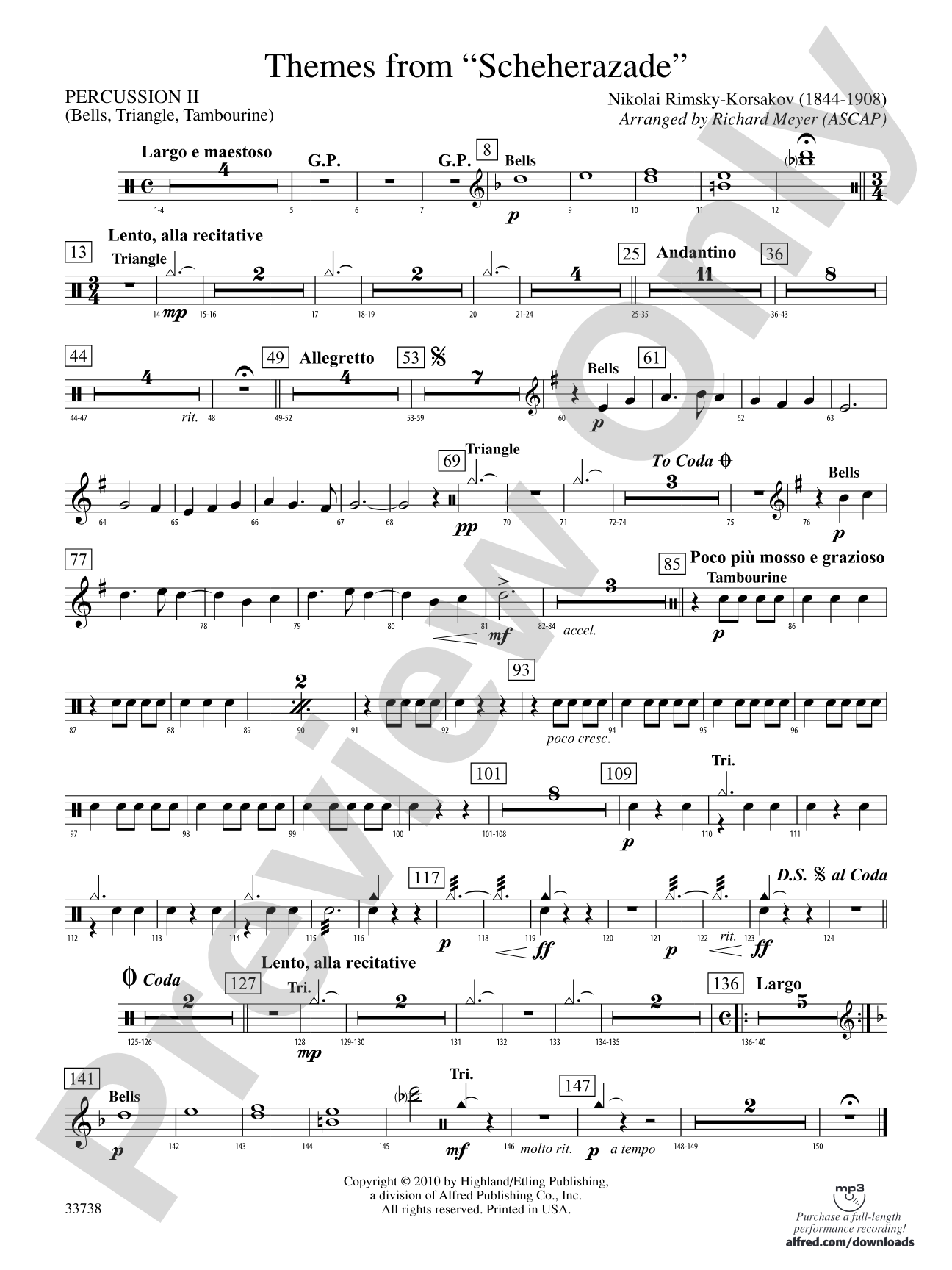

Themes from Scheherazade: 2nd Percussion
By Nikolai Rimsky-Korsakov / arr. Richard Meyer
Grade: 2
Item: 00-PC-0014522_PC2
$3.00
Pickup currently not available
Description
Rimsky-Korsakov's famous symphonic suite "Scheherazade" has been a staple of the symphonic literature since it was first written in 1888. Now your younger students can enjoy this Russian master's colorful orchestrations and imaginative themes in this "true-to-the-original" arrangement. Included are the Sultan's theme, Scheherazade's theme (for solo violin), "The Story of the Kalendar Prince" theme, and "The Young Prince and the Young Princess" themes. With plenty for every section to do, this arrangement is perfect for any concert or as a festival/contest selection.


Don't just read it, hear it, play along with it, and watch your students grow with it. In MakeMusic Cloud, Themes from Scheherazade: 2nd Percussion comes alive with professional accompaniment, adjustable tempo, and built-in practice tools that turn solo practice into real progress.
Open in the Player
Jump straight in and assign it today.
Start Your Free Trial
Open this title and explore the full library in minutes.
Sample Audio
1
Audio File
--:--
0:00
0:00
Sample Video
Additional Details
Series:
Highland/Etling First Philharmonic
Publisher:
Alfred Music
Page Count:
202
SKU:
00-PC-0014522_PC2
More about this title
About the Composer: Nikolai Rimsky-Korsakov
Nikolai Rimsky-Korsakov (1844–1908) was a Russian composer and orchestrator whose mastery of instrumental color shaped the sound of late-Romantic music. Though trained as a naval officer, he committed himself fully to composition and teaching, eventually leading the St. Petersburg Conservatory and mentoring the next generation of Russian composers. His gift for melody and his fearless approach to orchestration made him one of the most influential voices in Russian classical music.
Rimsky-Korsakov's legacy rests largely on his symphonic works and operas, which blend Russian folk idioms with sophisticated harmonic language. His orchestrations remain models of clarity and imagination, demonstrating how to give every section of the orchestra meaningful material. For young musicians, his works are windows into the possibilities of orchestral color and storytelling through instrumental sound.
Why we love this
Richard Meyer's arrangement preserves the narrative sweep and orchestral magic of the original while keeping the technical demands within reach of a developing ensemble. Grade 2 students get to inhabit the world of a genuine masterwork, with each section carrying recognizable themes from the suite rather than padding parts. The result is an arrangement that respects both the source material and the musicians performing it.
What to expect
Exotic and cinematic, with the swagger of the Sultan's court giving way to the shimmer of Scheherazade's tales. The music balances grandeur with delicacy, moving between moments of orchestral richness and intimate solos that let individual players shine.
Who it's for
Conductors building programs for intermediate orchestras who want their students to perform music that sounds substantial and sophisticated without demanding advanced technique. Young string players benefit enormously from the exposed melodic writing, while winds and brass gain experience with characterful accompaniment parts that require musicality, not just accuracy.
How to get the most out of it
- Balance the Scheherazade solo violin against the full orchestra; the soloist should sing through without forcing tone, allowing the strings below to support rather than dominate.
- Shape the Sultan's theme with clear articulation in the brass and woodwinds to establish its character before passing it between sections.
- Maintain flexible tempo relationships between themes; Scheherazade's music should breathe differently than the prince's more energetic sections.
- Let younger players discover how Rimsky-Korsakov uses orchestration itself as storytelling; point out color changes and instrumental handoffs that drive the narrative forward.
How to use it
This works beautifully as a centerpiece for a concert featuring Romantic-era works, or as a confident contest selection that showcases orchestral color and ensemble discipline. It also pairs well with shorter pedagogical pieces, giving the concert weight and demonstrating what students are building toward.
Skills your students will build
- Balancing transparent orchestration with full ensemble sound
- Following complex thematic material across multiple instrument groups
- Shaping phrased, lyrical lines in accompaniment parts
- Responding to conductor gestures that clarify orchestral transitions
- Building awareness of how color and texture convey musical meaning