Themes from Pictures at an Exhibition: String Bass Sheet Music Preview

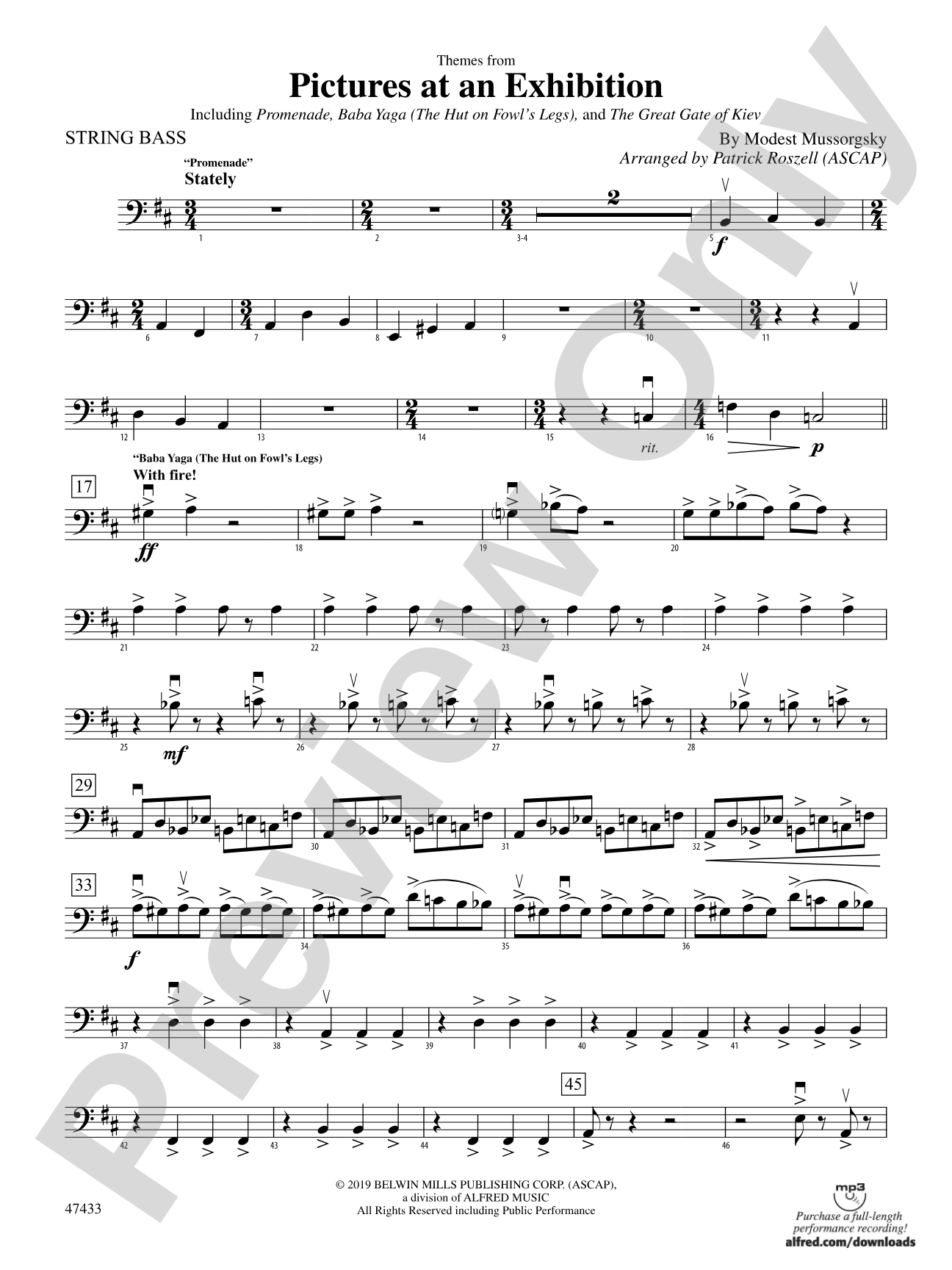
Themes from Pictures at an Exhibition: String Bass

Featuring: Promenade / Baba Yaga (The Hut on Fowl's Legs) / The Great Gate of Kiev

By Modest Mussorgsky / arr. Patrick Roszell

Grade: 2.5

Item: 00-PC-0017964_SB

Digital Download
$5.99
Description
Expose your students to one of the great compositions of the 19th century. This arrangement contains three of the more popular pieces from the original suite: "Promenade," "Baba Yaga (The Hut on Fowl's Legs)," and "The Great Gate of Kiev." A great contest or concert piece!

Don't just read it, hear it, play along with it, and watch your students grow with it. In MakeMusic Cloud, Themes from Pictures at an Exhibition: String Bass comes alive with professional accompaniment, adjustable tempo, and built-in practice tools that turn solo practice into real progress.

Sample Audio
0:00
0:00
Sample Video
Additional Details
Series: Belwin Intermediate String Orchestra
Publisher: Alfred Music
Page Count: 148
SKU: 00-PC-0017964_SB

More about this title

About the Composer: Modest Mussorgsky

Modest Mussorgsky (1839-1881) was a Russian composer who broke from Western European traditions to create a distinctly national musical voice. His work is marked by bold harmonies, vivid orchestration, and an almost theatrical approach to instrumental writing that captures narrative and character with remarkable directness.

Why we love this

This arrangement puts genuine masterwork repertoire within reach of intermediate orchestras. Roszell's scoring preserves the architectural integrity and dramatic flair of Mussorgsky's original while making it playable for developing musicians, meaning your students get to inhabit substantial musical ideas rather than diluted approximations.

What to expect

You move from the stately procession of 'Promenade' into the manic energy of 'Baba Yaga,' where strings skitter and clash with grotesque humor, then arrive at the monumental, almost hymn-like grandeur of 'The Great Gate of Kiev.' The arc is theatrical and satisfying.

Who it's for

String orchestra directors seeking contest and concert repertoire that actually engages students musically. This works for orchestras with solid fundamentals and the ability to balance multiple voice lines; the Grade 2.5 rating reflects accessibility without condescension.

How to get the most out of it

  • Balance the promenade theme carefully between first and second violins so the melody sings without drowning the harmonic foundation.
  • Rhythmic precision matters most in 'Baba Yaga'; lock the driving figures between upper and lower strings before adding tempo.
  • Let 'The Great Gate of Kiev' breathe in its broader sections; resist the urge to rush the processional character, especially as dynamics build toward the climax.
  • Use the published parts to clarify who carries the lead in each movement, then rehearse transitions between sections to maintain narrative momentum.

How to use it

Program this as a centerpiece in a concert that pairs lighter twentieth-century work with standard classical repertoire, or use it as your festival selection where judges expect to hear serious orchestral writing from intermediate ensembles. The three-movement structure also works well as a full concert standalone with minimal additional material.

Skills your students will build

  • Maintaining independent melodic lines while listening to surrounding textures
  • Dynamic contrast and shaping within longer sustained passages
  • Rhythmic coordination across multiple string sections in rapidly changing accompaniment figures
  • Reading multiple articulations (staccato, marcato, legato) in the same phrase
  • Understanding 19th-century Russian harmonic language and its departure from Common Practice tonality

You May Also Like