
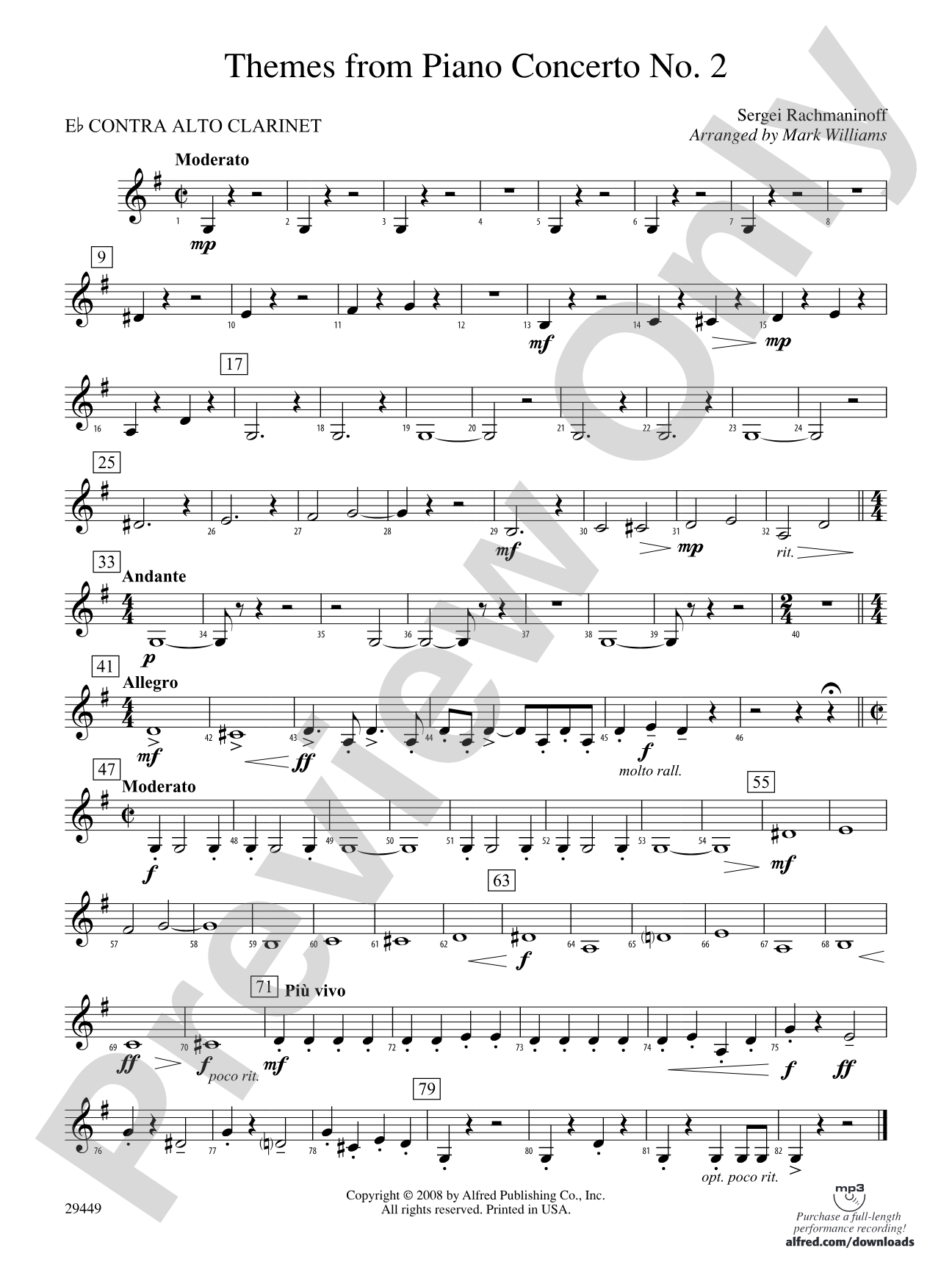

Themes from Piano Concerto No. 2: (wp) E-flat Contrabass Clarinet
By Mark Williams
Grade: 2 (Medium Easy)
Item: 00-PC-0001406_wpECBC
$3.00
Pickup currently not available
Description
The music of Sergei Rachmaninoff contains some of the world's most memorable melodies. It has served as the basis of at least two popular songs and a musical, and has also been included in at least 12 movie soundtracks! This arrangement takes some of the most popular of those melodies and makes them available to young bands. Enjoy the exotic sounds of this all-time classic! (2:40)


Don't just read it, hear it, play along with it, and watch your students grow with it. In MakeMusic Cloud, Themes from Piano Concerto No. 2: (wp) E-flat Contrabass Clarinet comes alive with professional accompaniment, adjustable tempo, and built-in practice tools that turn solo practice into real progress.
Open in the Player
Jump straight in and assign it today.
Start Your Free Trial
Open this title and explore the full library in minutes.
Sample Audio
1
Audio File
--:--
0:00
0:00
Sample Video
No sample videos found.
Additional Details
Series:
Challenger Band Series
Publisher:
Alfred Music
Page Count:
122
SKU:
00-PC-0001406_wpECBC
More about this title
About the Composer: Mark Williams

Mark Williams earned recognition as a prolific composer whose catalog exceeded 200 works for school ensembles. His expertise spanned band, orchestra, and choral literature, developed through decades of classroom teaching in Washington state and refined by his work as a woodwind performer and arranger for the 560th Air Force Band. His co-authorship of the Accent on Achievement Band Method shaped instrumental music pedagogy nationwide.
Williams' influence extended far beyond publication. He served as clinician and guest conductor across 34 U.S. states, five Canadian provinces, and Australia, bringing his distinctive approach to ensemble development directly to music educators. His contributions earned recognition through competitions including the Western International Band Clinic's Gralia Competition and multiple ASCAP Special Awards. Beyond composing, he performed regularly as a bassoon soloist and held the position of Conductor and Artistic Director for the Spokane British Brass Band.
Why we love this
Williams captures the grandeur of Rachmaninoff's melodies and makes them genuinely accessible to young bands without sacrificing musical substance. The Grade 2 scoring demonstrates expert knowledge of what young ensemble players can handle technically while keeping the emotional power intact. Directors appreciate that this arrangement solves the real problem of wanting to program major orchestral repertoire when your ensemble isn't ready for full symphonic adaptations.
What to expect
Lush and romantic, with the sweeping emotion Rachmaninoff is famous for translated into textures young players can execute. The exotic harmonic colors and singing melodic lines evoke the Russian Romantic tradition, creating a concert experience that feels substantial and rewarding despite the accessible technical demands.
Who it's for
Young concert bands working at the Grade 2 level who want to tackle music with genuine artistic merit and cultural substance. Directors seeking arrangement options for winter or spring concerts that engage student musicians with recognizable, emotionally compelling material.
How to get the most out of it
- Balance the melodic material carefully between sections; these themes are most effective when the primary voice sings clearly without overwhelming the harmonic support underneath.
- Take time to establish the key and character of each theme during sectional rehearsals, since the transitions between Rachmaninoff's contrasting sections require clarity in phrasing and articulation.
- Attend to dynamic shape within each phrase rather than treating dynamics as static markings, which will reveal the lyrical sophistication that makes these melodies so memorable.
How to use it
Program this as a centerpiece in a concert dedicated to accessible masterworks, pairing it with other Grade 2 selections that offer musical depth. The moderate duration (2:40) makes it suitable for festival or contest programming where you want to demonstrate artistic growth without overextending young ensemble stamina.
Skills your students will build
- Phrasing sustained melodic lines across multiple measures
- Balance between principal voice and harmonic accompaniment
- Intonation in chromatic and non-functional harmonic passages
- Dynamic shaping and control to express Romantic era musical character