
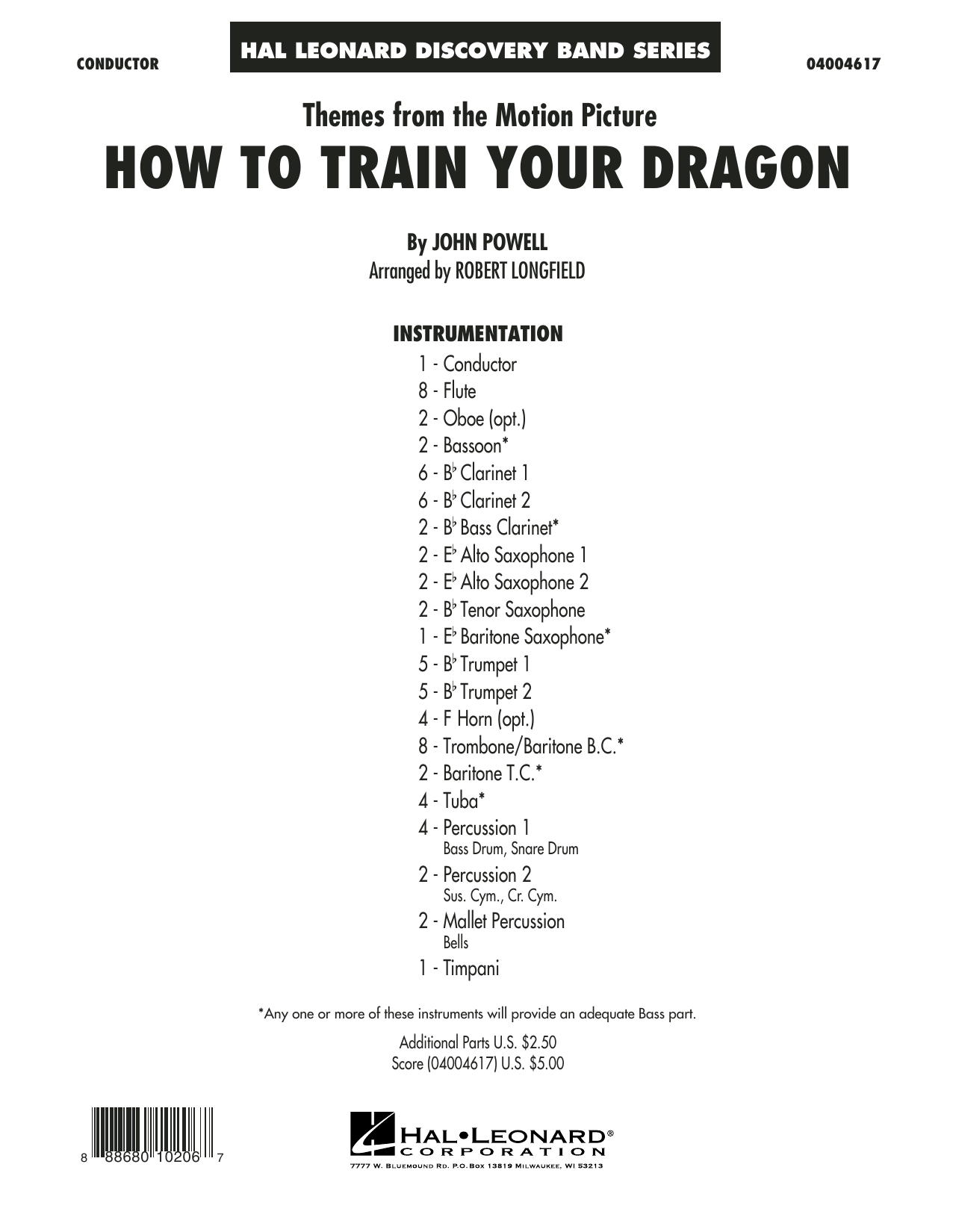

Themes from How to Train Your Dragon: Concert Band Conductor Score & Parts
As performed by John Powell / Arranged by Robert Longfield
Grade: 1.5
Item: 35-PK00321743
$55.00
Pickup currently not available
Buy Extra Parts (Digital PDF Download)
Parts Added to Cart!
Description
The popular animated film "How to Train Your Dragon" gave us a marvelous score by John Powell. This concise arrangement for second-year players features the primary themes in an easy and appealing setting. Dur: 2:20


Discover MakeMusic Cloud: thousands of interactive titles your students can play along with today.
Sample Audio
No sample audio found.
Sample Video
Additional Details
Publisher:
Hal Leonard
SKU:
35-PK00321743
More about this title
About the Artist: John Powell
John Powell has established himself as one of the most prolific and inventive composers for animated film, with a particular gift for writing music that works equally well in the theater and in the classroom. His scores favor accessible melodies, clear harmonic progressions, and orchestrations that translate beautifully across instrumental combinations. Powell's work demonstrates that film music for family audiences can be musically sophisticated without sacrificing immediate appeal to younger players and listeners.
Why we love this
Robert Longfield's arrangement captures the heroic sweep and humor of Powell's original score while respecting the technical limits of emerging musicians. The Grade 1.5 setting means you get genuine melodic payoff without the rhythmic complexity or range demands that would derail a second-year ensemble. It's the kind of piece that reminds your students why they wanted to play in the first place.
What to expect
The music captures the film's blend of adventure and heart, with soaring brass lines over supportive woodwind textures. Playful moments punctuate the grander themes, creating a sense of forward momentum that feels lighter than concert band fare without becoming trivial.
Who it's for
Directors building a concert that speaks to middle school audiences and their families will find this arrangement engages everyone in the room. It suits ensembles comfortable with basic harmonic movement and standard meter, yet still offers melodic sophistication that respects student musicianship.
How to get the most out of it
- Shape the primary theme with clear phrase breathing; even at this level, the melody will sing when your brass section marks the structural cadences with slight dynamic swells.
- Balance the woodwind doublings that carry the counter-melody against your trumpet line so both ideas breathe independently rather than blurring together.
- Treat the film's narrative quality seriously by maintaining consistent articulation across like passages; this arrangement rewards the precision you'd expect from more advanced groups.
- Keep tempo steady through the key changes; a slight lift in energy as the piece modulates will feel natural without requiring a formal ritardando.
How to use it
This works beautifully as a concert opener or closer, giving your program accessibility and warmth while showcasing your ensemble's ability to handle melodic music with style. Pair it alongside other film music or orchestral transcriptions to build a thematic concert, or use it as a standalone feature in a family-oriented concert that builds confidence in younger musicians.
Skills your students will build
- Sustaining lyrical phrasing across phrase boundaries
- Balance between melody and counter-melody in mixed textures
- Intonation stability in harmonic progressions with chromatic movement
- Coordinated articulation across sections in homophonic writing
- Ensemble cohesion through key modulations