
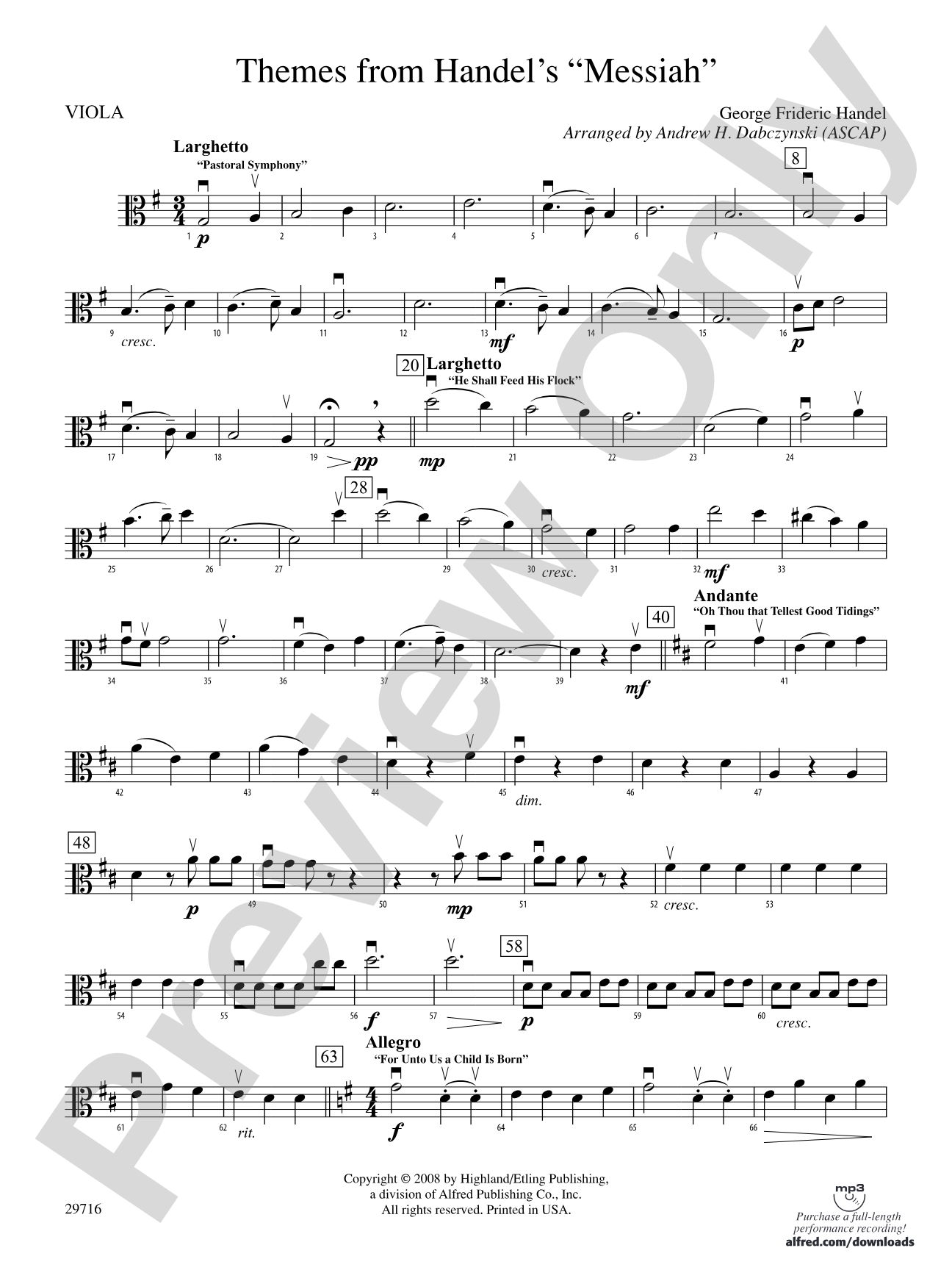

Themes from Handel's Messiah: Viola
By George Frideric Handel / arr. Andrew H. Dabczynski
Grade: 2
Item: 00-PC-0001569_VA1
$5.99
Pickup currently not available
Description
A piece for the beginning orchestra that is guaranteed to bring the audience to its feet! This satisfying arrangement of some of Handel's most beloved melodies from the famous oratorio will provide cultural literacy as well as great skill development. The piece begins with the gentle "Pastoral Symphony," then themes from "He Shall Feed His Flock," "Oh Thou That Tellest" and "For Unto Us" are heard. The arrangement ends with a rousing version of "The Hallelujah Chorus." (3:30)
Correlates with String Explorer Book One, Unit 13. This title is available in MakeMusic Cloud.


Correlates with String Explorer Book One, Unit 13. This title is available in MakeMusic Cloud.
Don't just read it, hear it, play along with it, and watch your students grow with it. In MakeMusic Cloud, Themes from Handel's Messiah: Viola comes alive with professional accompaniment, adjustable tempo, and built-in practice tools that turn solo practice into real progress.
Open in the Player
Jump straight in and assign it today.
Start Your Free Trial
Open this title and explore the full library in minutes.
Sample Audio
1
Audio File
--:--
0:00
0:00
Sample Video
No sample videos found.
Additional Details
Series:
Highland/Etling String Explorer
Publisher:
Alfred Music
Page Count:
140
SKU:
00-PC-0001569_VA1
More about this title
About the Composer: George Frideric Handel
George Frideric Handel (1685-1759) was a German-born composer who spent most of his career in England, where he became a central figure in establishing instrumental music as a concert genre. His oratorios, particularly Messiah, rank among the most performed works in Western music and have shaped choral and orchestral traditions for nearly three centuries.
Handel's gift for melody and dramatic architecture made him a master of both opera and sacred music. His influence on music education extends far beyond his lifetime; his works appear in curricula worldwide because they balance accessibility with genuine artistic depth, making them ideal for developing musicians to study alongside contemporary repertoire.
Why we love this
This arrangement captures the grandeur of Messiah without overwhelming young orchestras. By threading together four distinct movements and building to the iconic "Hallelujah" finale, Dabczynski creates a satisfying arc that feels complete and genuinely rewarding to perform. String players at this level rarely get to play music this recognizable and emotionally resonant.
What to expect
The piece unfolds like a guided tour through Handel's most luminous music. It opens with quiet pastoral beauty, gradually introduces melodic material that feels both fresh and somehow familiar, and builds toward a triumphant conclusion that never feels forced. The emotional arc mirrors the listener's experience of discovering something timeless.
Who it's for
This piece belongs in any Grade 2 string orchestra program, especially groups ready to tackle a substantial work with real musical depth. It works equally well for orchestras preparing for festival competition or for holiday and spring concerts seeking repertoire that resonates with audiences of all ages.
How to get the most out of it
- Shape the opening "Pastoral Symphony" with careful dynamic control; let the gentle character establish itself before the first themes enter, so the later melodies feel like a natural conversation rather than an abrupt shift.
- Balance the string parts so soloistic passages (particularly in "He Shall Feed His Flock") can be heard clearly without drowning out the accompanying voices; this teaches students to listen actively even when they're providing harmonic support.
- Approach the "Hallelujah" finale with rhythmic precision and unified articulation across the section; the power of this movement comes from clarity and momentum, not volume.
How to use it
Program this as a centerpiece concert work; its three-and-a-half-minute duration and familiar themes make it an ideal vehicle for demonstrating ensemble growth to families and community supporters. It pairs naturally with other Baroque repertoire or can anchor a concert built around sacred or holiday themes. If your program uses String Explorer materials, this provides a rewarding capstone for Unit 13 work.
Skills your students will build
- Maintaining lyrical phrasing across multiple melodic ideas without rushing
- Balancing between solo and accompaniment roles within a single ensemble texture
- Precision in rhythmic coordination during syncopated and shifting harmonic changes
- Dynamic control and shaping in contrasting sections (pastoral to triumphant)
- Reading and responding to conductor cues across longer formal structures