
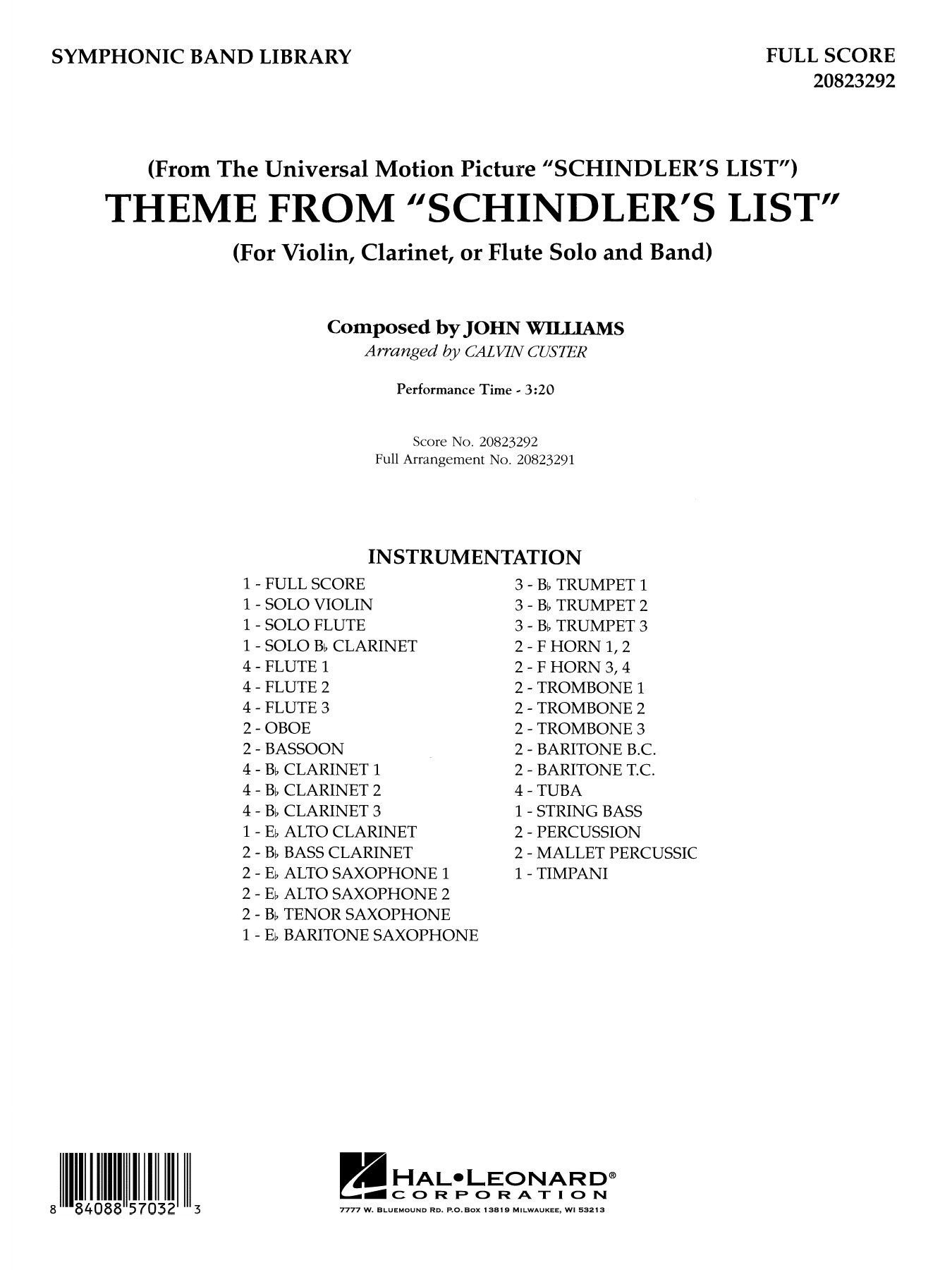

Theme from Schindler's List (arr. Calvin Custer): Concert Band Conductor Score & Parts
By John Williams / As performed by Itzhak Perlman / Arranged by Calvin Custer
Grade: 4
Item: 35-PK01929754
$80.00
Pickup currently not available
Buy Extra Parts (Digital PDF Download)
Parts Added to Cart!
Description
John Williams collected an unprecedented fifth Oscar for his exquisite musical score for Steven Spielberg's monumental movie. Calvin Custer's adaptation allows your band to feature either a violin, clarinet, or flute soloist on this simple yet poignant theme.


Theme from Schindler's List (arr. Calvin Custer): Concert Band Conductor Score & Parts isn't in MakeMusic Cloud just yet...but it could be. Let us know you'd like to see it, and you'll help shape what comes next. In the meantime, start a free trial and dive into thousands of interactive titles your students can play along with today.
Request This Title
Tell us you want it.
Start Your Free Trial
Explore everything that's ready to play right now.
Sample Audio
No sample audio found.
Sample Video
No sample videos found.
Additional Details
Publisher:
Hal Leonard
SKU:
35-PK01929754
More about this title
About the Composer: John Williams
John Williams stands as one of the most consequential film composers in cinema history, with a catalog spanning seven decades and five Academy Awards. His mastery of orchestration and gift for memorable melody have shaped the soundtracks of some of the most watched films ever made, from Star Wars to Schindler's List. In the concert band world, his arrangements serve as essential teaching tools, introducing students to sophisticated harmonic language and emotional depth through music they recognize and love.
Why we love this
Custer's arrangement preserves the theme's quiet dignity while giving your band genuine flexibility in how to voice the solo line. The Grade 4 difficulty level means the accompanimental writing stays accessible without sacrificing the orchestral sophistication of the original score, making this an excellent choice when you want to program something students and audiences will genuinely connect with emotionally.
What to expect
A single violin rises above sparse, respectful accompaniment. The melody unfolds with profound quietness, each phrase a statement of resilience and memory. There's no bombast here; instead, a deep, sustained humanity that asks the listener to pause and listen closely.
Who it's for
Concert bands at the Grade 4 level looking for repertoire that carries genuine emotional weight without excessive technical demands. This works beautifully for bands that want to feature a strong solo voice and introduce students to meaningful film music arrangements.
How to get the most out of it
- Choose your soloist based on the character you want to emphasize. The violin setting stays closest to the film's iconic Itzhak Perlman recording, but the clarinet and flute options each bring distinct warmth to the melody.
- Let the ensemble sit comfortably in the background; this theme lives on the soloist's line. Guard against dynamic creep in the accompaniment during rehearsals.
- Work the fermatas deliberately. They're moments for breath and reflection, not just technical stops. The soloist especially needs space to land these cadences with intention.
- Balance transparency with support. The band provides harmonic foundation, but the texture should never obscure the solo voice or the theme's fundamental simplicity.
How to use it
This pairs naturally with concert programs exploring humanitarian themes or commemorative repertoire. Consider programming it in the second half of a concert when audiences have settled in, or use it as a centerpiece around which to build thematic programming that resonates beyond the typical band concert.
Skills your students will build
- Balance between soloist and ensemble in chamber-like textures
- Sustaining quiet dynamics without loss of tone quality
- Phrasing and breath control in long-line melodies
- Responding to the soloist's interpretation while maintaining harmonic foundation