
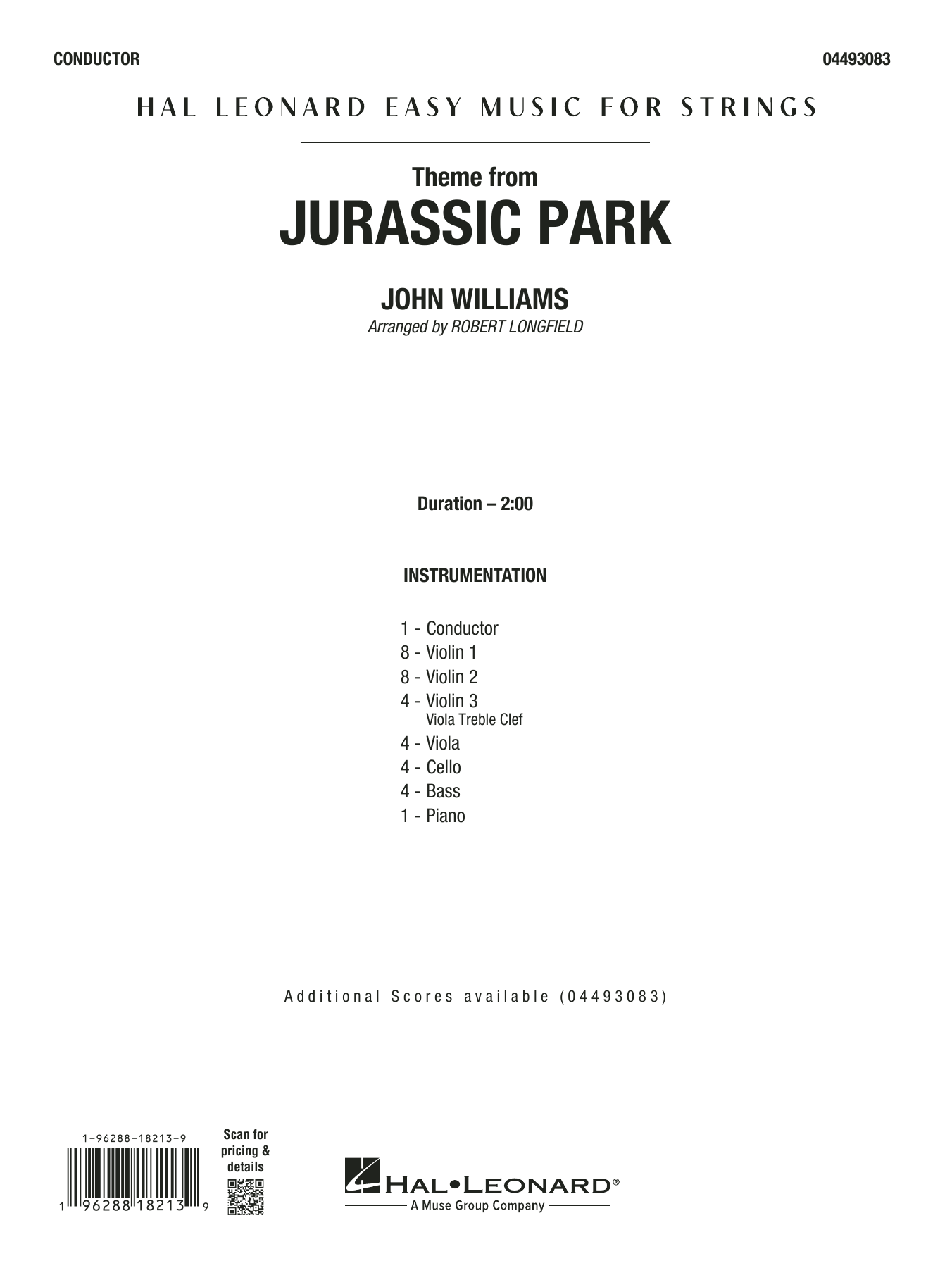

Theme from Jurassic Park (arr. Robert Longfield): String Orchestra Conductor Score & Parts
By John Williams / Arranged by Robert Longfield
Grade: 2
Item: 35-PK01517888
$45.00
Pickup currently not available
Buy Extra Parts (Digital PDF Download)
Parts Added to Cart!
Description
Unleash awe-inspiring beauty of "Theme from Jurassic Park" with this enchanting string orchestra arrangement by Robert Longfield. John Williams' iconic score comes to life, allowing your orchestra to recreate the majestic wonder of prehistoric times. Elevate your performance with luch harmonies and captivating melodies that transport audiences to the heart of Jurassic Park. Perfect for young orchestras seeking a timeless cinematic experience, this arrangement promises to captivate and inspire, making your performance a Jurassic journey like never before.


Theme from Jurassic Park (arr. Robert Longfield): String Orchestra Conductor Score & Parts isn't in MakeMusic Cloud just yet...but it could be. Let us know you'd like to see it, and you'll help shape what comes next. In the meantime, start a free trial and dive into thousands of interactive titles your students can play along with today.
Request This Title
Tell us you want it.
Start Your Free Trial
Explore everything that's ready to play right now.
Sample Audio
No sample audio found.
Sample Video
No sample videos found.
Additional Details
Publisher:
Hal Leonard
SKU:
35-PK01517888
More about this title
About the Composer: John Williams
John Williams stands as one of the most performed composers in film history, with a catalog spanning nearly six decades of cinema. His work across Star Wars, Indiana Jones, Jaws, and countless other blockbusters has defined the sound of modern orchestral film scoring, earning him five Academy Awards and a place among the most influential composers of our time.
For music educators, Williams represents accessible entry into orchestral writing. His melodies are singable, his harmonies logical, and his orchestrations demonstrate how smaller ensembles can achieve sweeping dramatic effect. Students who learn his work gain insight into how music shapes narrative and emotion at the highest professional level.
Why we love this
This arrangement captures everything that made the original theme a cultural phenomenon while scaling it perfectly for developing orchestras. The Grade 2 setting means your strings can focus on executing the iconic melody and supporting lines cleanly without drowning in technical demands, letting the sheer emotional power of Williams' composition do the heavy lifting. Audiences recognize this theme instantly, and that immediate connection transforms a school concert into a genuinely thrilling moment.
What to expect
The opening unfolds with cinematic grandeur, those soaring strings painting vistas of wonder and prehistoric mystery. Despite its Grade 2 accessibility, the arrangement preserves Williams' signature warmth and majesty, creating a sense of discovery that mirrors the film's sense of awe.
Who it's for
Young string orchestras with at least one year of ensemble experience, as well as programs looking to program a recognizable film score without overwhelming less advanced players. Music directors seeking a bridge between simple folk arrangements and more complex classical repertoire will find this an excellent motivator for serious musicianship.
How to get the most out of it
- Shape the main melody with a slow crescendo through the first phrase rather than hitting full volume immediately; let the grandeur build gradually so the peak lands with real impact.
- Balance the sustained harmonic foundation in lower strings against the exposed upper line; excessive vibrato from violas and cellos will blur Williams' crystalline chord progressions.
- Establish a rock-solid tempo before the first rehearsal and hold it steady throughout; any wavering undermines the cinematic sweep of the piece.
- Record a rough run-through early in rehearsals and play it back for your students so they hear how their individual parts weave into the complete orchestral texture.
How to use it
Consider this as the centerpiece of a spring concert, particularly one with a "Movies and Magic" or "Classics on Screen" theme that might include other film scores at comparable levels. It also works beautifully as an audience opener, the moment that shifts a school concert from routine to event, or paired with other adventure-themed orchestral music for thematic programming.
Skills your students will build
- Sustaining tone quality across dynamic shifts from piano to forte and back
- Maintaining rhythmic precision in both melodic lines and sustained harmonic accompaniment
- Balancing ensemble blend when the main theme passes between violin sections
- Interpreting expressive phrasing cues that serve a narrative rather than purely musical function