
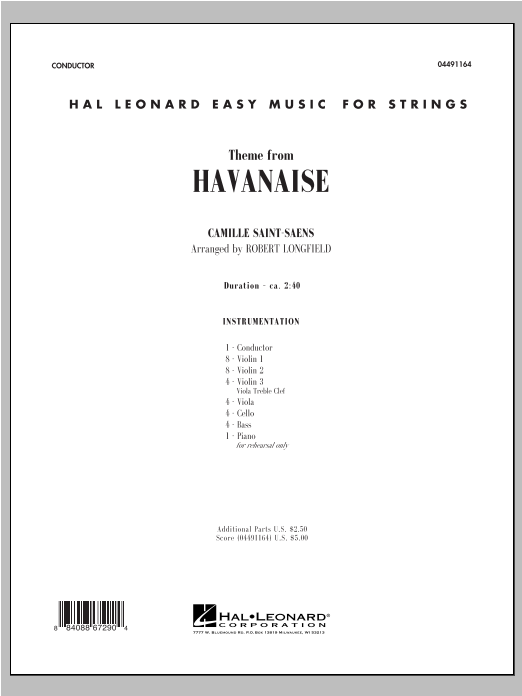

Theme From Havanaise: String Orchestra Conductor Score & Parts
By Camille Saint-Saens / Arranged by Robert Longfield
Grade: 2
Item: 35-PK00250448
$50.00
Pickup currently not available
Buy Extra Parts (Digital PDF Download)
| Product | Price | Quantity |
|---|---|---|
| Theme From Havanaise - Full Score | $7.50 | |
| Theme From Havanaise - Violin 1 | $7.00 | |
| Theme From Havanaise - Violin 2 | $7.00 | |
| Theme From Havanaise - Violin 3 (Viola Treble Clef) | $7.00 | |
| Theme From Havanaise - Viola | $7.00 | |
| Theme From Havanaise - Cello | $7.00 | |
| Theme From Havanaise - Bass | $7.00 | |
| Theme From Havanaise - Piano | $7.00 |
Parts Added to Cart!
Description
Here's a delightful movement based on a theme from French composer Saint-Saens, originally written for violin and orchestra. Featuring the familiar "habanera" rhythm throughout, Robert's superb new arrangement brings this standard of the violin repertoire to the concert stage for string orchestras. Dur: 2:40


Theme From Havanaise: String Orchestra Conductor Score & Parts isn't in MakeMusic Cloud just yet...but it could be. Let us know you'd like to see it, and you'll help shape what comes next. In the meantime, start a free trial and dive into thousands of interactive titles your students can play along with today.
Request This Title
Tell us you want it.
Start Your Free Trial
Explore everything that's ready to play right now.
Sample Audio
No sample audio found.
Sample Video
No sample videos found.
Additional Details
Publisher:
Hal Leonard
SKU:
35-PK00250448
More about this title
About the Composer: Camille Saint-Saens
Camille Saint-Saëns (1835-1921) was a French composer of formidable technique and prolific output, equally comfortable writing symphonies, concertos, operas, and chamber works. His violin writing combines technical brilliance with lyrical warmth, and the Havanaise stands among his most enduring contributions to the solo violin canon.
Saint-Saëns had a gift for crafting memorable melodies anchored in rhythmic vitality. The habanera rhythm that permeates this work reflects his fascination with Spanish and Latin musical idioms, a passion that shaped several of his most performed pieces. His orchestrations remain models of clarity and color.
Why we love this
Robert Longfield's arrangement opens the Havanaise to ensembles who might not have a concertmaster soloist ready for the original violin part. The habanera rhythm maintains its hypnotic pull across the full string section, and at Grade 2, students encounter a work with genuine concert presence without excessive technical demands. This is a legitimate crowd pleaser that lets young orchestras sound sophisticated.
What to expect
A moonlit walk through a Spanish courtyard. The habanera rhythm gives the piece an unhurried, almost languid quality, while Saint-Saëns' melody floats above with an easy elegance. There's warmth in the orchestration and a quiet confidence in the harmonic language.
Who it's for
String orchestras at the intermediate level looking for a work that combines accessibility with musical substance. Ensembles interested in exploring classical European repertoire beyond the usual suspects will find this a natural fit for concerts featuring chamber orchestral literature.
How to get the most out of it
- Maintain the habanera rhythm's swagger without letting it become mechanical. The accompaniment figures need flexibility and a conversational quality, especially in the lower strings.
- Balance the melody line across first violins so it projects clearly without overshadowing the harmonic support. A light touch from the violas and cellos allows the theme to breathe.
- Keep the tempo steady but not rigid. The piece benefits from subtle rubato in the melodic phrases, creating moments of gentle push and pull rather than metronomic precision.
How to use it
Pair this with other 19th-century orchestral favorites to build a thematic concert around European classical traditions. Its two and a half minute duration makes it an ideal companion piece to larger works, or program it as an elegant interlude between more demanding selections. The piece also serves well as an encore that audiences recognize and enjoy without requiring extensive rehearsal time.
Skills your students will build
- Sustaining consistent rhythmic pulse in Latin-influenced accompaniment patterns
- Balancing independent melodic lines across the first violin section
- Shaping longer phrases with subtle dynamic and tempo nuance
- Ensemble intonation across sustained harmonic progressions