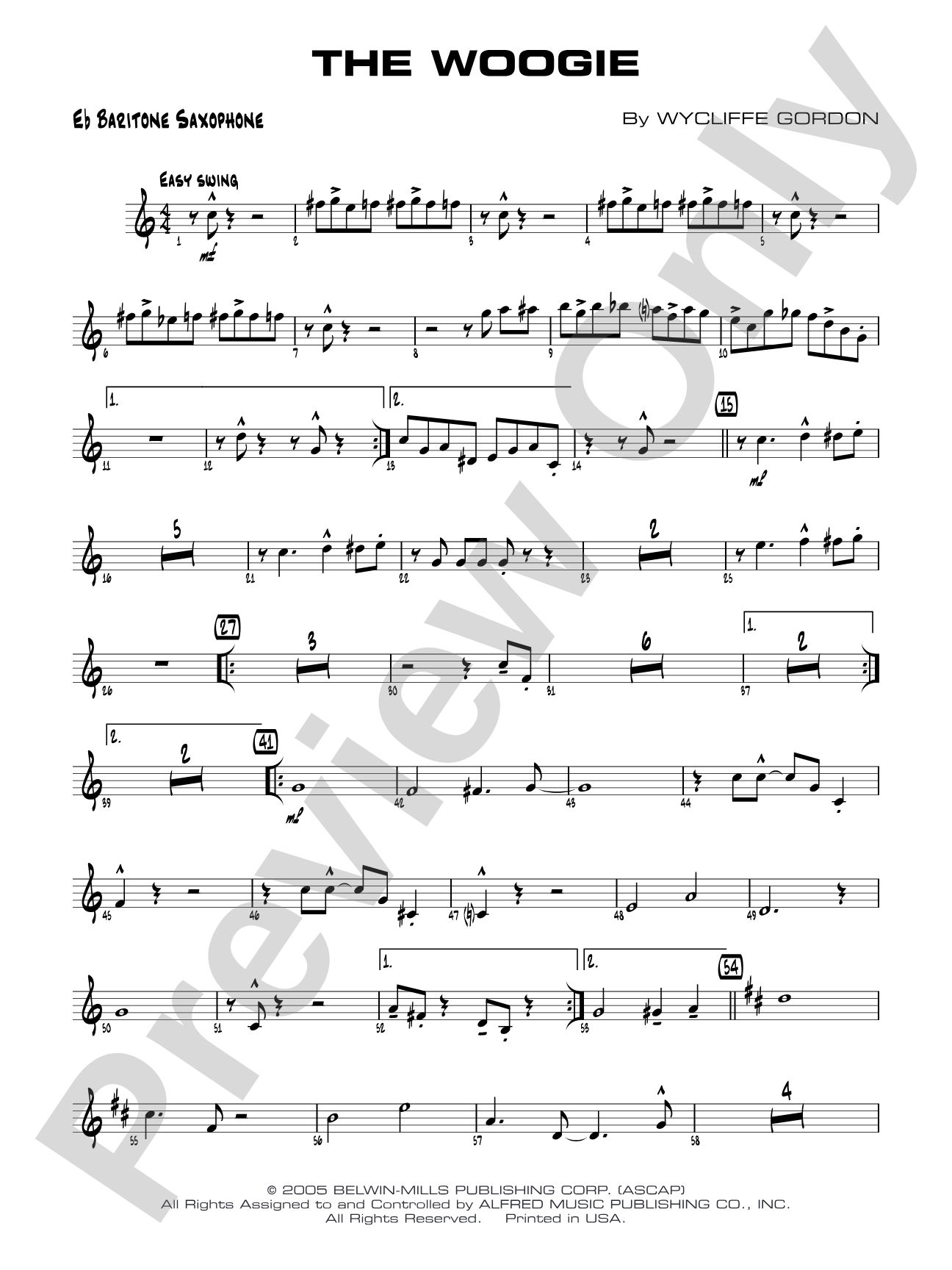
The Woogie: E-flat Baritone Saxophone Sheet Music Preview

The Woogie: E-flat Baritone Saxophone

By Wycliffe Gordon

Grade: 3 (Medium)

Item: 00-PC-0014735_BTX

Digital Download
$3.00
Description
This title in the new Jazz For Young People Series is composed and arranged by jazz great Wycliffe Gordon. "The Woogie" is a boogie-woogie swing shuffle originally composed for the Lincoln Center Jazz Orchestra. Solos are provided for trumpets 1 and 2, trombones 1 and 2, 1st tenor sax, baritone sax, and drum, too. This chart can be played as a swing shuffle or a boogaloo rock groove---either way it's hot! Includes all the usual optional parts. Correlated to the Jazz at Lincoln Center Jazz for Young People Curriculum. (5:10)

Don't just read it, hear it, play along with it, and watch your students grow with it. In MakeMusic Cloud, The Woogie: E-flat Baritone Saxophone comes alive with professional accompaniment, adjustable tempo, and built-in practice tools that turn solo practice into real progress.

Sample Audio
0:00
0:00
Sample Video
Additional Details
Series: Jazz for Young People Series
Publisher: Alfred Music
Page Count: 98
SKU: 00-PC-0014735_BTX

More about this title

About the Composer: Wycliffe Gordon

Wycliffe Gordon is a trombonist, composer, and educator who has been central to the Jazz at Lincoln Center organization for decades. His work spans performance, composition, and mentorship, with a particular focus on making jazz accessible and engaging for young musicians through carefully crafted educational repertoire.

Why we love this

Gordon's arrangement captures the infectious energy of boogie-woogie without oversimplifying the jazz language, giving your ensemble real swing feel and soloing opportunities across the section. The built-in flexibility between swing shuffle and boogaloo rock groove means you can shape the piece to match your ensemble's strengths and the energy of your concert context.

What to expect

The Woogie swings with the infectious momentum of a boogie-woogie shuffle, blending the forward drive of rock grooves with authentic jazz phrasing. It's the kind of piece that makes an audience move, while demanding from your musicians the discipline to nail rhythmic precision and the finesse to make the solos sing.

Who it's for

This piece serves Grade 3 jazz ensembles with solid fundamentals in swing articulation and section balance. It works equally well for groups just beginning to explore jazz standards or ensembles with a few years of small group experience who are ready to tackle ensemble solos and composed backgrounds.

How to get the most out of it

  • Let the rhythm section establish the groove pocket first during sectional rehearsals. The feel of this piece depends on the drummer locking in with the bass and piano, so isolate those parts early and let horns listen before jumping in.
  • Manage the solo transitions carefully during full ensemble run-throughs. With seven different soloists, marking your parts clearly and using a visual cue system (or a light hand on the podium) prevents confusion about who enters when.
  • Experiment with both the swing shuffle and boogaloo rock groove interpretations in rehearsal before deciding which best suits your ensemble. Even a brief side-by-side comparison will reveal which style feels more natural to your section's timing and articulation.
  • Balance the ensemble sound behind soloists by keeping ensemble sections light and rhythmically tight. Soloists need room to breathe, especially on trumpet and trombone passages, so avoid pushing volume when comping or hitting background figures.

How to use it

Position this chart in the second half of a jazz concert to build energy after more straightforward ballads or samba-influenced pieces. It pairs naturally with other Jazz for Young People Series titles and works as a crowd-pleasing closer that showcases individual soloists while keeping the ensemble sound front and center.

Skills your students will build

  • Swing articulation and shuffle rhythmic feel
  • Comping behind soloists with written backgrounds
  • Solo construction in jazz idiom (7 featured parts across sections)
  • Ensemble groove awareness and rhythm section coordination
  • Style flexibility between swing shuffle and boogaloo rock grooves
  • Reading and executing sectional voicings and stabs

You May Also Like