
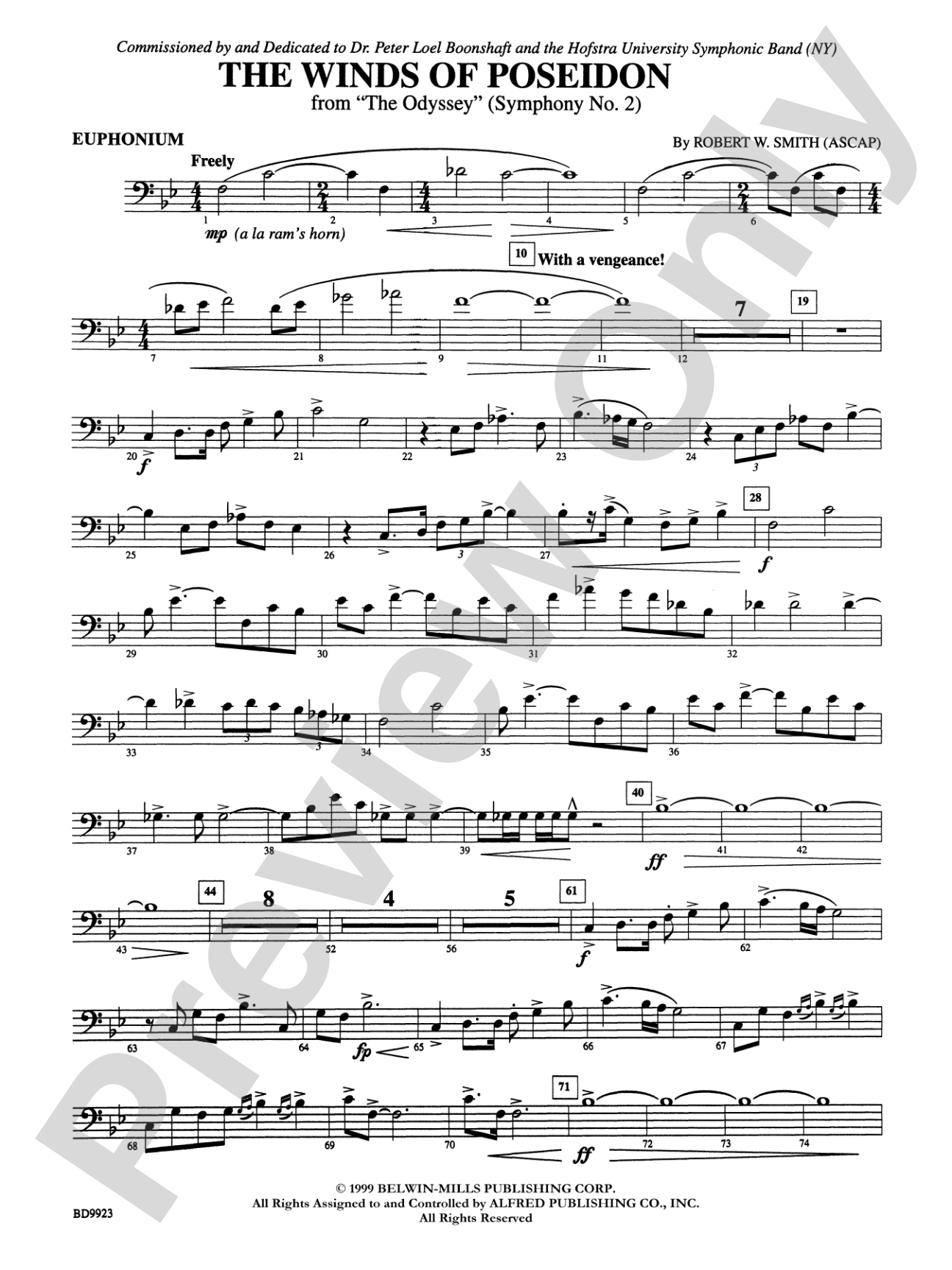

The Winds of Poseidon (from The Odyssey (Symphony No. 2)): Baritone B.C.
By Robert W. Smith
Grade: 4 (Medium)
Item: 00-PC-0002096_BBC1
$3.00
Pickup currently not available
Description
The Winds of Poseidon launches the eagerly awaited Second Symphony from the pen of Robert W. Smith. This work, the second movement of the symphony, is based on the classic story The Odyssey. Odysseus is the shipwrecked warrior who wanders the land and sea for ten years, and this bold musical statement captures the essence of the powerful winds and waves that propel Odysseus on his journey. The center section was inspired by the tale of the Sirens, whose beautiful and captivating singing lured sailors to their deaths on the rocks. The genius of the composer is strongly in evidence in this gigantic musical tale. (7:33)


The Winds of Poseidon (from The Odyssey (Symphony No. 2)): Baritone B.C. isn't in MakeMusic Cloud just yet...but it could be. Let us know you'd like to see it, and you'll help shape what comes next. In the meantime, start a free trial and dive into thousands of interactive titles your students can play along with today.
Request This Title
Tell us you want it.
Start Your Free Trial
Explore everything that's ready to play right now.
Sample Audio
No sample audio found.
Sample Video
No sample videos found.
Additional Details
Series:
Belwin Symphonic Band
Publisher:
Alfred Music
Page Count:
320
SKU:
00-PC-0002096_BBC1
More about this title
About the Composer: Robert W. Smith

Robert W. Smith stands among America's most performed composers of concert band and orchestral music, with more than 400 works in print across multiple publishers. His education includes a Bachelor's degree in Music Education from Troy State University and a Master's degree in Music from the University of Miami. Smith's original compositions have reached audiences across North America, Europe, Australia, and Asia, establishing him as a major voice in the band repertoire.
Beyond the concert hall, Smith's music has appeared in diverse contexts ranging from presidential ceremonies in Japan to Olympic broadcasts, the Macy's Thanksgiving Day Parade, and Opening Day at Dodger Stadium. His symphonies, particularly The Divine Comedy and The Odyssey, have become touchstones for ambitious concert band programs. As a conductor and clinician, he has worked extensively throughout the United States, Canada, and internationally, sharing his compositional vision with musicians at all levels.
Why we love this
Smith captures the raw drama of Homer's epic without sacrificing musicality or coherence. The dual narrative—Odysseus battling the elements while the Sirens' section offers a haunting contrast—gives conductors and students a genuine dramatic arc to explore, making this more than a showpiece but a full musical story worth inhabiting for rehearsals.
What to expect
The score opens with restless, churning energy that captures the violent indifference of the sea. The middle section shifts into something hypnotic and dangerous, where beauty becomes a threat; then the struggle resumes with renewed intensity, creating a satisfying arc from peril through seduction back to conflict.
Who it's for
Grade 4 concert bands with solid fundamentals and expressive maturity, particularly those eager to tackle substantial programmatic works. Programs looking to program a standalone symphonic movement that delivers drama and musicality in a single rehearsal arc will find strong material here.
How to get the most out of it
- Shape the opening winds with dynamic clarity so the sailors' struggle emerges naturally; avoid turning it into a wall of sound early on.
- Balance the Sirens' section carefully so the lyrical beauty feels genuinely seductive rather than merely soft; this is where ensemble blend becomes a storytelling tool.
- Use the full seven-and-a-half minutes to establish pacing and momentum; rushing through transitions will flatten the narrative tension Smith built into the score.
- Mark critical cues and dynamic shifts clearly for all players so the ensemble can follow the conductor's dramatic interpretation without losing musical precision.
How to use it
Program this as a centerpiece for a concert exploring classical storytelling in modern band music, or pair it with other Smith works to showcase his command of large-scale form. It works equally well as a season opener that signals to audiences they're in for something ambitious, or as a finale that leaves the hall thinking about the narrative they've just experienced.
Skills your students will build
- Reading and executing rapid dynamic shifts within sustained phrases
- Balancing ensemble blend in lyrical passages while maintaining harmonic clarity
- Responding to dramatic conducting gestures that shape programmatic intent
- Sustaining focus and musicality across an extended single-movement work
- Interpreting stylistic contrasts (tempestuous versus seductive) in the same composition