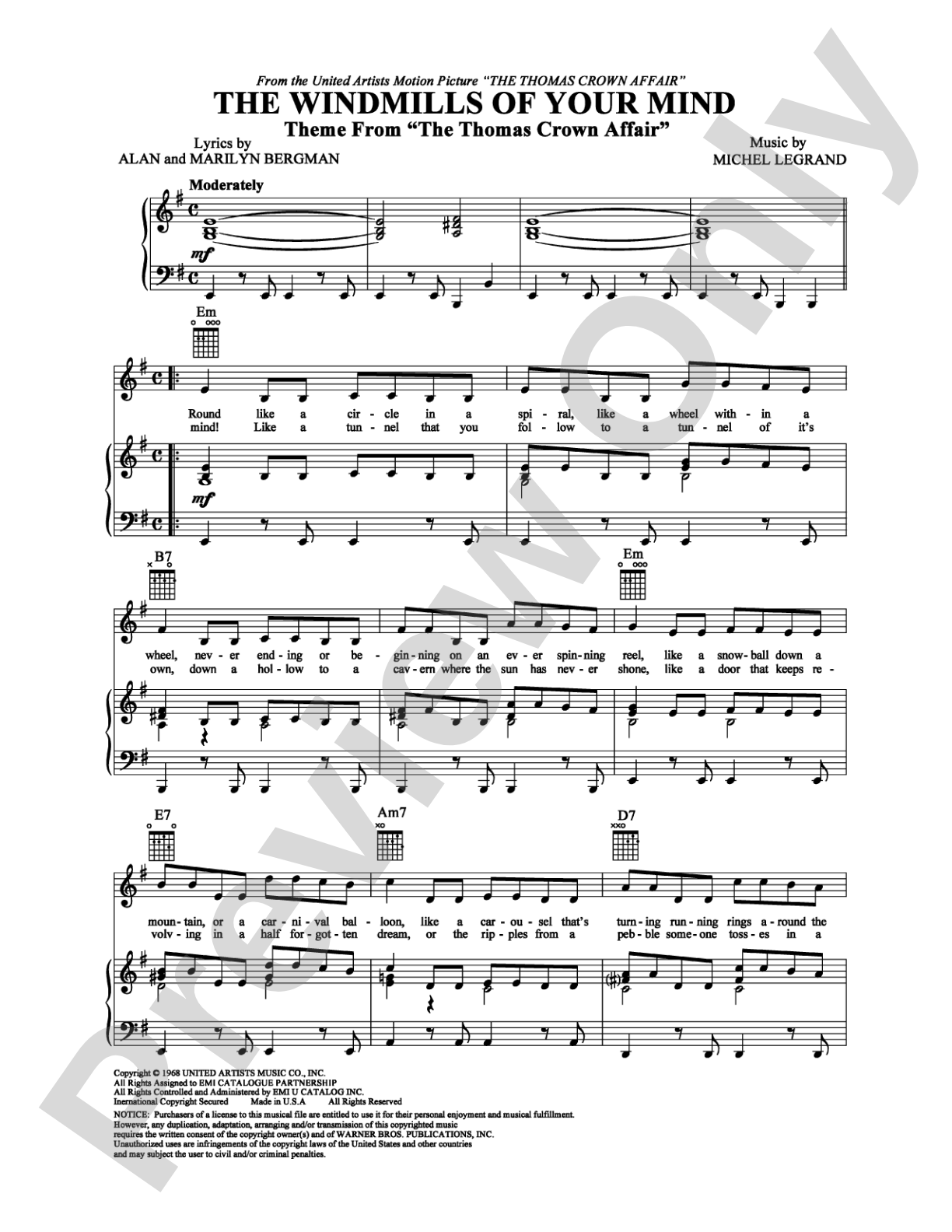
The Windmills of Your Mind: Piano/Vocal/Chords Digital Sheet Music

The Windmills of Your Mind: Piano/Vocal/Chords Digital Sheet Music

Michel Legrand, Dusty Springfield

Item: 00-PS-0005849

Digital Download
$3.99
Description

The Windmills of Your Mind: Piano/Vocal/Chords Digital Sheet Music isn't in MakeMusic Cloud just yet...but it could be. Let us know you'd like to see it, and you'll help shape what comes next. In the meantime, start a free trial and dive into thousands of interactive titles your students can play along with today.

Sample Audio
No sample audio found.
Sample Video
Additional Details
SKU: 00-PS-0005849

More about this title

About the Artist: Dusty Springfield

Dusty Springfield (1939-1999) was a British-American pop and soul singer whose contralto voice became one of the most recognizable in 1960s music. Known for her emotional delivery and sophisticated interpretations of standards and contemporary pop songs, she brought jazz-influenced phrasing and vulnerability to every recording. Her career spanned five decades, during which she earned multiple Grammy nominations and became a crucial bridge between British Invasion pop and American soul traditions.

Why we love this

Springfield's recording of this Michel Legrand composition showcases the kind of sophisticated vocal control that rewards student singers. The arrangement sits comfortably in a teaching context while demanding real musicianship, intonation, legit phrasing, and the ability to balance the piano part with the vocal line. It's a song that sounds deceptively simple until you try to sing it.

What to expect

The song moves with a wistful, almost hypnotic quality, like watching thoughts swirl and shift without quite landing. Springfield's voice sits perfectly in the introspective space between melancholy and acceptance, supported by lush harmonies that feel both intimate and timeless.

Who it's for

This works beautifully for jazz singers, cabaret performers, and vocalists exploring the American songbook and sophisticated pop standards. Pianists accompanying singers benefit from the clear harmonic structure and the opportunity to develop sensitive accompaniment skills.

How to get the most out of it

  • Study Springfield's original recording to absorb her phrasing choices, particularly how she shapes the longer melodic lines and where she places her breath for emotional impact.
  • The harmonic movement is intricate enough to reward careful attention to voice leading; let the accompaniment guide the emotional arc rather than rushing through chord changes.
  • Resist over-interpreting the melody early on; the power of this song builds through accumulated emotion, not dramatic gestures.

How to use it

This pairs well on recitals or cabaret-style programs featuring jazz standards and art songs from the 1960s onward. Consider programming it alongside other sophisticated vocal material to showcase a singer's interpretive maturity and harmonic awareness.

Skills your students will build

  • Interpreting legit pop song standards with jazz phrasing
  • Reading and accompanying complex harmonic progressions
  • Breath control and line shape in longer melodic phrases
  • Developing sensitivity to lyrical storytelling in accompaniment

You May Also Like