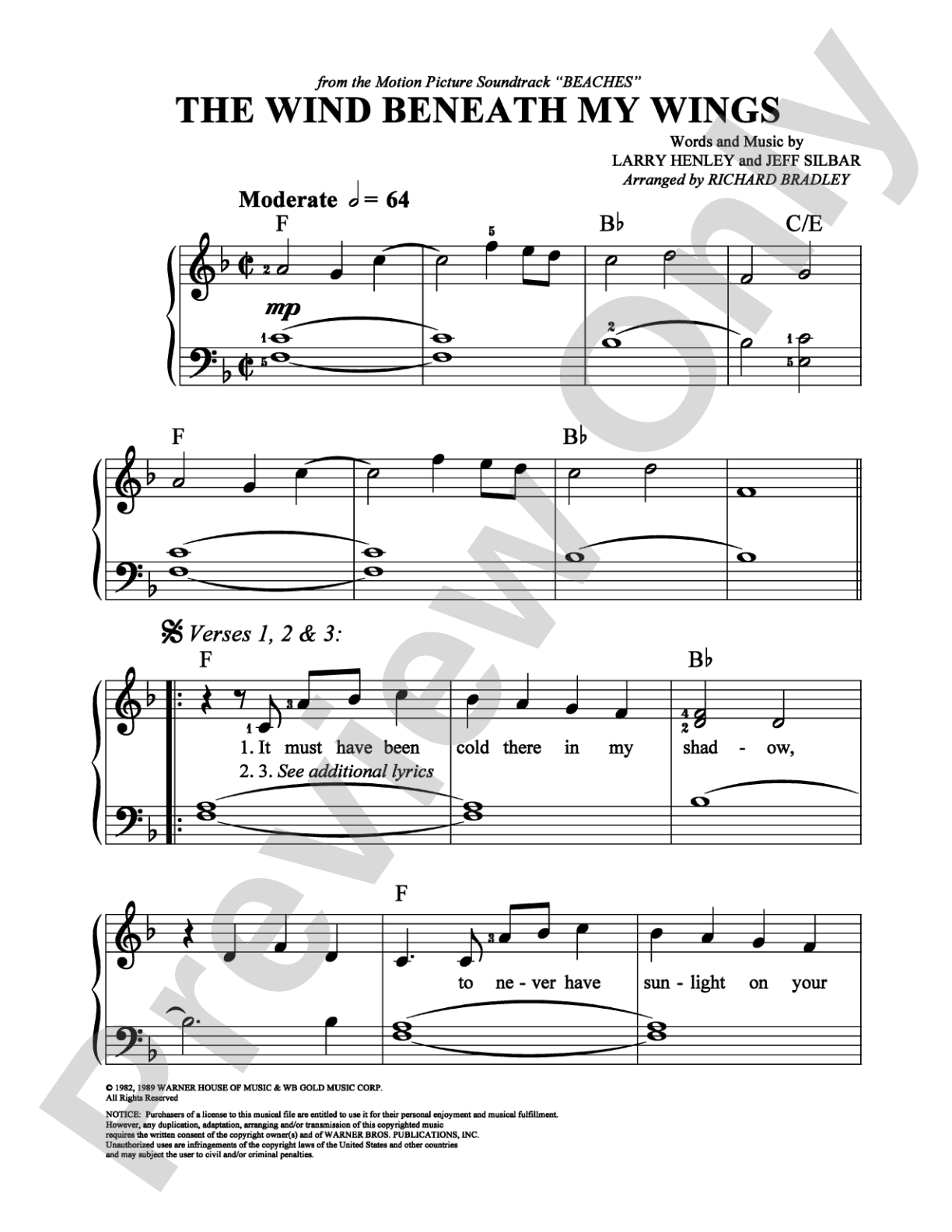
The Wind Beneath My Wings: Easy Piano Digital Sheet Music

The Wind Beneath My Wings: Easy Piano Digital Sheet Music

Bette Midler, Larry Henley, Jeff Silbar

Item: 00-PS-0009011

Digital Download
$3.99
Description

The Wind Beneath My Wings: Easy Piano Digital Sheet Music isn't in MakeMusic Cloud just yet...but it could be. Let us know you'd like to see it, and you'll help shape what comes next. In the meantime, start a free trial and dive into thousands of interactive titles your students can play along with today.

Sample Audio
No sample audio found.
Sample Video
Additional Details
SKU: 00-PS-0009011

More about this title

About the Artist: Bette Midler

Bette Midler emerged as one of the most distinctive vocalists of the 1970s, known for her powerhouse voice, theatrical presence, and ability to command a room with emotional authenticity. Her career spans decades of recording, live performance, and film work, during which she has become a cultural icon for her interpretive gifts and genuine connection to the material she performs.

Why we love this

This arrangement captures the soaring emotional arc that made the original unforgettable, and an easy piano setting puts that same emotional power within reach of pianists still building their technique. The song's simple melodic shape and supportive harmonic structure create a perfect vehicle for students learning to sing with their hands, not just read notes.

What to expect

Tender and hopeful, with moments of vulnerability that deepen into quiet strength. The music invites you to find the spaces between the notes, where the real emotion lives.

Who it's for

This arrangement serves pianists in the early-intermediate stages who are ready to tackle songs with genuine emotional content but need a stripped-down harmonic and rhythmic framework. It also works beautifully as a recital choice for students developing their interpretive voice and learning to honor a song's legacy while making it their own.

How to get the most out of it

  • Shape the melody in long phrases rather than measure-by-measure. Let the accompaniment sit lightly underneath so the tune remains the focal point.
  • Take time with the opening measures to establish the song's tender quality before the momentum builds in the second section.
  • Listen closely to how the original recording balances restraint with swell; aim for the same dynamic restraint in your interpretation.
  • The bridge often benefits from a slight tempo ease and softer touch before the final statement of the melody gains strength.

How to use it

This belongs in a solo recital or studio showcase where emotional maturity matters more than flashy technique. It also serves as a wonderful closing number for a program that touches on themes of resilience or hope, or as a bridge between classical repertoire and contemporary songs students care about.

Skills your students will build

  • Sustaining long melodic lines with consistent tone and phrasing
  • Balancing melody and accompaniment using dynamic control
  • Interpreting a well-known song with personal expression while respecting its established character
  • Managing rubato and tempo flexibility within a simple harmonic framework

You May Also Like