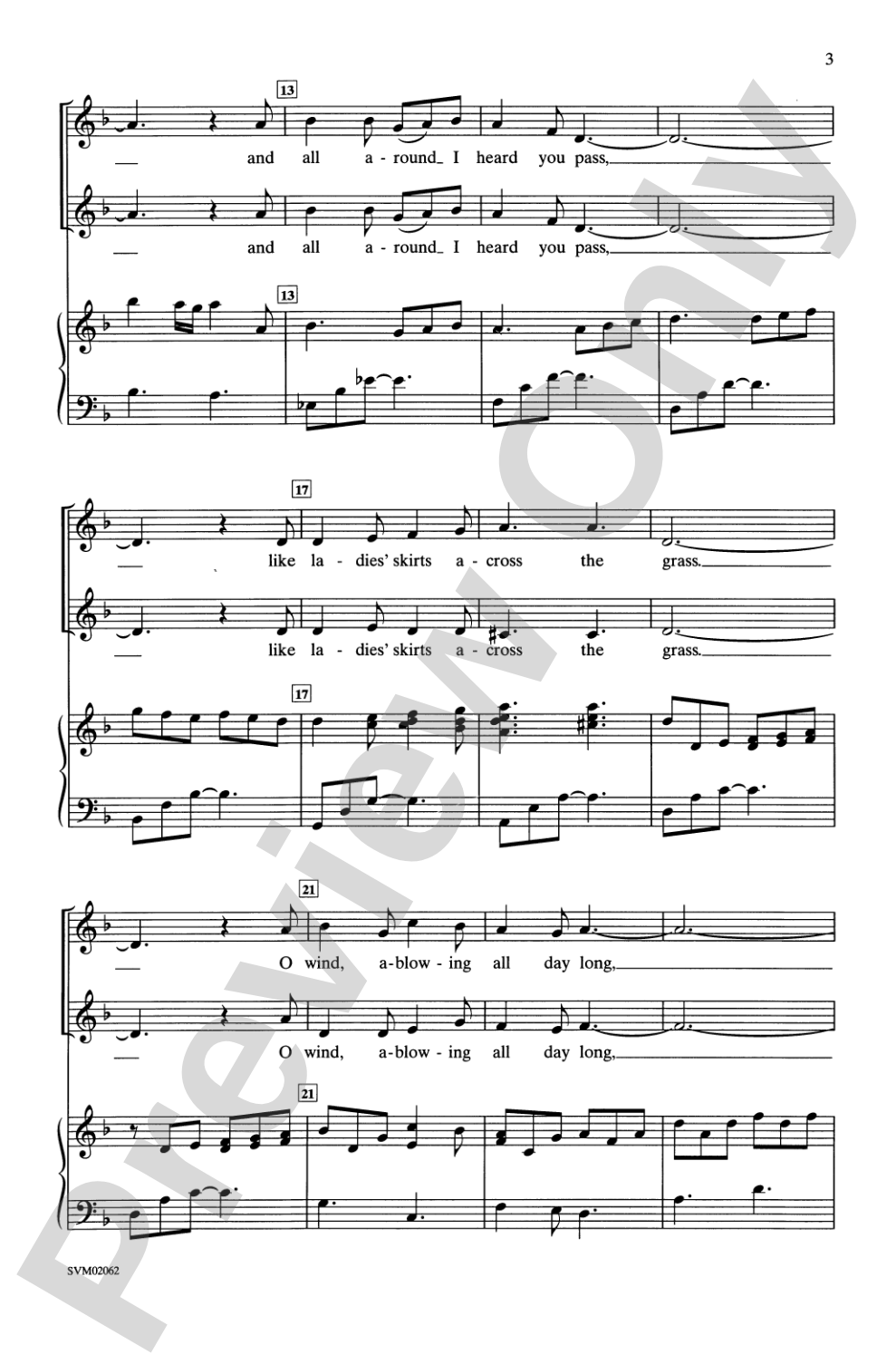
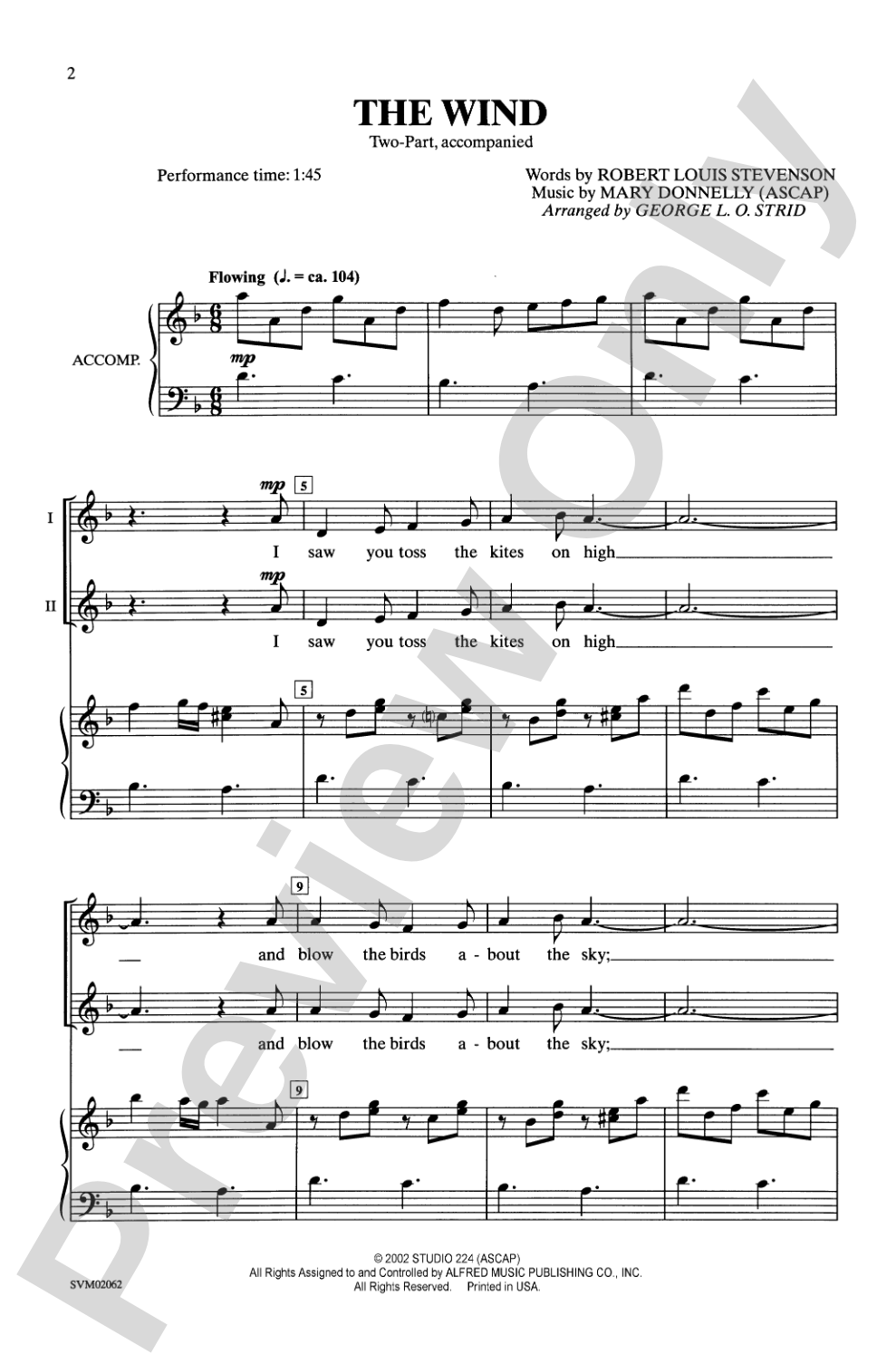
The Wind Sheet Music Preview

The Wind: 2-Part Choral Octavo

Words by Robert Louis Stevenson / music by Mary Donnelly / arr. George L. O. Strid

Level: Moderate

Item: 00-PO-0005361

Digital Download
$2.25

Minimum order quantity: 20 copies

Description
The famous Robert Louis Stevenson text is depicted in this arrangement by Mary Donnelly and George L.O. Strid - a welcome addition to the choral repertoire sure to be performed by all choirs.

The Wind: 2-Part Choral Octavo isn't in MakeMusic Cloud just yet...but it could be. Let us know you'd like to see it, and you'll help shape what comes next. In the meantime, start a free trial and dive into thousands of interactive titles your students can play along with today.

Sample Audio
No sample audio found.
Sample Video
Additional Details
Series: Alfred Archive Edition: Studio PR Catalog
Publisher: Alfred Music
Page Count: 8
SKU: 00-PO-0005361

More about this title

About the Composer: Mary Donnelly

Mary Donnelly

Mary Donnelly grew up in Reno, Nevada and studied English and French at the University of Nevada, Reno. While still an undergraduate, she founded and directed two children's choruses, work that sparked her passion for music education. She returned to school to earn teaching certification and later completed a Master's Degree in Education from Lesley College in Cambridge, Massachusetts, where her studies focused on integrating the arts across the curriculum.

Donnelly taught general music and choir in elementary and middle schools throughout the Washoe County School District for three decades. In 1985, while team-teaching sixth grade music with George Strid, their principal challenged them to write a musical for Reading Week. That collaboration launched a prolific partnership; together they have created over two hundred songs and twenty-five musicals. She is an active member of ACDA, NEA, and ASCAP.

Why we love this

Donnelly and Strid chose a text that resonates with young singers: Stevenson's meditation on the invisible yet powerful wind. The accessible 2-part voicing invites middle school choirs to explore nuanced interpretation without struggle, making this a natural fit for rehearsals that balance accessibility with literary substance. Directors appreciate repertoire rooted in strong poetry, and this arrangement delivers exactly that at a level where singers can focus on expression rather than technical hurdles.

What to expect

The arrangement captures something contemplative and observant without being heavy. Stevenson's words about the unseen wind moving through the world arrive as music that feels immediate and honest, inviting singers and listeners to pause and consider something ordinarily overlooked.

Who it's for

This octavo works well for middle school and developing high school choirs seeking repertoire with literary merit at a manageable technical level. It also suits adult community choirs and church ensembles looking for secular pieces that engage thoughtfully with a well-known poem.

How to get the most out of it

  • Let the text guide your phrasing. Stevenson's language has rhythm and imagery built in; trust it rather than forcing the music into metrically rigid shapes.
  • Encourage singers to imagine what 'the wind' represents in their own lives as they prepare. The more personal the connection, the more genuine the performance becomes.
  • Balance the two vocal lines carefully so neither dominates. This is an opportunity to build awareness of blend and equality between parts.

How to use it

Pair this with other Donnelly/Strid settings of literary texts for a programming theme around poetry in music. It also serves as an excellent concert opener, establishing a reflective tone before moving into contrasting repertoire. This piece works particularly well in spring concerts focused on nature or in assemblies celebrating literature.

Skills your students will build

  • Interpreting poetic text through musical phrasing
  • Balancing two independent vocal lines with equal weight
  • Sustaining legit singing in a moderate-tempo secular arrangement
  • Connecting emotional intention to performance choices

You May Also Like