
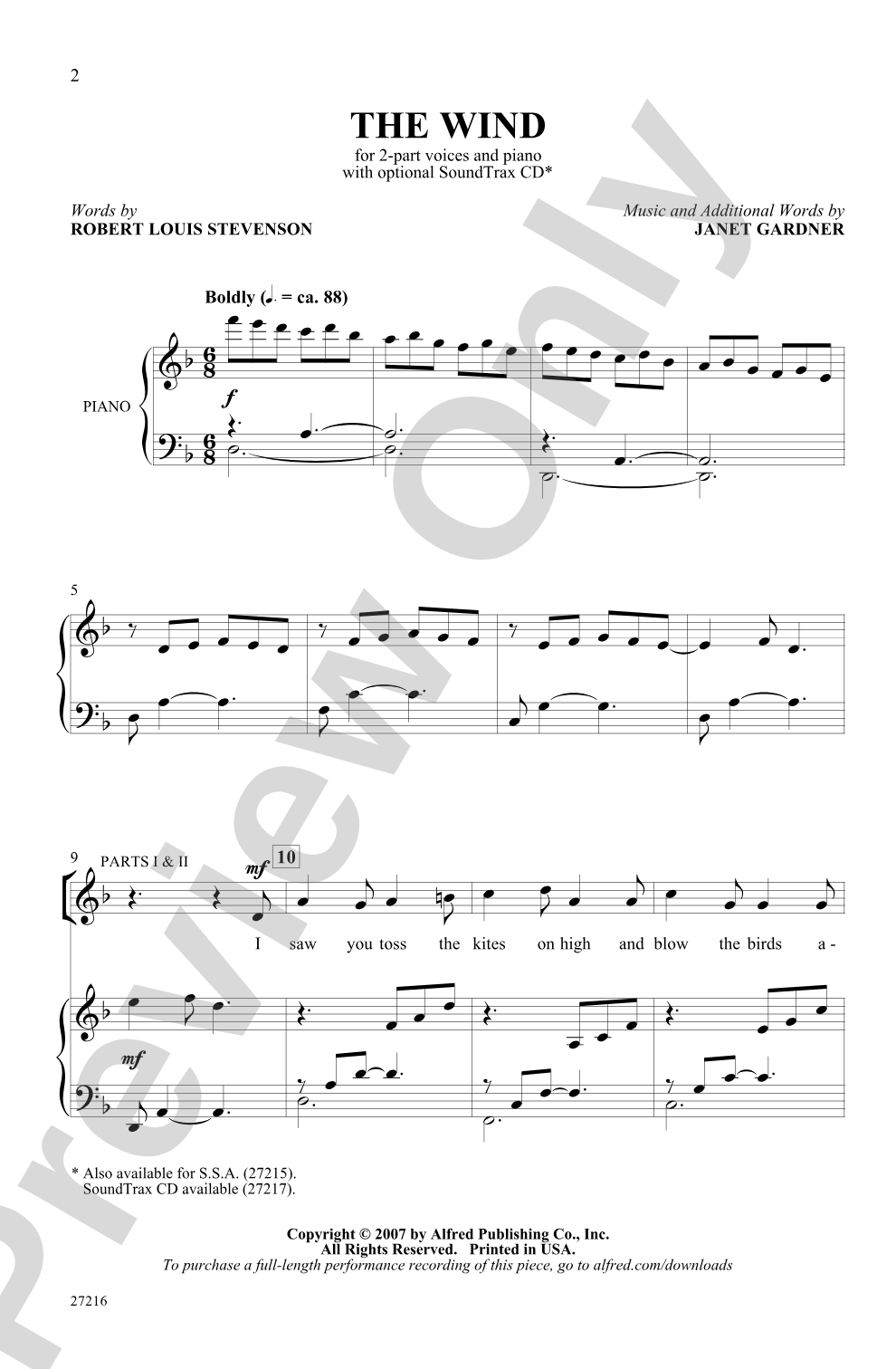

The Wind: 2-Part Choral Octavo
Words by Robert Louis Stevenson, music by Janet Gardner
Item: 00-PO-0000329
$1.75
Minimum order quantity: 20 copies
Pickup currently not available
Description
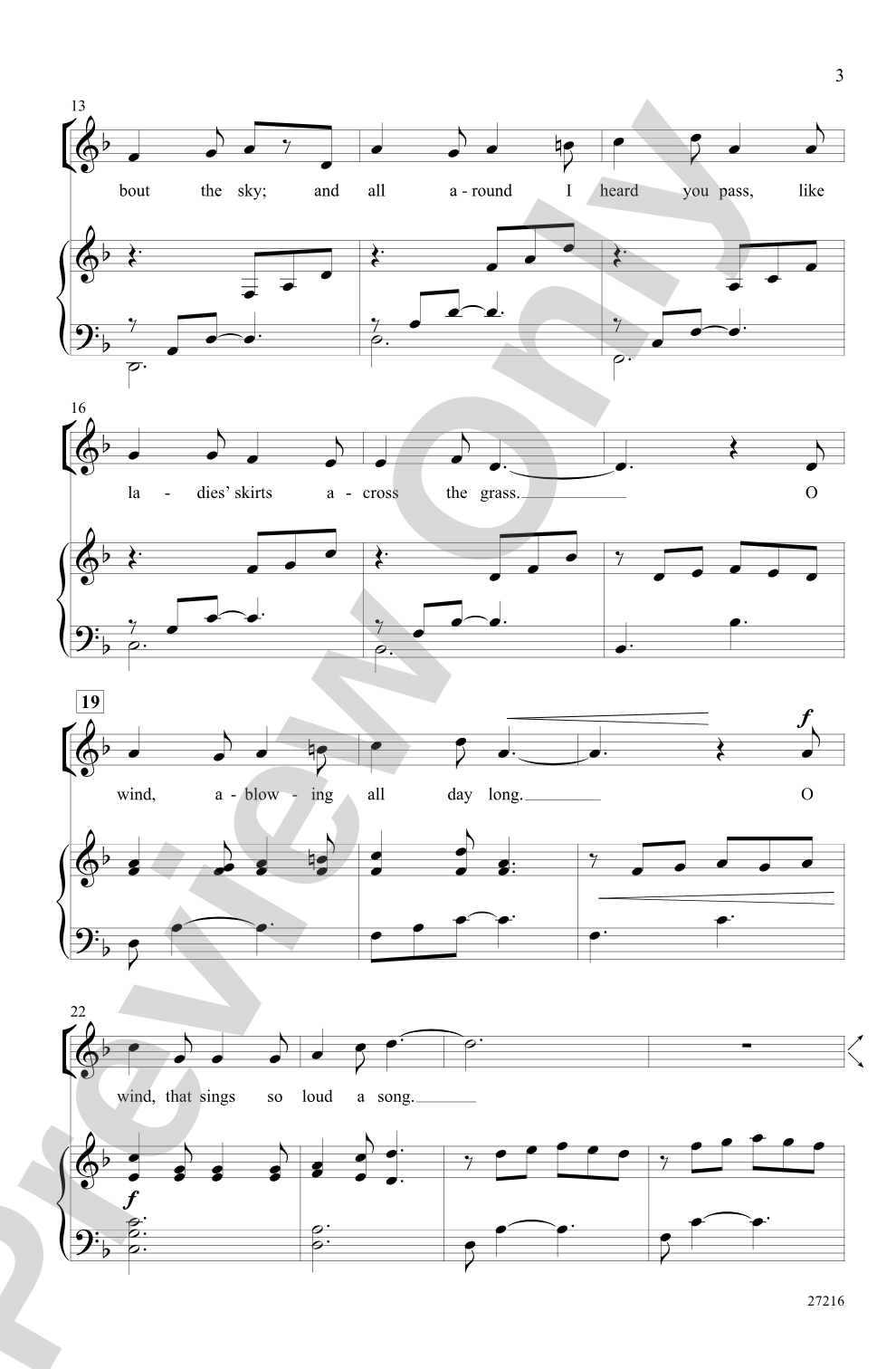
A blustery piano accompaniment provides a windy underscore to the words of Robert Louis Stevenson in this haunting treble choir feature. Carefully chosen vocal ranges and obvious musical phrasing make it a breeze for singers to sound their best while seeking a glimpse of the wind. "I saw the different things you did, but always you yourself you hid."


The Wind: 2-Part Choral Octavo isn't in MakeMusic Cloud just yet...but it could be. Let us know you'd like to see it, and you'll help shape what comes next. In the meantime, start a free trial and dive into thousands of interactive titles your students can play along with today.
Request This Title
Tell us you want it.
Start Your Free Trial
Explore everything that's ready to play right now.
Sample Audio
1
Audio File
--:--
0:00
0:00
Sample Video
No sample videos found.
Additional Details
Series:
Alfred Choral Designs
Publisher:
Alfred Music
Page Count:
8
SKU:
00-PO-0000329
More about this title
About the Composer: Janet Gardner

Janet Gardner studied music education at Concordia College in Moorhead, Minnesota, and spent 33 years teaching elementary general music in Montevideo, Minnesota. During her classroom career, she led workshops at state universities, served as a clinician at numerous state music conventions, and was invited to present as a featured composer and clinician at music education events throughout the United States and Canada. The Minnesota Music Education Association named her Classroom Teacher of the Year in 1995, and she chaired the Minnesota Elementary Composition Contest for six years.
Gardner has published musicals with Alfred Music, including Bones!, Broadway Santa, The Granny Awards, The Highlight Zone, The Phantom of the Music Room, and Star Search. Her choral compositions span literary texts and original concepts, with pieces including Godfrey Gordon Gustavus Gore, Nathan Nobb, The Tide Rises, The Tide Falls, and The Wind. Her work has earned annual ASCAP recognition. Since retiring from classroom teaching in 2006, Gardner continues composing in Montevideo, where she also serves her church as a musician, directs an ecumenical contemporary music ensemble, and participates in community arts leadership.
Why we love this
Gardner's setting captures Stevenson's mysterious text with a piano accompaniment that musically evokes its subject, adding atmospheric dimension without overwhelming young singers. The vocal ranges sit comfortably for treble voices, and the phrasing is intuitive enough that students can focus on interpretive depth rather than technical scrambling. This is the kind of piece that feels rewarding to perform because the music naturally supports the poetry.
What to expect
The piece captures something ethereal and elusive, much like trying to see the wind itself. The piano accompaniment swirls beneath the voices, creating movement and atmosphere, while the vocal writing remains lyrical and accessible. There's a haunting quality to Gardner's treatment of Stevenson's concealment theme that lingers with listeners.
Who it's for
This octavo suits treble choirs of intermediate capability who are ready to engage with literary text and two-part independence. It works equally well for middle school, high school, and community ensembles seeking a piece that sounds sophisticated without requiring advanced vocal maturity.
How to get the most out of it
- Balance the vocal line above the piano's blustery accompaniment by encouraging singers to project with intention rather than volume; the treble ranges work best with clear articulation and controlled breath support.
- Shape the phrases around Stevenson's words rather than musical measures alone; let the meaning of "but always you yourself you hid" inform the dynamic contour and pacing.
- Establish the rhythmic independence between vocal parts early in rehearsal so the two-part texture can emerge clearly without one voice shadowing the other.
How to use it
This piece fits naturally into a concert exploring nature, poetry, or mystery themes, and its eight-page length makes it manageable alongside larger choral works. Contest and festival programs benefit from its literary merit and distinctive character, particularly in divisions emphasizing artistic interpretation over technical difficulty.
Skills your students will build
- Two-part vocal independence and blend
- Interpretive singing from poetic text
- Sustained phrasing over piano accompaniment
- Dynamic control and nuanced expression